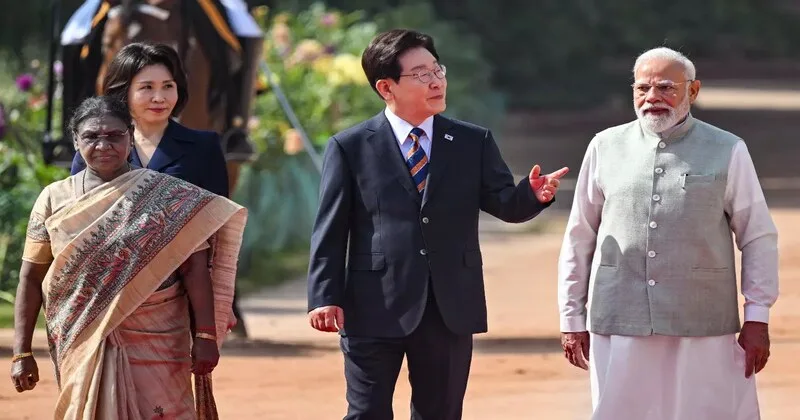
An ineluctable inference from South Korean President Lee Jae-myung’s recent summit meeting with Prime Minister Narendra Modi is that in New Delhi- Seoul ties are poised to grow. It is believed that the Modi-Lee summit led to over 25 announcements between the two nations for their advanced strategic, economic, technological and cultural cooperation. At the core of this summit’s outcomes is a Joint Strategic Vision for Special Strategic Partnership in shipbuilding, maritime logistics, sustainability and energy security. The summit led to a series of Memoranda of Understanding to boost their cooperation across multiple domains, including in steel supply chains, small and medium enterprises, science and technology, climate action and cultural interaction. At the summit, the two countries also set a target to increase their trade from $27 billion to $50 billion by 2030.
One thinks it would be safe to assume the development of South Korea -India ties would be free from any hurdle in future. Relations between the two nations have been growing warmer ever since they emerged as independent states in the post-World War II landscape. During the Korean war, New Delhi condemned North Korea as an aggressor against the South. The Indian Army rendered enormous services to South Korea in this war. In 1973, India and South Korea established diplomatic ties with each other. They concluded the Agreement on Trade Promotion and Economic and Technological Co-operation in 1974, the Agreement on Co-operation in Science & Technology in 1976, the Convention on Double Taxation Avoidance in 1985 and the Bilateral Investment Promotion/Protection Agreement in 1996.
India and South Korea signed the Comprehensive Economic Partnership Agreement in 2009 and the Civil Nuclear Cooperation Agreement in 2011. During Prime Minister Modi’s visit to Seoul in 2015, the two sides elevated their ties to a ‘Special Strategic Partnership’. In 2018, the two nations signed 11 agreements, including in the areas of trade, cultural and scientific and technological cooperation. In 2019, they concluded seven agreements (2019) to enhance cooperation in areas, including infrastructure development, start-ups and combating trans-border and international terror. In 2020, they agreed on a long-term ‘Roadmap on Defense Cooperation. This has led to regular bilateral consultations between the armed forces of the two countries.
Today New Delhi and Seoul recognize the importance of the freedom of navigation, overflight and unimpeded lawful commerce. They have mechanisms, such as the Foreign Ministers-led Joint Commission, the Vice Ministerial 2+2 and the National Security Council-level meet, to chart out a common course of action to serve their mutual interests.
One hopes both New Delhi and Seoul would use these mechanisms to do the needful in bridging the current trade deficit India has with South Korea.
One may also hope that New Delhi would help South Korea in advancing its interest in being part of the Quadrilateral Security Dialogue today . India today has very friendly ties with Japan, the United States and Australia . New Delhi can well use its clout with them to have South Korea aboard the QUAD.
Needless to say, helping South Korea on this front would be very much in India’s Interest as well . With South Korea aboard the QUAD , India could create a coalition of democracies in the Asian region . Such a forum can be helpful in achieving the common objective of India, the United States , Japan , Australia and South Korea to foster “a free, open, inclusive and peaceful Indo-Pacific” and foil the aggressive designs of China in the region. This forum could be helpful also in advancing India’s case for reforms in the leading comtemporary international institutions, such as the UN Security Council, the International Monetary Fund and the World Trade Organization.