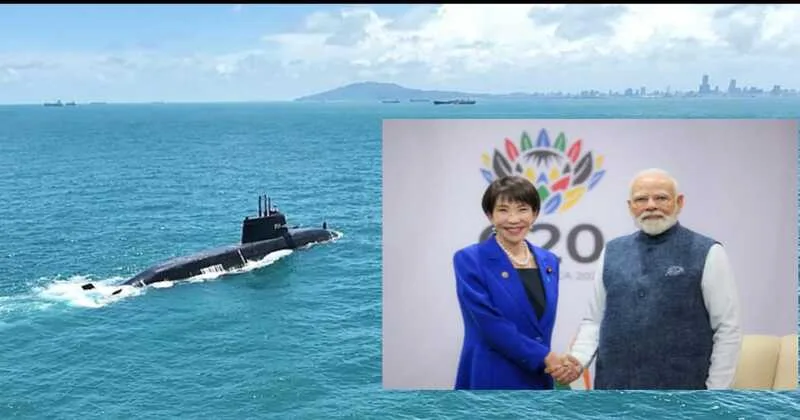
In a development that underscores the sharpening contours of the Indo-Pacific strategic landscape, Taiwan and Japan have emerged at the centre of a quiet but consequential realignment, one in which India is playing a calibrated, low-visibility yet increasingly significant role. From discreet contributions to Taiwan’s Indigenous Defense Submarine (IDS) program to an open endorsement of Japan’s shift on lethal weapons exports, New Delhi’s actions reflect a layered Indo-Pacific strategy that blends strategic signalling with operational restraint, even as China responds with growing unease.
India’s quiet role in Taiwan’s indigenous submarine push
At the heart of this evolving dynamic lies Taiwan’s Indigenous Defense Submarine program, spearheaded by the Kaohsiung-based shipbuilder CSBC Corporation under what officials describe as a “Non-Red Supply Chain” framework. The program aims to insulate critical defence production from Chinese pressure by relying on a network of trusted international partners. The lead platform, the Hai Kun-class (Narwhal) attack submarine, represents Taiwan’s most ambitious indigenous naval effort to date. Within this framework, India’s contribution has remained deliberately understated but technically consequential. While high-end systems, including the combat management suite and Mk 48 heavyweight torpedoes, are sourced from the United States, Indian defence firms are understood to have supplied sub-components and mechanical assemblies. These contributions likely include structural elements and specialised systems linked to fluid handling and onboard support architecture. Though specific details remain classified due to the diplomatic sensitivity surrounding India–Taiwan engagement, the nature of these inputs reflects the growing maturity of India’s submarine-grade manufacturing ecosystem.
New Delhi’s role is not limited to hardware. Taiwan has also drawn upon Indian technical human capital since the early phases of the IDS program. Retired Indian Navy personnel and engineers, particularly those with operational and maintenance experience on Scorpene (Kalvari-class) and Kilo-class submarines, have reportedly played advisory roles in Kaohsiung. Their involvement has helped bridge critical gaps in submarine construction, integration, and lifecycle management. For a navy transitioning toward indigenous capability, such tacit knowledge transfer has proven as valuable as physical components.
A distributed Indo-Pacific consortium behind the IDS Program
India’s participation sits within a broader, largely undeclared consortium of seven to eight countries that have quietly supported Taiwan’s submarine ambitions despite sustained pressure from Beijing. The United States anchors the program through the provision of combat systems and weapons integration. The United Kingdom has contributed advanced optical systems, including periscopes, while Japan is believed to have provided strategic inputs, particularly in lithium-ion battery technologies. Additional contributors, including Australia, Canada, Spain, and South Korea, have supplied design inputs, consulting expertise, and niche subsystems. This distributed model has allowed Taiwan to de-risk dependencies and sustain program momentum under politically constrained conditions. The “Non-Red Supply Chain” thus represents not only an industrial workaround but also a geopolitical innovation, one that reflects the emergence of a networked security architecture across the Indo-Pacific.
For India, participation in such a framework aligns with its broader strategic approach that engaging selectively, avoiding overt military alignment, and contributing in domains where plausible deniability can be maintained. This approach enables New Delhi to support partners facing similar maritime security challenges without crossing diplomatic thresholds that could trigger direct escalation.
Strategic Calculus: India’s Indo-Pacific approach in practice
India’s involvement in the Hai Kun program reflects a carefully calibrated strategic calculus. Despite the absence of formal diplomatic ties with Taiwan, New Delhi has leveraged dual-use technologies and sub-critical components to support a partner confronting the expanding maritime footprint of China’s People’s Liberation Army Navy. At the same time, this collaboration serves as a proving ground for India’s defence industrial base.
Tier-2 and Tier-3 Indian suppliers, in particular, stand to benefit from participation in such high-end projects. Meeting the stringent quality and reliability standards required for submarine systems, among the most demanding in military engineering, provides validation that can enhance their competitiveness in global supply chains. This dual benefit, strategic signalling and industrial advancement, captures the essence of India’s Indo-Pacific strategy.
The approach is marked by incrementalism rather than overt alignment. India avoids formal security commitments while steadily expanding its role in regional security frameworks. By contributing to Taiwan’s IDS program in a limited yet meaningful way, New Delhi reinforces its position as a credible but non-provocative actor in the Indo-Pacific. Meanwhile, the program itself continues to make progress. The lead vessel, ROCS Hai Kun (SS-711), has entered the final stages of Sea Acceptance Trials following successful deep-water submerged testing earlier this year. Despite minor delays linked to the integration of foreign-supplied optronic mast systems, CSBC remains on track to deliver the submarine to the Republic of China Navy by June 2026. The program’s trajectory highlights both Taiwan’s determination and the resilience of its diversified supply chain model.
India–Japan defence convergence and China’s strategic warning
Parallel to its quiet engagement with Taiwan, India has taken a more visible stance in supporting Japan’s recent decision to ease long-standing restrictions on lethal weapons exports. The move marks a significant departure from Japan’s post-World War II pacifist framework and has been welcomed by New Delhi as an opportunity to deepen bilateral defence cooperation.
India’s Ministry of External Affairs has emphasised that defence collaboration forms a key pillar of the India–Japan Special Strategic and Global Partnership, reflecting growing alignment across both security and economic domains. The convergence spans maritime security, defence technology, and joint exercises, indicating a sustained trajectory rather than a tactical shift.
However, China has responded sharply to these developments. According to a report by the Global Times, Chinese analysts have warned India against deepening military cooperation with Japan in a manner that could be perceived as part of a broader Indo-Pacific strategy aimed at counterbalancing China. Beijing views Tokyo’s policy shift as destabilising, arguing that it undermines the postwar international order and risks accelerating militarisation in the Asia-Pacific.
From China’s perspective, India’s endorsement of Japan’s evolving defence posture contributes to the emergence of a containment-oriented geopolitical framework. The concern is that closer India–Japan cooperation could embolden security blocs and intensify strategic polarisation across the Indo-Pacific.
For India, however, the calculus remains rooted in its own threat perceptions and long-term strategic interests. Partnerships with technologically advanced countries such as Japan are seen as essential for enhancing defence preparedness and maintaining balance in a rapidly shifting regional order. Rather than signalling alignment within a rigid bloc, India’s approach reflects a flexible and interest-driven engagement with multiple partners.
An Indo-Pacific strategy defined by subtlety and scale
Taken together, India’s involvement in Taiwan’s IDS program and its expanding defence partnership with Japan illustrate a coherent Indo-Pacific strategy, one that operates through layers of visibility and influence. On one level, New Delhi contributes quietly to sensitive projects that enhance regional deterrence without provoking overt confrontation. On another, it openly strengthens ties with key partners such as Japan, signalling its commitment to a stable and balanced Indo-Pacific.
This dual-track approach allows India to navigate a complex geopolitical environment marked by intensifying great power competition. By combining industrial participation, knowledge transfer, and strategic partnerships, New Delhi is positioning itself as a pivotal actor in the evolving Indo-Pacific order.