
Women in statesmanship, managing territories, governing countries, even making war, have proved themselves equal to men — if not superior. In India I have no doubt of that. Whenever they have had the opportunity, they have proved that they have as much ability as men, with this advantage — that they seldom degenerate. They keep to the moral standard, which is innate in their nature. And thus as governors and rulers of their state, they prove — at least in India — far superior to men –Swami Vivekananda, The women of India, Lecture delivered at Cambridge, December 17, 1894, New Discoveries, Vol. 2, pp. 411-26. (Complete Works of Swami Vivekananda, Vol 9, Lectures and discourses)
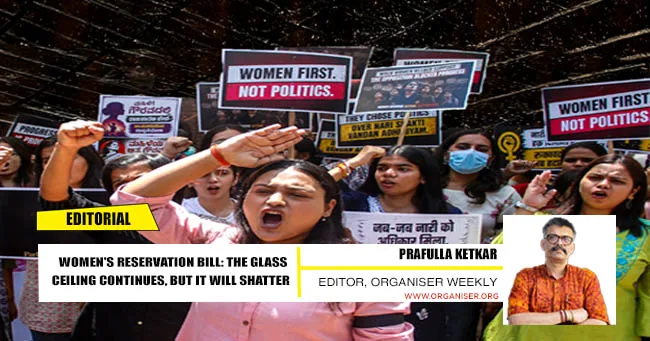
Another attempt to implement women’s reservation in legislative roles has hit a stumbling block. The Nari Shakti Vandan Adhiniyam, passed in 2023, required amendments to the Constitution to fast-track its implementation. The Government planned a special session for focused discussion and support for the amendments. Regrettably, this could not happen. The glass ceiling for women in legislative roles continues.
Examining the history of the Women’s Reservation Bill reveals obvious reasons for its blockade. When the Bill emerged in 1996, arguments and divisions were manufactured to stall progress. Patriarchal excuses, not genuine concerns for women, dominated the debate. Male politicians’ real fear was losing control and privilege in their constituencies.
The 131st Amendment introduced reservations for women from the Scheduled Castes (SC) and the Scheduled Tribes (ST). Now, demands for OBC and religious reservation have emerged. Other Backward Classes (OBCs) have a reservation in education and Government employment, but not in political representation. Even then, men from OBC categories have adequate legislative representation. Religion-based reservation was rejected by the Constituent Assembly after the painful Partition on religious lines. Yet, communal parties use it to block women’s reservation. These demands will not stand in court but are raised to obstruct progress.
Since 2000, the North-South issue has emerged. Southern Bharat has controlled population growth. Under the current delimitation formula, these States fear losing seats in Parliament. The proposed amendment had two features: increasing the number of Lok Sabha seats and giving all States a flat 50 per cent increase in seats. Women would be elected from 33 per cent of the additional seats. The proportion of regions in representative bodies would remain the same. Delimitation would use the 2011 census to redraw constituencies. Clubbing women’s reservation with increased Lok Sabha seats and delimitation would address all genuine concerns.
Casteist-dynastic parties continue rhetorical arguments, ensuring the glass ceiling remains for women in politics. When the Bill was introduced in 2023, they asked for immediate implementation. Now, the same people question the Government for haste. Will current delimitation norms and seats address Southern States’ concerns? These political tricks cannot last. Since ancient times, women in Bharat have fulfilled diverse roles—from motherhood to statesmanship. When given opportunities, they have broken barriers across fields since Independence. The Constitution gave every adult the right to vote; women exercised it Independently. In many States, women outnumber men in voting percentage and influence the outcome. Girls’ educational performance surpasses that of boys across States. They play key roles in missions such as Mangalyaan and Operation Sindoor. In politics, women prove themselves in local governance. As Prime Minister Narendra Modi said, giving women representation is not charity but a delayed right.
Women will break the glass ceiling and bring their vision to governance. Political parties dominated by men, caste groups, or families must recognise and embrace complementarity. As Dr Babasaheb Ambedkar wisely observed, the progress of a community is measured by the advancement of its women. Equal participation is essential for balanced development and attaining Viksit and Atmanirbhar Bharat. No self-styled champion of justice or secularism can halt this transformation.