Pakistan on April 22, Thursday urged the United Nations to call upon India to restore full implementation of the Indus Waters Treaty (IWT), warning that New Delhi’s “illegal” decision to hold the accord in abeyance carried grave peace, security and humanitarian consequences for the region. It is a bilateral agreement between two nations with the UNSC playing no role in its negotiations or its end result.
As such, India is clear that the UNSC, which has failed to get Pakistan Occupied Jammu Kashmir (PoJK), including Gilgit-Baltistan vacated, has no role in IWT restoration either. The IWT was put in abeyance, a sort of coma, by the Indian side on April 23 last year and no doctor, other than of course the Indian government, can revive or restore it.
The development comes after the completion of one year since India placed the IWT in abeyance. This was done a day after last year’s April 22 attack in Pahalgam in which 24 Hindu males and two others were killed by Pakistan-backed terrorists.
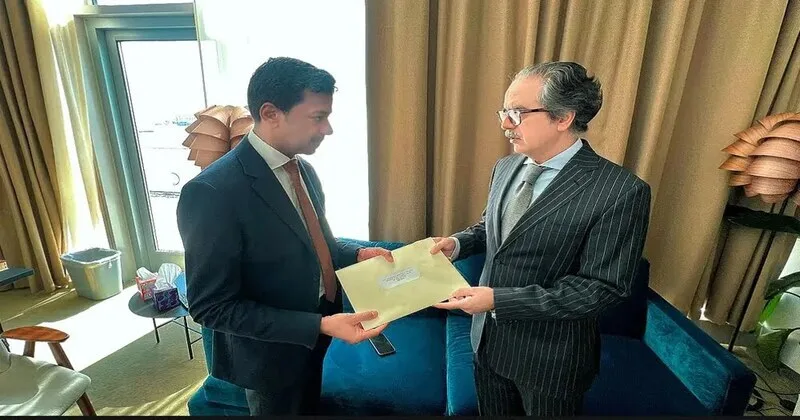
According to a statement issued by Pakistan’s Mission to the UN, the country’s permanent representative, Ambassador Asim Iftikhar Ahmad, handed over the letter. It was written by Pakistan’s Deputy Prime Minister and Foreign Minister Ishaq Dar to the UNSC Jamal Fares Alrowaiei of Bahrain. “The letter draws the attention of the Security Council, one year after India’s illegal decision to hold the IWT in abeyance of its grave peace and security and humanitarian consequences”, the statement by Pakistan said.
It urged the UNSC to take cognisance of the situation and call on India to restore full implementation of the treaty, resume all treaty-mandated cooperation and data-sharing without delay. India should also desist from any form of water coercion and comply fully with its international obligations in good faith, the letter added.
UN sanctioned terrorists in Pakistan
Pakistan’s Permanent Representative also briefed the Security Council President on what it described as the “regurgitation of baseless allegations’’ at a time when Pakistan was engaged in mediation efforts to promote regional and international peace and security. It must be said here that Pakistan is trying to encash its so-called mediation efforts between the US and Iran and telling the world that it is a peaceful nation. It is another matter that the UNSC knows too well that the maximum number of UN-sanctioned terrorists live in luxury in Pakistan as it harbours and protects them.
Ambassador Iftikhar further underscored what he claimed was the “unresolved Jammu and Kashmir dispute, a longstanding item on the SC’s agenda, was the root cause of instability in South Asia that necessitated a just and lasting settlement in accordance with relevant SC resolutions and wishes of the Kashmiri people”.
The IWT of 1960 stands as one of the most carefully negotiated and legally robust trans-boundary water agreements in modern international law. Concluded between Pakistan and India with the good offices of the World Bank, it was designed to remove water from the volatility of politics and conflict and to anchor it firmly in law, engineering discipline and neutral dispute resolution. It is a binding international instrument governed by the foundational principle of pacta sunt servanda or that treaties must be honoured in good faith.
At the heart of the IWT lies an allocation of rivers. Article II vests the eastern rivers, Ravi, Beas, and Sutlej, exclusively in India, while Article III accords Pakistan rights over the western rivers, Indus, Jhelum and Chenab. This allocation with India having unlimited rights to produce hydropower from waters of the western Rivers was what the treaty said. But Pakistan has always tried to stymie these rights regarding hydropower generation leading to friction between the two sides on interpretation of the treaty.
India’s usage of the Western Rivers for setting up Run-of-River (RoR) hydroelectric projects in constrained by some rights granted to Pakistan regarding designs of the dams etc. On ground, Pakistan tries to bind India in knots by objecting to and thereby delaying its projects thereby inflicting heavy losses. These so-called safeguards granted to Pakistan were weaponised by it to strategically harm India by misinterpreting the Treaty clauses. Pakistan’s objections to projects such as Kishanganga and Ratle stemmed from unfounded allegations regarding excessive pondage, gated spillways and drawdown mechanisms. Pakistan has been falsely claiming that controlling sediments in an optimum manner by India constitutes a violation of the treaty.
During lean seasons, particularly winters, the flows become a trickle due to freezing temperatures in the catchment areas of most rivers, almost zero snow melt. In the Indus river, with a flow of 48.7 Million Acre Feet (MAF) in July to September annually, comes down to only 5.8 MAF during January-March every year. Instead of taking these ground realities into its articulation, Pakistan has often accused India of stealing its waters during the lean phase.
No treaty violations, just a pause
Pakistan has falsely claimed that the approved 260 MW Dulhasti Stage-II Hydropower Project on the Chenab River violates the Treaty’s provisions. These approvals infringe upon Pakistan’s legally protected rights under the binding international agreement, it has further said. Incidentally, this project was conceived decades ago but was delayed due to paucity of requisite funds and the necessary political will in India.
The treaty abeyance and expedited approval of upstream projects, including the withholding of hydrological data and imaginary diversion of river flows and alteration of natural regimes, constitute deliberate water weaponisation, Pakistan alleged. It needs to be stressed here that India has not diverted an ounce of water after putting the treaty in abeyance last year as falsely alleged. Under the IWT, customary international law, and Article 51 of the UN Charter, Pakistan has clear legal avenues to respond, it has said in a veiled threat.
Pakistan also claimed that international law expressly prohibits the use of water as a weapon against downstream populations. It said strict enforcement of the IWT was essential not only for bilateral stability but also for the integrity of global water governance norms. However, it very conveniently sidestepped the issue of using terrorist proxies against India as a dirt cheap option to further its agenda.