In a sharply worded and uncompromising judgment, the Delhi High Court has delivered a stinging rebuke to Arvind Kejriwal and his associates, dismissing their recusal applications as a calculated exercise in judicial manipulation rather than a legitimate legal concern. The 115-page verdict by Justice Swarana Kanta Sharma goes far beyond a routine dismissal. It methodically dissects the arguments placed before the court and lays bare what it describes as a deliberate attempt to undermine the integrity of the judiciary through insinuation, contradiction, and selective outrage.
At its core, the judgment exposes a troubling pattern, one where the courtroom is not treated as a forum for justice, but as a stage for political strategy. Justice Sharma’s refusal to recuse herself, despite sustained pressure and allegations, is not merely a procedural decision. It is a direct assertion that the judiciary cannot and will not bend to orchestrated campaigns designed to influence its composition.
A Manufactured ‘Catch-22’ Strategy
One of the most damning aspects highlighted in the judgment is what can only be described as a carefully engineered “Catch-22” scenario. Justice Sharma identifies how the recusal plea was structured in a way that would benefit the applicant regardless of the outcome. If the judge stepped aside, it would effectively hand litigants the power to pick and choose benches by levelling allegations, no matter how baseless. If the judge refused, that very refusal would be weaponised as supposed proof of bias.
This “heads I win, tails you lose” strategy strikes at the very foundation of judicial independence. The court makes it clear that such tactics, if tolerated, would reduce the judiciary to a hostage of litigant pressure, where reputations can be tarnished and proceedings derailed at will. The implication is stark: this was not a plea for fairness, but an attempt to rig the system in advance.
Perhaps the most disturbing dimension of the case is the inversion of roles that Justice Sharma points out. What began ostensibly as a legal dispute gradually morphed into a personal trial of the judge herself. In a striking observation, the court notes that the litigant was effectively testing the resilience of the institution, forcing the judge into what she described as an “Agni Pariksha.”
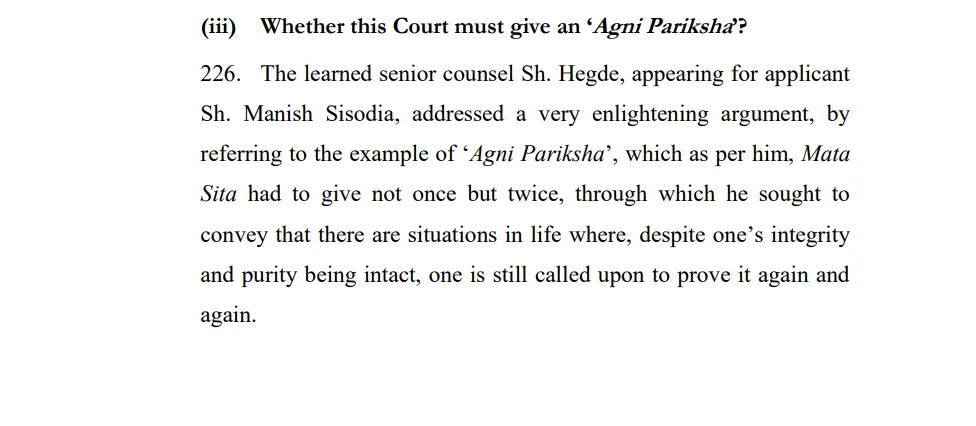
Such a situation, the judgment underscores, is fundamentally incompatible with constitutional principles. Judges are not required to defend their integrity against vague, speculative, or imaginary allegations. To demand otherwise is to put the entire justice delivery system on trial. The court sees this as a dangerous precedent, one where judicial officers are dragged into the arena of public suspicion without any substantive basis.
The message is unequivocal: allowing such conduct would open the floodgates to systematic harassment of judges, eroding public confidence in the judiciary.
Contradictions that undermine credibility
Justice Sharma’s judgment also dismantles the internal inconsistencies in Kejriwal’s arguments with surgical precision. On one hand, the plea acknowledged that the professional engagement of a judge’s family members as government counsel does not automatically warrant recusal. On the other, it attempted to construct a conflict of interest by suggesting that the Central Bureau of Investigation, represented by the Solicitor General, could indirectly influence those very family members.
The court categorically rejects this line of reasoning, calling it a “constructed narrative” built on conjecture rather than fact. By taking contradictory positions within the same set of proceedings, the applicants effectively undermined their own credibility. The judgment notes that such shifting stands are not accidental—they are indicative of a strategy tailored to suit convenience rather than truth.
More troublingly, the attempt to drag the professional lives of a judge’s family into the argument is seen as a form of targeted character assassination. The court makes it clear that insinuations without evidence cannot be allowed to form the basis of judicial proceedings.
Selective memory and convenient omissions
Another critical flaw exposed in the recusal plea is what the court describes as “selective perception.” The applicants highlighted a single adverse order to build their narrative of bias, while deliberately ignoring multiple instances where the same court had granted them relief.
Justice Sharma points out that in several sensitive matters, the court had upheld the rights of Kejriwal and members of his party. These instances were conspicuously omitted from the plea. Instead, the focus was narrowed to one stay order, which the court had passed after finding prima facie errors in the trial court’s conclusions.
This selective recall, the judgment suggests, is not a coincidence. It is a calculated attempt to manufacture a perception of bias by cherry-picking facts. Such conduct, the court warns, undermines the very idea of fair litigation, where arguments must be rooted in a complete and honest presentation of facts.
Among the more startling elements of the plea was the reliance on an alleged television interview of Amit Shah to question the impartiality of the court. The applicants failed to provide any concrete quote or verifiable detail of the statement they were relying upon.
Justice Sharma treats this as a serious lapse. The judgment observes that invoking vague political commentary to cast doubt on a constitutional authority is not just irresponsible, it is a direct assault on the rule of law. Courts, the order reiterates, cannot be turned into arenas where political narratives replace evidence.
The underlying concern is clear: if such arguments are entertained, any external statement, real or imagined, could be used to derail judicial proceedings. This would effectively collapse the distinction between legal reasoning and political rhetoric.
A case for contempt?
While the judgment stops short of initiating contempt proceedings, it leaves little doubt about the gravity of the conduct in question. The systematic attempt to force recusal through unverified claims, contradictory arguments, and selective omissions is described in terms that strongly suggest a case fit for contempt.
The court’s reasoning is rooted in a broader principle: when litigants attempt to manipulate the composition of the bench, they are not merely challenging a judge, they are attacking the credibility of the institution itself. Such actions, if left unchecked, risk eroding public trust in the judiciary.
Justice Sharma’s refusal to recuse, despite the pressure, emerges as the defining moment of the judgment. It is a clear assertion that justice cannot be negotiated, coerced, or engineered through tactics designed to intimidate the bench.
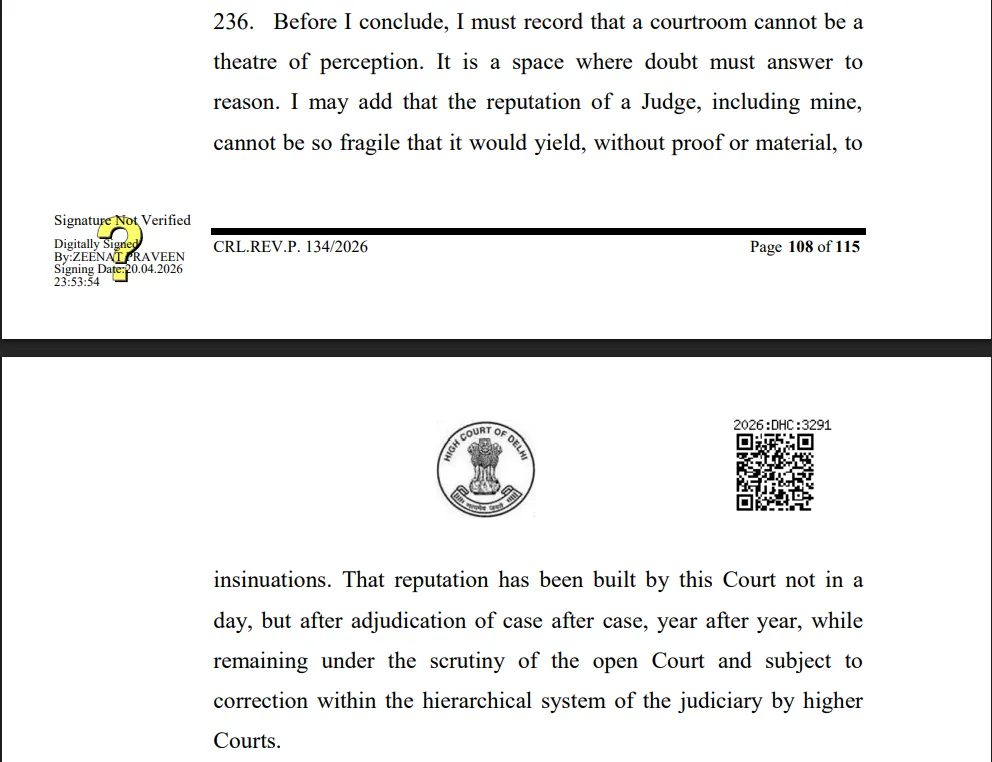
The ruling reinforces a fundamental truth: the independence of the judiciary is non-negotiable. Any attempt to compromise it, whether through insinuation, political theatre, or strategic litigation, will be met with firm resistance.
This judgment is not just about one recusal plea. It is a broader indictment of a growing tendency to treat courts as extensions of political battlegrounds. By exposing the mechanics of what it sees as a mala fide strategy, the Delhi High Court has sent a clear and unambiguous message.
Litigation is not a game of perception management. It is a process governed by evidence, consistency, and respect for institutions. Attempts to subvert this process, no matter how sophisticated, will not only fail but will also invite serious legal consequences.
In standing her ground, Justice Swarana Kanta Sharma has not just dismissed a plea; she has drawn a line. And in doing so, she has reaffirmed that the judiciary will not be reduced to a tool in the hands of those seeking to bend it to their will.