When Democracy Needs Protection: The Bengal question
June 23, 2026
  • Read Ecopy
  • Circulation
  • Advertise
  • Careers
  • About Us
  • Contact Us
Android AppiPhone AppArattai
Organiser
  • ‌
  • Bharat
    • Assam
    • Bihar
    • Chhattisgarh
    • Jharkhand
    • Maharashtra
    • View All States
  • World
    • Asia
    • Europe
    • North America
    • South America
    • Africa
    • Australia
  • Editorial
  • International
  • Opinion
  • RSS @ 100
  • More
    • Op Sindoor
    • Analysis
    • Sports
    • Defence
    • Politics
    • Business
    • Economy
    • Culture
    • Special Report
    • Sci & Tech
    • Entertainment
    • G20
    • Azadi Ka Amrit Mahotsav
    • Vocal4Local
    • Web Stories
    • Education
    • Employment
    • Books
    • Interviews
    • Travel
    • Law
    • Health
    • Obituary
  • Subscribe
    • Subscribe Print Edition
    • Subscribe Ecopy
    • Read Ecopy
  • ‌
  • Bharat
    • Assam
    • Bihar
    • Chhattisgarh
    • Jharkhand
    • Maharashtra
    • View All States
  • World
    • Asia
    • Europe
    • North America
    • South America
    • Africa
    • Australia
  • Editorial
  • International
  • Opinion
  • RSS @ 100
  • More
    • Op Sindoor
    • Analysis
    • Sports
    • Defence
    • Politics
    • Business
    • Economy
    • Culture
    • Special Report
    • Sci & Tech
    • Entertainment
    • G20
    • Azadi Ka Amrit Mahotsav
    • Vocal4Local
    • Web Stories
    • Education
    • Employment
    • Books
    • Interviews
    • Travel
    • Law
    • Health
    • Obituary
  • Subscribe
    • Subscribe Print Edition
    • Subscribe Ecopy
    • Read Ecopy
Organiser
  • Home
  • Bharat
  • World
  • Operation Sindoor
  • Editorial
  • Analysis
  • Opinion
  • Culture
  • Defence
  • International Edition
  • RSS @ 100
  • Magazine
  • Read Ecopy
Home Bharat

When Democracy Needs Protection: Inside the continuing debate over central forces and electoral safety in West Bengal

The debate over central forces in West Bengal elections highlights a deeper concern about electoral safety, political trust, and democratic fairness. Beyond political accusations lies the fundamental question of whether voters can exercise their franchise without fear or pressure

Diganta ChakrabortyDiganta Chakraborty
Apr 22, 2026, 06:00 pm IST
in Bharat, West Bengal
Follow on Google News
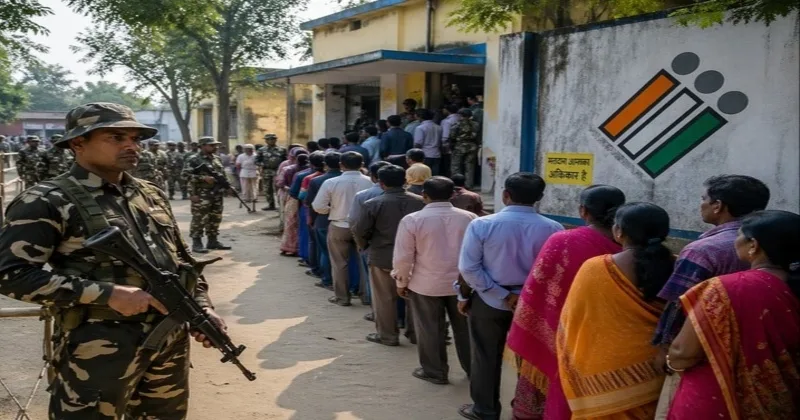
The debate over central forces in West Bengal elections highlights a deeper concern about electoral safety, political trust, and democratic fairness

The debate over central forces in West Bengal elections highlights a deeper concern about electoral safety, political trust, and democratic fairness

FacebookTwitterWhatsAppTelegramEmail

The deployment of central forces during elections in India is neither unprecedented nor extraordinary. It has long been a constitutional and administrative mechanism designed to ensure that voting takes place in a free, fair, and peaceful atmosphere, especially in states where political tensions run high. Yet, recent remarks by West Bengal Chief Minister Mamata Banerjee have once again stirred controversy. She alleged that this time the army is being brought into Bengal for election duty, asking, “We respect the military. Let them work for the country. Why should they come to conduct elections?” She further claimed that central forces were being deployed to loot EVMs.

Such statements raise an important question: what is the ground reality in Bengal, and why does the demand for central forces repeatedly arise during elections in the state? To understand the issue, one must first examine Bengal’s recent electoral history. Elections in the state have often been accompanied by violence, intimidation, and political clashes. This is not a matter of partisan rhetoric but a recurring pattern witnessed across multiple election cycles. Even Panchayat elections—meant to be grassroots exercises in local democracy—have seen disturbing incidents. Opposition candidates have reportedly been prevented from filing nominations, party workers have been attacked, and several lives have been lost in clashes. In many areas, fear rather than democratic competition has shaped the electoral environment.

Central forces are not sent to insult any state government or undermine federalism. They are deployed to maintain neutrality where local policing may be perceived as politically compromised or insufficient. In any democracy, the voter must feel secure enough to cast a ballot freely. If citizens believe that stepping out to vote could invite threats, violence, or retaliation, democracy becomes hollow. The presence of central forces often serves as reassurance to ordinary voters that someone independent is watching. This is particularly relevant in politically charged regions where rival parties accuse one another of using local muscle power. In such situations, a neutral security presence can reduce tensions and build confidence.

Yet the concern in Bengal goes beyond polling booths. Many people quietly ask: What happens after the forces leave? This is the deeper crisis. If voters feel safe only for one day, but fear retaliation later, then democracy remains incomplete. Free elections are not merely about casting a ballot; they are about being able to choose without consequences. That lingering fear explains why so many continue to demand stronger security measures in Bengal elections. Another issue that deserves attention is the tone of political discourse.

Senior Abhishek Banerjee, a prominent leader of the All India Trinamool Congress, reportedly challenged Union Home Minister Amit Shah with remarks to the effect of, “If you have guts, come on 4th May.” Such confrontational rhetoric is alarming in a democracy. Political disagreements are natural, but language that appears threatening or provocative lowers the standard of public life. If nationally prominent leaders can be addressed in such a tone, ordinary citizens may reasonably ask what kind of pressure local opposition workers might face in areas where power equations are far more unequal. This is why rhetoric matters. It sets the atmosphere in which elections take place.

If the state leadership objects to central forces, then what is the alternative? Should polling environments be left vulnerable to local intimidation, partisan clashes, and fear? Surely, trained personnel accountable to constitutional institutions are preferable to the shadow of political muscle power. No democracy should have to depend on extraordinary security every election. Ideally, elections should be peaceful enough that such deployment becomes unnecessary. But ideals cannot replace reality. Where violence has become normalised, security becomes essential.

Also Read: Thrissur Fire Incident: Explosion at fireworks facility leaves 13 dead ahead of Thrissur Pooram

West Bengal deserves an electoral culture that reflects its rich legacy of political awareness, intellectual debate, and democratic participation. This is a land shaped by reformers, freedom fighters, scholars, and mass movements that helped define modern India. Its politics should therefore be guided by ideas, public service, and healthy competition—not by fear, violence, or coercion. A stronger democracy in Bengal means creating an environment where every citizen can participate without anxiety. Candidates from all parties should be able to file nominations freely, campaign openly, and present their vision to the people. Voters should feel secure enough to cast their ballots according to conscience, without intimidation from local power brokers or political groups. After results are declared, citizens should not have to fear reprisals because of how they voted.

Democracy also requires respect for opposition voices. A ruling party may govern, but it does not own the state. Dissent is not disloyalty, and criticism is not an enemy act. Institutions such as the police, administration, and election machinery must inspire trust by acting impartially. The people of Bengal deserve politics driven by development, employment, education, and law and order—not endless cycles of confrontation. When elections become peaceful contests of ideas rather than battles of control, Bengal will truly honour its democratic heritage.

And, the real question is not why central forces are coming. The real question is why Bengal still needs them. When opposition workers fear contesting, when voters worry about reprisals, and when political rhetoric becomes threatening, democracy is already under strain. In such circumstances, central forces do not weaken democracy; they help protect it. The day Bengal no longer requires such deployment will be the day Bengal’s democracy has fully matured. Until then, the people deserve security, neutrality, and above all, the freedom to vote without fear.

Topics: Mamata BanerjeeWest bengal electionselectoral violenceDemocracy In Indiapolitical rhetoricCentral forces
ShareTweetSendShareSend
✮ Subscribe Organiser YouTube Channel. ✮
✮ Join Organiser's WhatsApp channel for Nationalist views beyond the news. ✮
Previous News

Why Guru Nanak Devji’s Message is a moral compass for today

Next News

Akividu Municipality passes resolution for Bhagwan Ram Temple reconstruction amid opposition from converted Christians

Related News

Kakoli Ghosh Dastidar and Sagarika Ghose

TMC internal rift: Kakoli Ghosh Dastidar hits back at Sagarika Ghose saying, ‘What about team of thieves you belong?’

TMC chief and former CM of Bengal Mamata Banerjee

Mamata’s Damage-control Exercise? TMC reshuffle comes as rebel leaders reject Banerjee family’s leadership

Yusuf Pathan, Saayoni Ghosh, Shatrughan Sinha among 20 TMC rebel list signatories

TMC Rebellion Deepens: Rebel MPs to meet speaker Om Birla, seek recognition as ‘Real Trinamool Congress’

Following TMC’s defeat in 2026 West Bengal Assembly election, speculation grew that its MPs were moving towards the NDA under BJP pressure

Why TMC MPs are looking towards the NDA: Examining the electoral arithmetic behind the political shift

‘TMC Will Not Survive’: Sukhendu Sekhar Ray Warns of Bigger Revolt as Bengal Rebellion Threatens to Reach Parliament

‘TMC will not survive’: MP Sukhendu Sekhar Ray warns MLA revolt could soon engulf parliament

Prime Minister Narendra Modi

BJP’s Victory with Vision: An idea of India that is Indian

Load More

Latest News

Keralam’s former Industries Secretary, Mohammed Haneesh IAS (Right Side)

Keralam Cashew scam: Former Industries Secretary apologises before High Court after contempt proceedings

Tamil Nadu: Assembly Speaker directs all bureaucrats to strictly follow warrant of precedence after Mayor-MLA row

Kamakhya Mandir

Kamakhya Mandir’s Ambubachi Mela: The ancient tradition that honours the menstruation of mother Earth

Amazon in dock for mocking Hindu Gods

Amazon File: From Ganesha to Aryabhata-Has Amazon India become a platform for Anti-Hindu narratives?

The West Bengal Budget 2026–27 aims to drive growth through infrastructure, industry, innovation and welfare

Reimagining Bengal: How the West Bengal Budget 2026–27 seeks to balance growth, welfare & economic transformation

Pratiraksha is Gujarat Police's Aadhaar-based verification platform designed to identify illegal workers and prevent identity fraud in industrial sectors

Pratiraksha: How Gujarat police uses Aadhaar verification to secure industrial workforce against identity fraud

Israel-Iran crisis has highlighted not only shifting dynamics of West Asia but also growing confidence of India's foreign policy

India, Israel and the rise of strategic autonomy in an era of global geopolitical realignment

Saleem and Jaleel arrested in forced religious conversion case

Karnataka Conversion Case: Forced conversion of Hindu woman and minor son sparks outrage; Saleem and Jaleel arrested

Bareilly Cantonment Emerges as Model for Sustainable Urban Development in India (Image Source X)

Uttar Pradesh: Bareilly Cantonment becomes India’s first carbon-negative cantonment

CM Yogi Adityanath making industry, investment and the connectivity revolution in Eastern Uttar Pradesh

The Purvanchal Growth Story: How industry, infrastructure, tourism & exports are fueling development in eastern UP

Load More
  • Privacy
  • Terms
  • Cookie Policy
  • Refund and Cancellation
  • Delivery and Shipping

© Bharat Prakashan (Delhi) Limited.
Tech-enabled by Ananthapuri Technologies

  • Home
  • Search Organiser
  • Bharat
    • Assam
    • Bihar
    • Chhattisgarh
    • Jharkhand
    • Maharashtra
    • View All States
  • World
    • Asia
    • Africa
    • North America
    • South America
    • Europe
    • Australia
  • Editorial
  • Operation Sindoor
  • Opinion
  • Analysis
  • Defence
  • Culture
  • Sports
  • Business
  • RSS @ 100
  • Entertainment
  • More ..
    • Sci & Tech
    • Vocal4Local
    • Special Report
    • Education
    • Employment
    • Books
    • Interviews
    • Travel
    • Health
    • Politics
    • Law
    • Economy
    • Obituary
  • Subscribe Magazine
  • Read Ecopy
  • Advertise
  • Circulation
  • Careers
  • About Us
  • Contact Us
  • Policies & Terms
    • Privacy Policy
    • Cookie Policy
    • Refund and Cancellation
    • Terms of Use

© Bharat Prakashan (Delhi) Limited.
Tech-enabled by Ananthapuri Technologies