What began as a workplace harassment and coercion case at a BPO unit in Nashik has now opened up a far deeper and far more uncomfortable debate. While the police investigation continues, with one of the accused, Nida Khan, absconding and agencies probing serious angles including organised coercion and possible trafficking links, a parallel issue has emerged that cannot be ignored. It is not just about what happened inside an office. It is about what is being funded, promoted, and normalised outside it.
Details available from the official website of Tata Trusts reveal that as part of its Corporate Social Responsibility initiatives, the organisation has been actively funding and supporting madrasa-linked educational interventions.
At first glance, this is presented as an effort to “modernise education.” However, a closer reading exposes a far more ideological project. The stated aim is not merely to teach science or mathematics. It is to actively demonstrate how Islamic teachings are interconnected with modern scientific concepts.
This is where serious questions arise. Is this education, or is it an attempt to blend religious doctrine with scientific reasoning in a way that compromises intellectual clarity?
Tata Trusts used to fund special Madarsa programs to connect science and math with Islam!
No such program for other faiths. https://t.co/H86YRMoAoi
— Sanjeev Newar | सञ्जीव नेवर (@SanjeevSanskrit) April 18, 2026
The Madrasa Programme: Integration or Indoctrination?
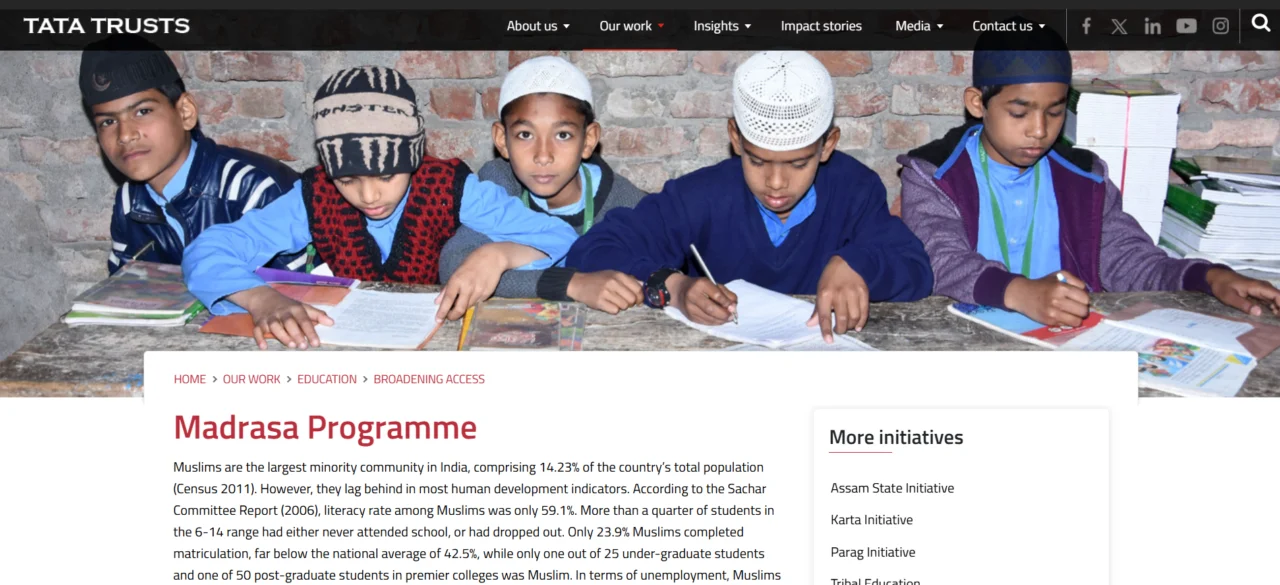
According to the Trust’s own documentation, the programme focuses on introducing modern pedagogy, training teachers, and integrating technology into madrasa education. It claims to improve learning outcomes in subjects like mathematics, science, and language.
On paper, this sounds progressive. In practice, the core objective reveals something else entirely.
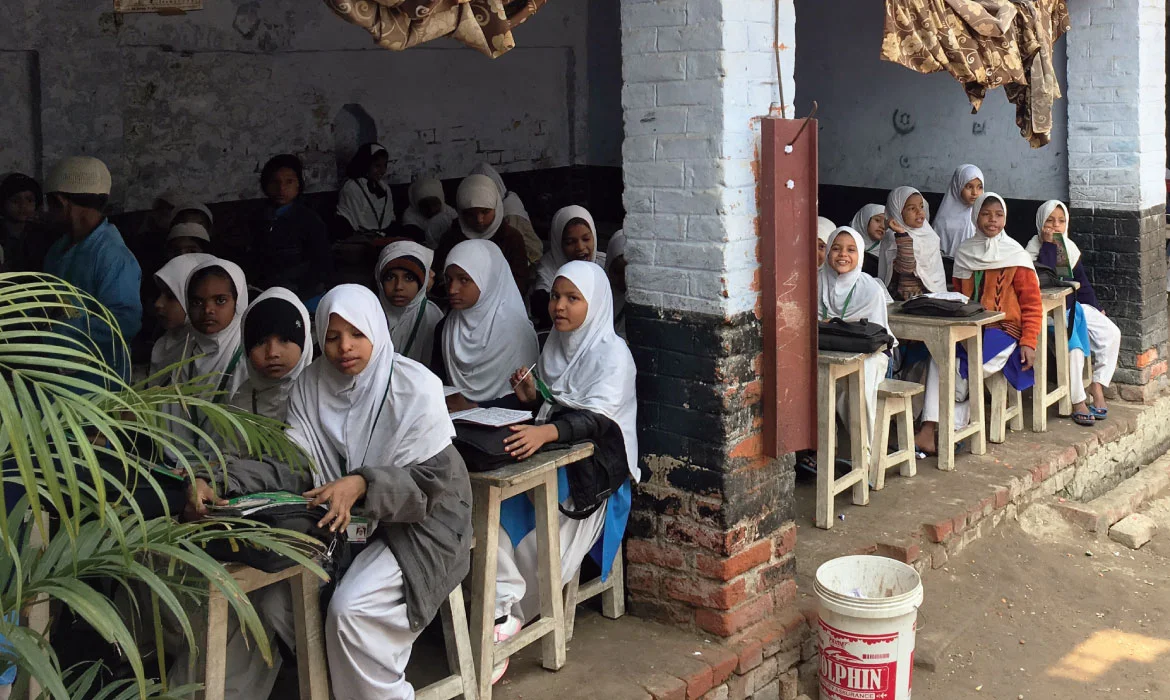
The programme explicitly states that it aims to connect science, mathematics, and social sciences with dini taalim, or religious instruction. Students are encouraged to draw parallels between scientific concepts and religious teachings. Projects include linking human anatomy to postures during prayer, mapping religious journeys alongside geography, and presenting religious narratives alongside scientific subjects.
As per an image in circulation the teachings include, “As part of this initiative, students map India and Arabia on the world map, and highlight the Hijrat of Prophet Mohammed (SAS); make a project on Muslim scientists; study Islamic architecture and the geometric shapes that are reflective of this style; make a PowerPoint presentation on human joints and relate it to the ones involved in different postures during namaaz, etc. These activities provide a pedagogical framework to integrate science, maths and geography with the Islamic way of life. Madrasa teachers are trained to make these connections via lesson plans.”
This is not neutral education. This is a structured integration of faith-based narratives into scientific learning.
The question that must be asked is simple. When science is taught through the lens of theology, does it remain science?
Science and Islam: A fundamental conflict
The idea of presenting religion and science as seamlessly interconnected is often repeated, but a closer look shows clear areas of conflict.
For instance, certain verses in the Quran describe the Earth as “spread out” or “like a carpet” (for example, 15:19). While many modern scholars interpret this metaphorically, literal readings have historically been used to support a flat Earth understanding. This does not align with the established scientific view of a spherical planet.
Similarly, the Quran states that humans were created from clay (15:26). This points to a direct and immediate creation of human beings. In contrast, modern science explains human origins through evolution by natural selection, a gradual process over millions of years supported by fossil and genetic evidence. These are fundamentally different explanations.
Another commonly discussed example is embryology. The Quran (23:14) describes human development as progressing from a “clinging clot” (alaqa) to a “lump of flesh” (mudghah), then bones, and finally flesh covering the bones. Many argue that this sequence does not match modern embryology, where bones and muscles develop together.
Astronomy also raises questions. Some interpretations of verses such as 21:33 and 36:38-40 have been used to support a geocentric understanding, where the sun and moon move around a stationary Earth. While others interpret these verses as describing relative motion, many argue they reflect the understanding of the 7th century rather than modern astronomy.
There are also philosophical differences. Certain traditional theological schools, such as the Ash’arite school, have supported the idea of occasionalism, which holds that all events occur directly by divine will rather than through fixed natural laws. Some scholars argue that this outlook can discourage scientific inquiry, which depends on discovering consistent laws of nature.
Taken together, these examples show that the claim of a seamless connection between religion and modern science is not straightforward. At best, it relies on selective interpretation. At worst, it can create confusion about established scientific principles.
What is a Madrasa and why the concern?
A madrasa is fundamentally a religious institution, typically attached to a mosque, where the primary focus is the study of religious texts. Its core objective is theological education, not scientific inquiry.
When such institutions become the focus of corporate funding, particularly with the intention of blending theology with modern education, the implications are serious. It raises concerns about the nature of knowledge being imparted and the framework within which students are taught to think.
Education, especially science education, is expected to encourage questioning, evidence-based reasoning, and critical thinking. When it is intertwined with doctrinal belief systems, there is a risk that questioning itself becomes limited.
Data and Development Narrative
The Trusts justify their programme by citing socio-economic data. According to their own material, Muslims constitute 14.23 percent of India’s population based on Census 2011 and lag behind on several human development indicators. The Sachar Committee Report of 2006 is cited to highlight lower literacy rates, higher dropout levels, and limited representation in higher education.
These concerns are real and deserve policy attention. However, the method chosen to address them is what raises eyebrows.
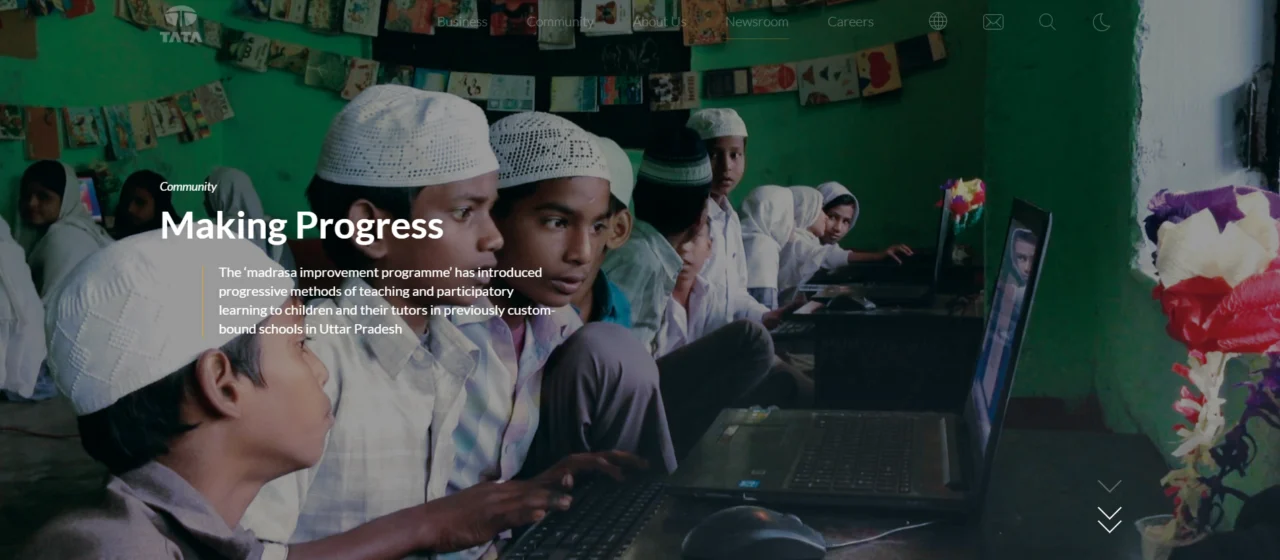
Instead of focusing purely on mainstream, secular, science-based education, the programme emphasises madrasa-based intervention with religious integration. The effort is not to move students fully into modern education systems, but to reshape existing religious institutions.
This raises a critical question. Does this approach genuinely empower students, or does it reinforce parallel systems of education?
A Quiet but Expanding Network
The scale of the programme is not insignificant. The Trusts claim to be working with approximately 400 madrasas, with around 75 designated as model institutions. The initiative has reached thousands of children across regions including eastern Uttar Pradesh, Bihar, West Bengal, and even parts of Mumbai.
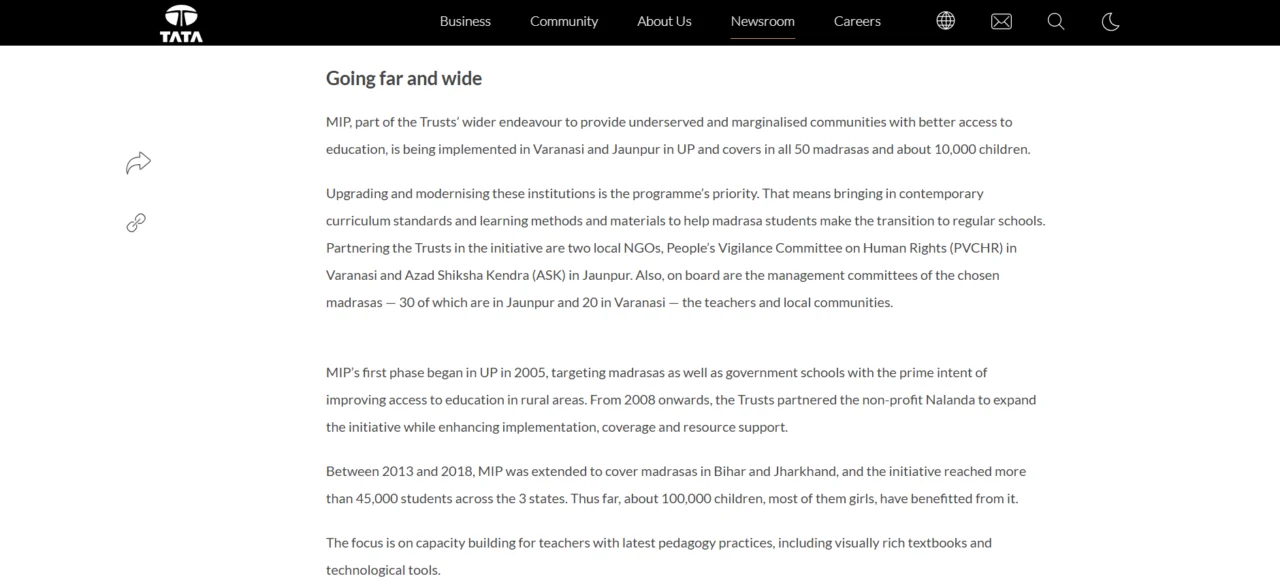
Programmes such as Integrated Approach to Technology in Education and Integrating Dini and Dunyavi education are being implemented. These involve teaching students to use digital tools, engage with online resources, and connect their learning with religious frameworks.
There is also active collaboration with government bodies such as the Ministry of Minority Affairs and state education boards. This indicates that the initiative is not isolated but embedded within broader policy ecosystems.
This expansion raises a larger concern. When private corporate funding intersects with religious education and public policy, what safeguards exist to ensure neutrality?
The Nashik Case
Against this backdrop, the ongoing investigation in Nashik becomes even more significant. The case involves nine FIRs filed between 2022 and 2026, detailing allegations of harassment, coercion, and religious targeting within a corporate workplace.
Several employees, including individuals in positions of authority, have been named in the complaints. Allegations include inappropriate physical conduct, intimidation, and persistent interference in personal choices. Some complainants have also alleged pressure to participate in specific religious practices and derogatory remarks about their own beliefs.
Police are currently verifying these claims and examining evidence. One accused is reportedly absconding, while others are in custody. Investigators are also exploring whether the incidents reflect a broader pattern rather than isolated acts.
Another serious allegation that has emerged is the failure of internal mechanisms. Multiple complainants have stated that they approached HR and senior management but did not receive adequate support or action.
Connecting the Dots
It would be premature to draw direct conclusions linking corporate CSR initiatives with individual criminal cases. However, it is equally irresponsible to ignore the broader ecosystem in which these developments are occurring.
On one hand, there are allegations of coercion, identity-based targeting, and workplace misconduct. On the other, there are institutional efforts to promote religiously integrated education under the banner of modernisation.
The overlap raises uncomfortable questions. Is there a larger ideological influence shaping certain spaces? Are institutions inadvertently enabling narratives that blur the line between faith and critical reasoning?
These are not questions of prejudice. They are questions of accountability.
The ongoing investigation in Nashik will take its legal course. Facts will emerge, evidence will be tested, and the courts will decide responsibility. However, the larger debate triggered by these developments cannot be confined to one case.
Education must remain rooted in clarity, not confusion. Science must be taught as science, not as an extension of theology. Corporate social responsibility must be accountable, transparent, and free from ideological ambiguity.
When institutions as influential as Tata Trusts engage in programmes that blend religion with scientific learning, they invite scrutiny. That scrutiny is not only justified, it is necessary.
At a time when India is striving to strengthen its scientific temper and educational standards, the direction of such initiatives must be questioned. Not out of hostility, but out of a commitment to intellectual honesty and societal progress.
The real issue is not whether communities should be uplifted. They must be. The real issue is how that upliftment is carried out, and whether it strengthens individuals to think freely or confines them within pre-defined frameworks.
That is the debate this moment demands.