For a civilisation that mentions metal tools sharp enough and rust free enough to function as razors in one of their oldest texts, the Rig Veda, and that went on to distinguish between iron and steel with technical precision in texts like the Brihat Samhita, metallurgy was never incidental fluke. It was a studied, refined, and applied knowledge system that was sustained through experimentation and skillful application. What is also worth recognising is how widely this knowledge was distributed. If a text as old as the Rig Veda mentions iron metallurgy, then by extension it includes all the regions that formed what was Bharat then- a land of cultural nationalism spreading across the Jambudweep.
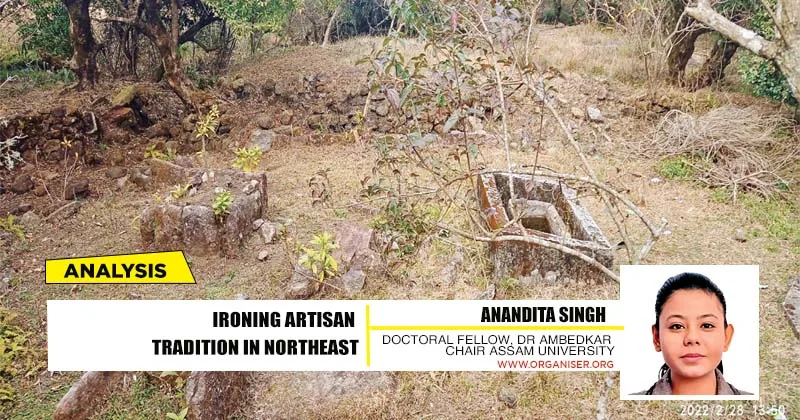
As evidence of this, a few years ago, in Sohra in present-day Meghalaya, I came across a row of brick furnaces, thirteen to fifteen of them set in close alignment in what is now a deserted site. Their structure and placement left little room for ambiguity. These were not domestic installations. They were part of a production space. Iron was being smelted here not occasionally, but repeatedly, in an organised manner.
Discovering Furnace Remains
Once that observation is taken seriously, similar traces begin to align. Nineteenth-century observers such as SF Hannay and William Robinson recorded furnace remains across upper Assam at Jaypur, Borhat, and along the banks of the Safari river. These were not isolated finds. They point to zones of industrial activity and economic production.
What appears simple today was anything but in the context in which it was done. Iron had to be located, extracted, transported, smelted, and shaped without the aid of mechanised tools, without electricity, and without the kind of force-multiplying technologies that make such processes routine today. To cut, refine, and control metal and its ore under these conditions required not just effort, but an applied understanding of heat, airflow, material behaviour, and proportion along with principles that align closely with what we would now describe in terms of physics and measurement. It is one thing to work with iron when tools already exist; it is quite another to produce those very tools from raw earth. And yet, this is precisely what was achieved.
For an enterprise that dates back centuries and spans over ages, it is natural that a cohesive system would get established and several communities would come together in a synchronised symphony. The iron production centres were embedded within society. Among the Khasi and Pnar communities, iron working formed part of a long-standing artisanal tradition, reflected even in language; the word nar for iron carrying everyday familiarity.
In Manipur, memory preserves the same association in a different form. Khamlangba, a central figure in Meitei tradition, is linked to the discovery of iron and the settlement of iron-smelting communities in Kakching. A locality there, Yotsungbam Pareng, literally translates to “a place of iron smelting”. These are not decorative cultural fragments; they indicate that iron was woven into both practice and identity.
The scale of this activity becomes unmistakable in historical accounts. Francis Buchanan Hamilton noted that an iron mine in Doyang supplied ore in abundance across Assam. Hannay describes extensive deposits from Jeypore to the Doyang river, and more importantly, the organisation built around them. At Teeroogong Hill and Hattighur, thirty to forty workshops operated simultaneously. Each unit consisting of a master and four workers produced multiple pieces of crude iron within a single day. Production followed seasonal cycles, but it was not scattered. It was coordinated, with output delivered into state storehouses.
Strategic Use of Iron
The Ahom polity did not stand apart from this system either and instead it structured it. Iron workers were organised into administrative units such as the Hazaree Khels and Satkeahs, numbering in the thousands. After successive military encounters, knowledge was expanded through the incorporation of skilled metalworkers, and workshops were established for the manufacture of weapons.
Iron here was not merely useful. It was strategic. Quantitative indicators from the region make the scale of this activity difficult to dismiss. Accounts recorded by SF Hannay described production centres such as Teeroogong and Hattighur where as many as 30 to 40 workshops operated simultaneously. Each unit typically consisted of a master and four workers producing around 8 pieces of crude iron in a single day. Even by conservative estimates, this amounts to roughly 240 to 320 pieces of iron being churned out daily from a single cluster. In other instances, individual furnace teams are noted to have produced up to 13 pieces within 24 hours through continuous operation. This level of output was supported by a substantial labour base.
Under the Ahom administration, iron workers were organised into units numbering close to 3,000 individuals.
In the Khasi Hills, iron smelting was carried out in above-ground bloomery furnaces, each charged with alternating layers of ore and charcoal. The fuel preferably charcoal derived from local oak was selected with care. Air was driven through kaolin clay tuyeres using large bellows, and temperature was regulated through the controlled operation of these bellows. There is nothing tentative about this. It reflects familiarity, repetition, and control.
Archaeology extends the timeline of iron production. At sites such as Nongkrem, Shillong, Raitkteng, and Cherrapunji, slag has been radiocarbon dated, with the earliest samples from Nongkrem falling between 353 BC and AD 128. Iron smelting in the Khasi Hills is therefore not a late development, but one rooted deep in the early historical period, with continuity that spans centuries.
The wider geographical spread of this activity is equally difficult to overlook. Archaeological evidence from Daojali Hading in present-day Dima Hasao reveals furnace remains and iron slag within a Neolithic habitation context, indicating that metallurgical practices in the region extend far back in time. In the Tiru Hills often referred to locally as Tiru Loha Khat traces of Ahom-era iron working survive in the form of workshop remains, slag concentrations, and smelting areas still identifiable in the landscape.
Even the distribution of iron-bearing resources across the region reflects this depth of understanding. High-quality zones were not only known but actively worked, extending from South and North Nongstoin in the Khasi Hills to Kaliyani in Karbi Anglong, and from Hahim in Kamrup to Dhupdhora and Chandordinga. The Dihing riverbed yielded iron nodules, while the Tiru Hills provided limonite ore that was systematically extracted. This was a landscape that was read not merely as terrain, but as a repository of specific material potentials. Each site recognised for the particular quality of ore it could offer and integrated into broader production cycles.
Trade, Exchange & Circulation
Recent scholarship has, at times, attempted to situate these developments within a framework of geographical isolation, particularly in relation to the Khasi Hills. It suggests that such metallurgical techniques emerged as self-contained responses to environmental constraints. However, this interpretation does not withstand closer scrutiny. The hills were not insulated enclaves but active participants in a wider network of exchange and circulation.
Iron ore from the Khasi and Jaintia regions moved alongside commodities such as cotton, wax, and ivory, descending into the plains especially into areas corresponding to present-day Mymensingh in Bangladesh where it entered vibrant trade circuits. In these markets, iron was exchanged for salt, rice, tobacco, and livestock, embedding it within a larger economic system that linked upland and lowland communities.
The integration of iron into broader industrial practices further underscores this interconnectedness. In the Brahmaputra valley, for instance, the shipbuilding industry depended not only on timber but also on iron components such as anchors, chains, and fastenings. Iron sourced from the Naga Hills was transported into the valley to meet these requirements, demonstrating how different ecological zones contributed specialised resources to a shared industrial enterprise.
Softer, more ductile iron produced in parts of lower Assam often associated with Khasi and Garo production zones was deliberately employed in the making of nails, smaller firearms, and the inner linings of cannon, where flexibility and resistance to fracture were crucial. In contrast, the harder, more resilient iron from upper Assam was reserved for implements that demanded rigidity and durability, such as swords, axes, knives, and agricultural tools. Such differentiation points to an embedded metallurgical sensibility: an empirical yet sophisticated knowledge system that recognised gradations within the material itself and deployed them with precision.
Military demand, in particular, was significant. During the Ahom period, successive campaigns led to the capture and replication of firearms and artillery, alongside the establishment of dedicated workshops for their manufacture. Accounts from the seventeenth century further reinforce this. The French traveller Jean-Baptiste Tavernier, writing in the context of Mir Jumla’s campaign in Assam, noted the presence of locally manufactured iron cannons in Assam, alongside the production of high-quality gunpowder. Iron production, therefore, extended into sophisticated military applications, demanding precision in both material selection and processing.
When the archaeological, technical, cultural, economic, and political strands are brought together, a coherent picture emerges. Iron smelting in the pre-colonial North East was not marginal, nor was it dependent on external stimulus. It functioned through its own logic: local resources, specialised labour, established techniques, and integrated exchange. To reat it as incidental is to misread the evidence.
And this is where the larger point becomes unavoidable. The metallurgical traditions visible in the North East are not separate from the wider Indian civilisational framework that engaged deeply with material knowledge. They are expressions of the same underlying orientation towards understanding, refining, and applying the properties of the physical world.
The furnaces at Sohra, then, are not anomalies waiting to be explained. They are confirmations. They tell us that what existed here was not absence, but system.