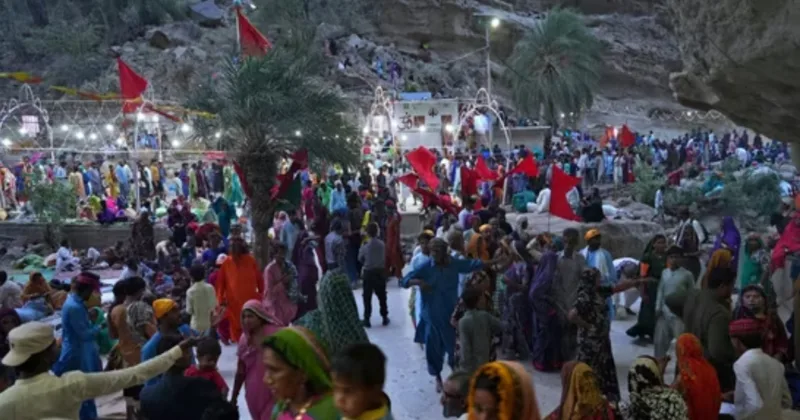
The three-day annual festival of the historic Hinglaj Mata temple concluded in remote Hingol Park in Balochistan hills on April 20. It is estimated that over 3,00,000 people visited the shrine in these three days, mostly Pakistanis, but some Hindu Sindhis who live in UK, the US and elsewhere.
A large number of Sindhis displaced from Pakistan live in India and many had migrated to western countries, including the UK, the US and Canada. For them, this is one of the most revered shrines their forefathers visited on regular basis. On Baisakhi and some other occasions, some Sikh pilgrims from India visit gurudwaras located in Pakistan. However, there is no provision for the Hindus (particularly Sindhis) to visit Hinglaj Mata shrine.
The festival had started on April 17 as thousands of Hindu devotees trekked for days to reach the shrine. The Shri Hinglaj Mata Welfare Mandli arranged a 24-hour “Bhandara” (langar), ensuring uninterrupted provision of food, cold water, sherbet and tea. Mandli officials, including President Mukhi Vinod Kumar Lasi, General Secretary Veersi Mal Kediwani, Dr Tola Ram Lasi, spokesperson Parkash Kumar Lasi and hundreds of volunteers remained engaged in serving pilgrims round the clock.
Number Of Pilgrims Rising
Speaking to the media, spokesperson Parkash Kumar Lasi said thousands of devotees travel on foot for days from various cities of Sindh in extreme heat to visit the sacred shrine and pray for fulfilment of their wishes. He said the record increase in pilgrims reflects their deep spiritual connection with the holy site, according to a Dawn report.
Considered the third-largest Hindu religious gathering after festivals in India and Nepal, the event attracted around 300,000 pilgrims this month, with nearly a million (10 lakh) devotees visiting the shrine in a year. The large gathering this year is a symbol of eternal unwavering faith Hindus in Pakistan have in Sanatana.
Several thousand devotees travelled to the Hinglaj Mata Temple on foot from various areas of Sindh, including Tharparkar, Umerkot, and Sanghar. The journey, which for many took 20 days, demonstrated a strong religious devotion.
The Balochistan government, the Provincial Disaster Management Authority (PDMA), and the district administration made extensive arrangements to ensure the festival ran smoothly. Deputy Commissioner Lasbela Humaira Baloch and Senior Superintendent of Police Najeebullah Pandrani remained on site to oversee administrative and security matters.
To ensure pilgrims’ safety, a large-scale security operation was put in place. Contingents of the Pakistan Army, Frontier Corps, Police and Levies were deployed to provide foolproof security for the massive event.
Several political and social figures visited the temple to participate in rituals. Attendees included Jamiat Ulema-i-Islam leader and former Balochistan Member of Provincial Assembly Mukhi Sham Lal Lasi, Sindh Governor’s Coordinator Vishal Palyani and MPA Sanjay Kumar.
Senator Daanesh Kumar, who also attended, described the temple as one of the most sacred sites in Hinduism. “The arrival of three times more pilgrims than last year is proof of interfaith harmony and Pakistan being a safe country,” Kumar said while talking to the media. He noted that pilgrims could perform their religious rituals in the harsh mountain terrain due to their staunch faith.
He appreciated the efforts of the local administration, volunteers, and the Hinglaj Mata Mandir Committee in ensuring smooth, well-organised arrangements for the pilgrims.
Legends of Hinglaj Mata Mandir
The main legend of Hinglaj Mata relates to the creation of the Shakti Peethas. It is believed that Goddess Sati’s Brahmarandhra (the top/crown of her head) fell here, making it a significant Shakti Peetha where she’s worshipped as Hinglaj Devi, smeared with sindoor (vermilion) from her forehead. This is the most abiding and first legend that most Hindus recite about the Hinglaj Mata, linking it to Prajapati Daksha’s yagya in Kankal (Haridwar) and the events thereafter.
Another legend links the temple to Ramayana and Bhagwan Ram’s return to Ayodhya from exile. It is said that after killing Ravan, Shri Ram returned to ascend to the throne of Ayodhya. A sage Kumbodhar explained to Shri Ram that to cleanse himself of this sin, he should make a pilgrimage to Hinglaj Mata, the only place that could purify him. Shri Ram then follows the advice and immediately leaves with his army for Hinglaj. Mata Sita, Lakshman and Pawanputra Hanuman also accompany him during the journey.
Shivaharkaray Shakti Peeth Temple
The second Shakti Peetha in Pakistan is Shivaharkaray Shakti Peeth Temple. This is the place where the third eye of goddess Sati is believed to have fallen. It is not very far away from Hinglaj but more remote and less accessible. Therefore, the Shaktipeeth comes third among all 51 Shakti Peethas. It is also known as Karavipur Shaktipeeth or Nani Peeth where the goddess is worshipped as Mahishasurmardini (the slayer of Demon Mahishasur) in the form Karavipur Devi and Lord Shiva as Krodhish in Ragi form.
The Shivaharkaray Shakti Peeth is a testament to Hindu reverence and faith. Though neglected and situated far-off beyond Hinglaj temple further up in the hills, this temple shines with divine grace. Along with the Hinglaj Mata Mandir in the same hilly region of Balochistan, this temple is also a source of energy for Hindus worldwide.
Lyari Tehsil of Lasbela District
The Hinglaj Mata Mandir is located in a narrow gorge in the remote, hilly terrain of Lyari Tehsil of Lasbela district, Hinglaj Mata (also known as Hinglaj Devi, Hingula Devi, or Nani Mandir). The shrine lies within Hingol National Park, near the town of Hinglaj on the Makran coast in Balochistan’s Lasbela district. Dedicated to a form of Durga, the temple is tucked inside a natural mountain cavern along the banks of the Hingol River.
The Lyari tehsil is not to be confused with Liyari, a suburb of Karachi, the capital of Sindh, which has become well known the world over due to its depiction in the recent movie Dhurandhar and its sequel. Of course, the Liyari area of Karachi is a stronghold of ethnic Baloch who call it “Mother of Karachi’’. Actually, Liyari was one of the first areas to be inhabited by Baloch fishermen and Sindhi (Hindu) baniyas much before Karachi emerged as an urban centre and a harbour.