The controversy surrounding the ‘Lenskart’ dress code had barely subsided when a new instance of tampering with Hindu faith and cultural symbols emerged this time involving ‘Air India,’ following closely on the heels of a similar incident at the Tata Group’s ‘TCS’ in Nashik. Questions have now been raised regarding Air India’s dressing policy as well. Claims circulating on social media allege that Air India’s cabin crew handbook prohibits the use of religious symbols such as the ‘bindi’, ‘sindoor’, ‘tilak’ and ‘kalava’. As soon as these claims surfaced, many internet users began interpreting the issue through the lens of Hindu identity.
The matter escalated further when an ‘X’ user allegedly shared screenshots of the grooming policy. These images displayed regulations that appeared to restrict the religious expression of employees. Some individuals questioned how an Indian company could possibly impose restrictions on the religious identity of its own employees. However, Air India has refuted all these claims, clarifying that employees are indeed permitted to wear a ‘bindi’. According to the company, the documents currently going viral on social media are outdated and are no longer in effect.
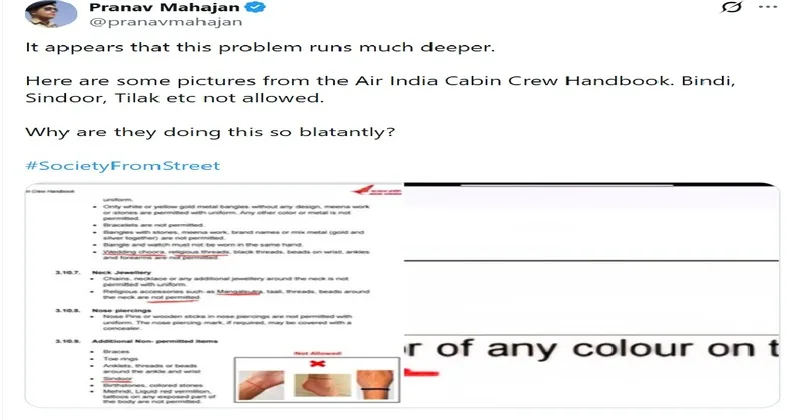
It appears that this problem runs much deeper.
Here are some pictures from the Air India Cabin Crew Handbook. Bindi, Sindoor, Tilak etc not allowed.
Why are they doing this so blatantly?#SocietyFromStreet pic.twitter.com/uqVRbXBwwF
— Pranav Mahajan (@pranavmahajan) April 18, 2026
It is noteworthy that a similar controversy involving Lenskart was previously brought to light by author and activist Shefali Vaidya, who highlighted the company’s internal dress code policy on social media. Sharing a screenshot on ‘X’ (formerly Twitter), Vaidya pointed out that while Lenskart’s policy permitted employees to wear a ‘hijab’, it simultaneously prohibited Hindu religious symbols such as the ‘bindi’, ‘tilak’ and ‘kalava’.
She strongly criticized this policy, labeling it as “anti-Hindu” and calling for a boycott of Lenskart. Upon the revelation of this policy, it was widely condemned on social media as an instance of “double standards” and “corporate jihad.” Following the escalation of the controversy, Lenskart CEO Peyush Bansal stepped forward to clarify that the document currently going viral is either “outdated” or has been “misinterpreted.” He asserted that the company does not discriminate against any religion and that there are no restrictions regarding the wearing of a bindi, tilak, or hijab. However, subsequently, activist Shefali Vaidya shared a new message on X, once again questioning Peyush Bansal: “Here is the proof that you lied, @peyushbansal. You claimed that the leaked style guide was ‘incorrect and outdated’ and that you had withdrawn it on February 7th. So, please explain why your company was conducting video audits of its stores and imposing fines on April 8, 2026.”
Here is proof that you LIED @peyushbansal. You claimed that the style guide that was leaked was ‘inaccurate and outdated’ and that you withdrew it on 7th of February. So please explain WHY on 8th April 2026 your company was conducting video audits of stores and penalising… https://t.co/3ssJ7sSCzf pic.twitter.com/855KBuTw1i
— Shefali Vaidya. 🇮🇳 (@ShefVaidya) April 18, 2026
Now, delving deeper into similar news stories, just last month on March 25- a young Dalit woman employed at TCS in Nashik, Maharashtra, recounted how her colleagues mocked her religious beliefs, pressured her to convert, and subjected her to sexual harassment. By April 3, nine FIRs had been registered in connection with this case, with complaints filed by eight Hindu women and one man. The allegations included being coerced into performing ‘Namaz’, being forced to consume non-vegetarian food and facing psychological pressure to abandon their traditional religious identities. The Lenskart controversy surfaced in the wake of this incident; a situation where, once again, a company is accused of engaging in disrespectful conduct toward Hindu religious identities. And now, another Tata Group entity Air India has come under the spotlight, facing the very same allegations that were leveled against Lenskart.
The Tata Group and the Persistent Questions
The Tata Group stands as one of India’s most prestigious industrial conglomerates. For a long time, it has been regarded within the country as a symbol of trust and ethics; however, controversies surrounding its various companies in recent years have cast a shadow of doubt over this very image. It would not be an exaggeration to say that when allegations of a similar nature repeatedly surface regarding matters linked to the same group, it may indicate a discernible pattern circumstances that necessitate a serious legal review.
Other Companies Are Not Far Behind
Indeed, the issue at hand is not confined to just one or two Tata companies. Whether it concerns Air India’s dress code, TCS’s conversion and dress policies, or Tanishq’s 2020 advertisement, controversies appear to be cropping up everywhere. Similarly, within the corporate sphere, the questions raised by an employee at Tech Mahindra regarding the workplace environment fall into this same category. Incidents such as Surf Excel’s 2019 campaign, the allegations leveled against HDFC Bank, and Fabindia’s “Jashn-e-Riwaaz” campaign all point to a growing reality: cultural sensitivity is becoming a significant challenge within the corporate world.
Companies Are Undermining the Very Society from Which They Profit
A common thread runs through all these instances: in the name of balancing branding with market demands, Hindu symbols and India’s core cultural sentiments are being disregarded. This occurs despite the fact that the domestic consumer base comprising the Hindu community, which constitutes approximately 80 percent of the country’s population forms a major pillar of India’s economy. Furthermore, a substantial portion of the revenue generated by the retail, FMCG, e-commerce and service sectors is derived from this very majority community. Consequently, the question naturally arises: is it truly a sound strategy for these companies to disregard the faiths and traditions of the very society that contributes most significantly to their economic success?
Corporate Policies Under the Lens of the Constitution
Indeed, whenever the subject of religious freedom arises, the Indian Constitution serves as the ultimate guiding authority. Advocate Ashutosh Kumar Jha states, “Article 25 grants every citizen the freedom to live their life in accordance with their faith. If an employee at the workplace is compelled to alter or renounce their religious identity, it constitutes a direct violation of this right.”
Echoing this sentiment, Senior Advocate Dhananjay Singh observes, “Articles 14 and 21 also become pertinent in this context; specifically, the Right to Equality and the Right to Live with Dignity. Both of these rights are compromised in such instances. Any policy that restricts the symbols of one religion while granting exemptions to another disrupts the constitutional equilibrium.” Thus, this issue transcends the realm of mere corporate policy or ethics; it becomes a matter of constitutional validity.
Coincidence or sign- still debated
In light of these events, a significant section of society views them as indicative of an emerging “anti-Hindu narrative.” Social media platforms are rife with such sentiments; for when controversies of a similar nature surface repeatedly, they become increasingly difficult to ignore.