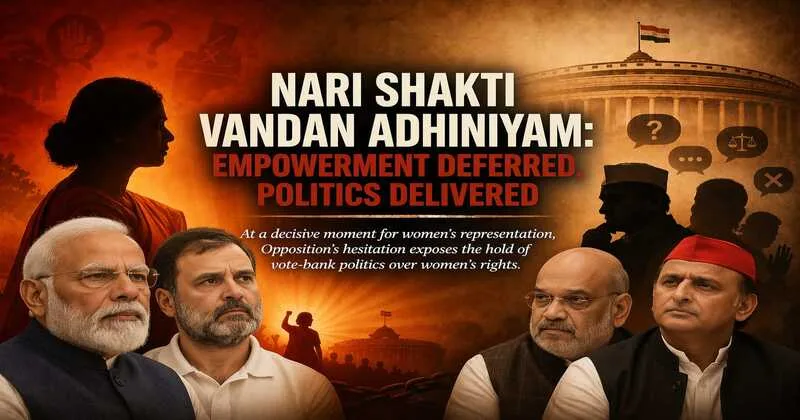
Has the role of the Congress and the INDI alliance on the Nari Shakti Vandan Adhiniyam (Women’s Reservation Bill) exposed that, for them, women’s empowerment is merely an electoral slogan?
At a time when India stood on the brink of a historic reform to ensure 33 per cent reservation for women in Parliament and State Assemblies, the failure of the Congress and its INDI alliance partners to extend decisive support resulted in the Bill falling short of the required majority. What could have been a transformative milestone in India’s democratic evolution instead turned into a moment of political hesitation and contradiction.
This critical episode in Parliament has laid bare the underlying inconsistencies within opposition politics. For decades, parties like the Congress, the Samajwadi Party and their allies have championed the cause of women’s empowerment in rhetoric. Yet, when confronted with the opportunity to translate words into action, they resorted to conditionalities, reservations and political calculations.
The constitutional amendment required a two-thirds majority-352 votes to pass. However, it secured only 298 votes, while a substantial number of Members either opposed or refrained from unequivocal support. This outcome suggests that political arithmetic, rather than a commitment to women’s rights, dictated the course of action.
The Congress, notably, did not mount a direct opposition but instead engaged in a strategy of ambiguity. Rahul Gandhi described the Bill as insufficient, yet the party stopped short of lending full support when it mattered most. A genuinely reform-oriented approach would have entailed supporting the legislation first and subsequently advocating for improvements. The failure to adopt this course raises legitimate concerns about intent.
Union Home Minister Amit Shah, addressing the House, pointed out that while not all opposition members voted against the Bill, many effectively stalled it through “ifs and buts”. He emphasized that the legislation was designed to operationalize women’s reservation from the 2029 Lok Sabha elections, providing a clear and time-bound framework.
The Samajwadi Party further complicated the discourse by demanding sub-quotas within the reservation structure. While such demands may be framed as inclusive, they introduce complexities that risk delaying or derailing the reform altogether. By attaching conditions, the opposition collectively made the passage of the Bill more difficult.
This brings us to the central question: is the opposition genuinely committed to advancing women’s rights or is it still navigating the contours of vote-bank politics? The parliamentary developments suggest the latter. Instead of prioritizing a structural reform capable of empowering millions of women, political considerations appear to have taken precedence.
In contrast, the government articulated a structured and forward-looking roadmap. Prime Minister Narendra Modi assured the House that the delimitation process would be conducted fairly, without disadvantaging any region-North, South, East, or West. Despite these assurances, sections of the opposition sought to amplify apprehensions.
Amit Shah also addressed concerns regarding regional representation with data, clarifying that states in southern India would not lose seats but are likely to witness an increase in both absolute numbers and proportional share. Yet, these clarifications did little to prevent the issue from being politicized.
At the grassroots level, states like Madhya Pradesh demonstrate that when political intent aligns with policy execution, tangible results follow. Women’s participation in Panchayati Raj institutions there has crossed 50 per cent, with women actively contributing to governance and decision-making. This stands as a testament to what sustained commitment can achieve.
In contrast, the Congress and its allies have often remained entangled in prolonged theoretical debates. On issues such as OBC reservation, decisive action was delayed for years. Against this backdrop, their current positioning on women’s rights appears less persuasive and more politically contingent.
Admittedly, one may question why such reforms were not expedited in earlier years. However, in the present context, what stands out is that the opposition appeared predisposed to obstruct rather than enable. This explains the pattern of conditions and objections that ultimately hindered the Bill’s passage.
The broader implication is deeply concerning. The rights of half the population seem to have been reduced to instruments of political negotiation. In a democracy, such an approach risks undermining both the spirit of reform and the credibility of political commitment.
The Congress and the INDI alliance appear to have missed a historic opportunity. If their commitment to women empowerment were substantive, the Nari Shakti Vandan Adhiniyam would have received unequivocal support. Their failure to do so reinforces the perception that, for them, women empowerment remains more a matter of political rhetoric than a genuine and consistent resolve.