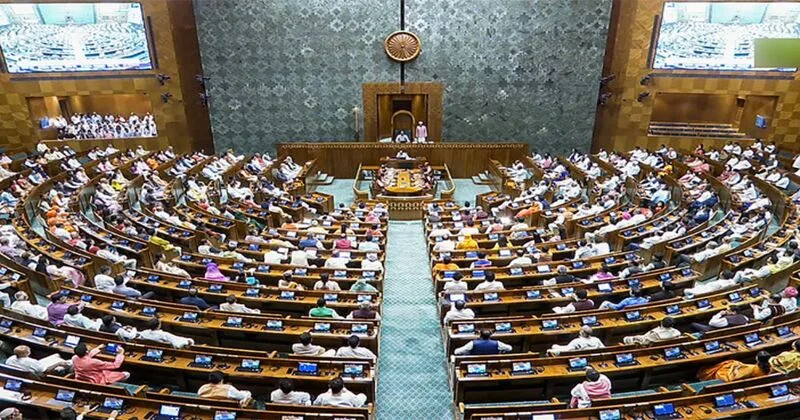
The failure of the 131st Constitution Amendment Bill in the Lok Sabha on April 17, 2026, will be remembered as a day of profound betrayal in the annals of Bharat’s democratic journey. This was the moment when the mask of progressive rhetoric finally slipped from the face of the INDI Alliance, revealing a core of regressive gatekeeping and narrow political survivalism. What was intended to be a historic leap toward institutionalising women’s representation by the 2029 general elections has instead been deliberately sabotaged.
In rejecting this amendment, the opposition has not merely blocked a legislative clause; it has effectively issued a stay order on the political destiny of Bharat’s women, forcing them into a decade of waiting that they did not ask for and do not deserve. By halting the Nari Shakti Vandan Adhiniyam at the threshold of implementation, the opposition has crafted its own political Waterloo, a moment where its strategic miscalculations and inherent contradictions have finally converged to alienate the most decisive voter bloc in the nation.
The Great Betrayal: A decade of denial
The significance of the 131st Amendment lay in its ability to bridge the temporal gap between the legislative intent of 2023 and the practical reality of 2029. The original Nari Shakti Vandan Adhiniyam was passed with near unanimity, yet its implementation remained tied to the post-Census delimitation process. Recognising the urgency of the moment and the soaring aspirations of Bharat’s daughters, the government moved to expedite this process, ensuring that the 33 per cent reservation would be a reality in the next Lok Sabha. By voting against this amendment, the INDI Alliance has ensured that the doors of Parliament remain restricted to women for another ten years.
The implementation is now pushed to 2034, a distant horizon that feels like a sentence of political exile for an entire generation of women leaders. This is not just a procedural delay; it is an active denial of agency. For millions of women who saw in the 2023 Act a promise of immediate empowerment, this sabotage is a cold reminder that for certain political entities, power remains a zero-sum game where the inclusion of women is seen as a threat to entrenched patriarchy and dynastic structures. The opposition has effectively told the women of Bharat that their representation is a secondary concern, subordinate to the tactical anxieties of a coalition that fears the disruption of its traditional power bases.
The Delimitation Bogey: Deconstructing a false narrative
The primary shield used by the opposition to justify this betrayal has been the manufactured fear of a North-South imbalance. This narrative, amplified with tactical precision, sought to cast the 131st Amendment as a tool for regional subjugation. However, a closer look at the mathematical reality of the proposed 816-seat Lok Sabha decisively dismantles this propaganda. The government’s proposal was never about shrinking the representation of any region; it was about expanding the democratic pie to reflect a growing population and ensuring that no state loses its relative weight. Under the 816-seat model, the total number of seats in the southern states, Tamil Nadu, Kerala, Karnataka, Andhra Pradesh, and Telangana, would have increased from the current 129 to 195.
This is an absolute gain, a significant expansion that would have strengthened the voice of the South in the national legislature. Yet, the opposition chose to ignore this arithmetic, preferring instead to fan the flames of regionalism to stall the empowerment of women. Their argument that southern states would be disadvantaged is a hollow fiction when one considers that their share in the total House would have remained stable. What remains, therefore, is not a legitimate structural concern but a politically motivated blockade designed to prevent the emergence of a new, independent class of female leaders who might challenge the status quo of regional satraps. By pitting regional identity against gender justice, the INDI Alliance has failed both.
The myth of strategic dependence
Another layer of the opposition’s narrative has been the assertion that the Bharatiya Janata Party is relying on delimitation as a crutch for electoral dominance in 2029. This claim is as disconnected from reality as it is desperate. The political trajectory of Bharat since the 2024 Lok Sabha elections has proven that the BJP’s strength is rooted in organisational resilience and ideological clarity, not in the redrawing of constituency maps. While the 2024 results were a case of tactical underperformance due to localised complacency, the subsequent and decisive victories in Maharashtra, Bihar, Haryana and Delhi have demonstrated that the party’s base remains structurally intact and capable of rapid recalibration.
A party that can sweep state after state under the existing boundaries does not need a new map to secure victory. The push for the 131st Amendment was driven by a civilizational commitment to Nari Shakti, not by a search for electoral shortcuts. By blocking the bill, the opposition has not hindered the BJP; it has only hindered the women of Bharat. They have mistaken a transformative national reform for a partisan manoeuvre, and in doing so, they have exposed their own fear of a shifting political landscape where traditional vote banks are being replaced by a conscious and assertive female electorate that transcends caste and regional lines.
Historical hypocrisy and the DNA of obstruction
To understand this latest betrayal, one must look at the long history of the Women’s Reservation Bill. For decades, it was held hostage by the very parties that now form the core of the INDI Alliance. From the tearing of the bill in the well of the House in the late 1990s to the tactical delays of the UPA era, the resistance to women’s leadership has been a consistent thread in the opposition’s DNA. The difference today is that the mask of support has become even thinner.
In 2023, they voted for the bill because the public pressure was overwhelming; in 2026, they blocked the implementation because they thought they could hide behind the technicalities of the Census and Delimitation. This is the hallmark of a political class that views women as a laboratory for welfare schemes but never as partners in governance. They are comfortable with women as beneficiaries, but they are terrified of women as decision makers. The 131st Amendment was the litmus test for their sincerity, and they failed it spectacularly. By ensuring that the 33 per cent quota remains a paper promise until 2034, they have proven that their commitment to gender equality is nothing more than an electoral posturing, easily discarded when it conflicts with their internal power dynamics.
The 2024 lesson and the rise of the nirnayak force
The reduced margins of 2024 served as a crucial lesson for the BJP cadre, highlighting the dangers of the ease factor and the necessity of constant grassroots engagement. However, the opposition misread this as a sign of terminal decline. They failed to realise that the Indian voter, particularly the woman voter, is no longer a passive recipient of messages but an active participant in the democratic process. Women now constitute nearly 49 per cent of the electorate, and their turnout has consistently outperformed that of men in several key states.
This is the Nirnayak force, the decisive factor that determines the survival of governments. This demographic responds to the politics of inclusion and symbolic recognition as much as it does to tangible benefits. By effectively halting the entry of women into Parliament for another decade, the INDI Alliance has committed strategic suicide. They have provided the ruling side with a potent moral narrative: we tried to give you your rights by 2029, and they stopped it. In the mass perception of the electorate, the complexities of Census timelines and Delimitation Commissions will be stripped away to reveal a simple, hard-hitting truth of obstructionism versus empowerment.
Digital awareness and the end of gatekeeping
The opposition also underestimates the role of digital connectivity in shaping the modern female voter. In earlier decades, political manoeuvres in the national capital could be obscured by regional media or buried in procedural jargon. Today, every woman with a smartphone in a remote village in Bihar or a professional hub in Bengaluru is aware of the legislative blockades. The narrative of Nari Shakti is not just a top-down slogan; it is a lived aspiration.
When the 131st Amendment was defeated, the news did not just reach the political elite; it reached the self-help groups, the local entrepreneurs and the first-time voters who were looking forward to seeing women represent their interests in 2029. The opposition’s attempt to gatekeep the Parliament has been broadcast in real time to the very people they seek to court. This transparency has made it impossible for the INDI Alliance to maintain a dual identity, of being pro-woman in their manifestos while being anti-woman in their parliamentary votes. The gap between their words and their actions has become an unbridgeable chasm, and the female electorate is watching with a degree of political awareness that Bharat has never seen before.
Nari Shakti and the price of political hypocrisy
The failure of this amendment raises fundamental questions about the accountability of the opposition. For decades, these parties have used women’s reservations as a convenient slogan during election cycles, only to retreat into the shadows when implementation became a reality. The 2023 consensus was a rare moment of national unity, yet the moment it required a follow up action to make it functional for 2029, that unity evaporated into a cloud of procedural excuses.
The INDI Alliance now faces the daunting task of explaining to the women of Bharat why their political representation was sacrificed at the altar of regional paranoia and tactical obstruction. If women voters interpret this episode as a denial of their rightful share in the democratic process, the electoral consequences for the opposition will be terminal. They have trapped themselves in a perception vacuum where they are seen as the gatekeepers of an old, male dominated order, while the Prime Minister and his party are seen as the champions of a new, inclusive Bharat. This is not just a legislative failure; it is a moral bankruptcy that will haunt the opposition in every polling booth across the country.
The opposition’s perception trap
In politics, perception often outweighs the fine print of legislative detail. The opposition’s dilemma is compounded by the fact that their arguments have already been publicly dismantled by the government’s transparent data on seat expansion. By foregrounding concerns about regional imbalance that the numbers simply do not support, they have tied themselves to a narrative that no longer resonates with an aspirational and data conscious public. At the same time, their inability to present any coherent alternative that would allow for women’s reservation by 2029 without delimitation exposes their lack of a vision.
They are seen as the side that says no, the side that blocks, the side that fears change. Contrast this with the ruling side, which has demonstrated a willingness to expand the very structure of the Lok Sabha to accommodate the aspirations of women and states alike. The side that attempts progress gains the moral high ground; the side that obstructs it loses its credibility and its future. For the INDI Alliance, the defeat of the 131st Amendment is not a tactical victory; it is a strategic catastrophe that has placed them on the wrong side of history.
Beyond 2034: The long shadow of sabotage
The road to 2029 and 2034 will now be defined by this moment of sabotage. The myth that the BJP requires delimitation to win has been thoroughly undermined by its organizational resilience and its ability to learn from setbacks. The real battle ahead will not be fought over constituency boundaries but over the narrative of empowerment. The INDI Alliance has handed the BJP a powerful ideological weapon, one that resonates across every household in Bharat.
The delay of women’s reservation until 2034 will become a rallying cry for the ruling side, a constant reminder of the opposition’s betrayal. It will be used to mobilize the silent revolution of women voters who see their dreams of leadership deferred by a political class that values its own survival over national progress. As the nation moves toward the next electoral cycle, the memory of April 17, 2026, will linger. It will be remembered as the day when the opposition chose to halt the march of Nari Shakti, and in doing so, ensured their own eventual defeat. The shadow of this sabotage will stretch far beyond the 2029 elections, casting a pall over the opposition’s claims to represent the aspirations of a modern, developing Bharat.
A turning point in the political landscape
The defeat of the Constitution 131st Amendment Bill is an inflection point that will reshape the political landscape of Bharat for years to come. For the INDI Alliance, it is a Waterloo, a moment where their internal contradictions and lack of a positive agenda have been laid bare before the nation. By advancing flawed arguments and underestimating the political intelligence of women voters, they have placed themselves in a precarious position. Meanwhile, the Bharatiya Janata Party has demonstrated that its strength remains independent of structural changes, rooted instead in its commitment to the transformative idea of women’s representation and the expansion of democratic space. In the final analysis, the politics of empowerment carries an enduring weight that no amount of procedural obstruction can truly suppress.
When a transformative idea like Nari Shakti is seen to be blocked, the political cost is rarely immediate, but it is always decisive. As Bharat marches toward the next decade, the women whose aspirations were pushed to 2034 will remember exactly who stood in their way and who fought to open the doors. The memory of this betrayal will be the architect of the opposition’s downfall, ensuring that their temporary victory in the Lok Sabha becomes a permanent defeat in the hearts of the people. The women of Bharat are no longer willing to wait for a seat at the table; by blocking their path, the INDI Alliance has ensured that the table itself will be taken over by those who championed their cause.