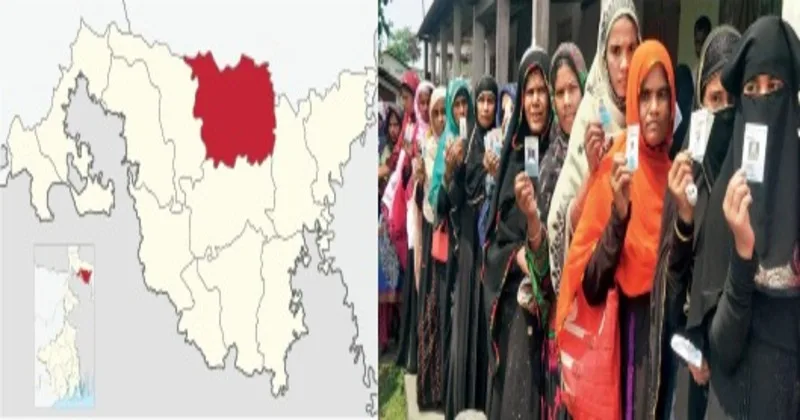
The demographic composition of Cooch Behar, a border district in North Bengal, is undergoing a gradual yet significant change. While this shift has largely remained under the radar, its political implications are now coming into sharp focus. A closer look at data from the past three decades suggests a clear trend—the growth rate of the Muslim population in the district has been significantly higher than that of the Hindu population.
In 1991, Muslims around 23 per cent of the district’s total population. Recent estimates suggest that by 2026, this share could approach or exceed 30 per cent, marking an increase of nearly 7 percentage points over three decades. However, the debate is not limited to growth rates alone. Questions are being raised about the underlying causes of this demographic shift. From cross-border migration to electoral politics, multiple factors are being discussed and debated.
Data Snapshot: Population trends in Cooch Behar
1991
Total Population: ~2.17 million
- Muslim Population: 506,728 (23.34 per cent)
- Hindu Population: ~1.62 million (74–75 per cent)
2011 (Last Census)
Total Population: 2,819,086
- Muslim Population: 720,033 (25.54 per cent)
- Hindu Population: 72.06 per cent
2026 (Estimated)
Total Population: ~3.3–3.5 million
- Muslim Population: Over 1 million (29 per cent-30 per cent)
- Hindu Population: ~2.23 million (70 per cent)
Comparative Growth (1991–2026)
- Muslim Population Growth: ~67 per cent
- Hindu Population Growth: ~37 per cent
This indicates that the Muslim population has grown at approximately 1.7 times the rate of the Hindu population over the last three decades.
Assembly-wise estimated muslim population share
- Sitai: 38–40 per cent
- Dinhata: 40–42 per cent
- Sitalkuchi: 35–36 per cent
- Tufanganj: 28–30 per cent
- Natabari: 27–29 per cent
- Mathabhanga: 24–26 per cent
- Cooch Behar South: 28–29 per cent
- Cooch Behar North: 20–22 per cent
- Mekhliganj: 18–20 per cent
Higher proportions are observed in areas closer to the international border, a pattern that has long been discussed in administrative and political circles.
Border dynamics and electoral politics
Given its proximity to the Bangladesh border, Cooch Behar has historically been at the center of debates around cross-border movement and migration. Critics allege that instead of strictly controlling such movement, there has at times been political reluctance to address the issue decisively.
Some political analysts and opposition voices argue that migration concerns have become intertwined with electoral considerations, raising questions about whether demographic changes have been overlooked for political gains.
A concern beyond communities
According to some analysts, this situation is not a matter of concern for Hindus alone. It may also impact Indian Muslims who have lived in the country for generations. The concern is that discussions around migration can sometimes lead to the generalization of an entire community. This may blur the distinction between undocumented migrants and Indian citizens, potentially increasing social mistrust.
Key questions emerging
- What are the actual drivers behind this demographic change in Cooch Behar?
- To what extent does cross-border migration contribute to this shift?
- Has electoral politics played a role in shaping or ignoring this issue?
The demographic evolution of Cooch Behar is no longer just a matter of statistics. It has become a complex issue involving border management, governance, and social balance—emerging as a significant factor in the political discourse of North Bengal, especially ahead of the 2026 elections.
Numbers may remain silent—but over time, they raise some of the most difficult questions.