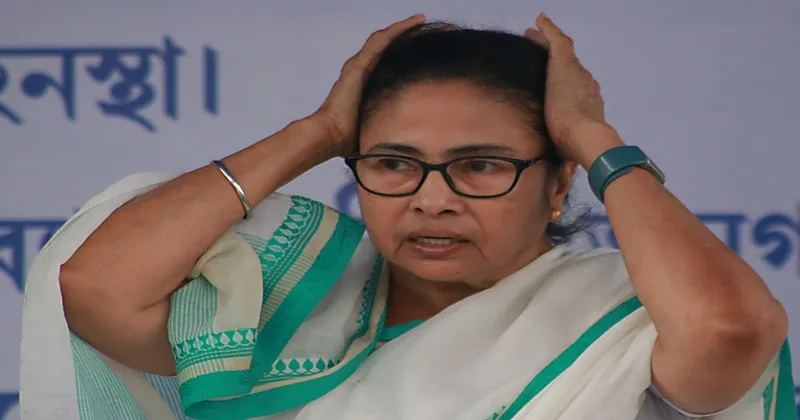
The politics of West Bengal has historically served as a stage for broad-based social, ideological and democratic struggles. True to this tradition, the upcoming 2026 Assembly elections appear to stand at a decisive crossroads. It is these elections that will now determine the trajectory of democracy; specifically its quality, accountability and institutional robustness within the state. In such a scenario, an evaluation of the Trinamool Congress government led by Mamata Banerjee becomes imperative.
Indeed, over the past decade, the tenure under Mamata Banerjee’s leadership has witnessed an excessive centralization of power. The Trinamool Congress, which swept to power in 2011 on a wave of hope for change(Parivartan), initially garnered significant public support; however, with the passage of time, this style of governance gradually morphed into a personality-centric administration. The role of institutions in administrative decision-making became increasingly circumscribed, while the traditional separation between the political and administrative machinery blurred, appearing to give way to partisan bias. Ironically, Mamata’s rule was established on the very premise that it would put an end to anarchy in West Bengal, halt infiltration from Bangladesh, curb violence and generate new employment opportunities. But what was the reality?
The reality is that the Mamata government failed to deliver on its promises; on the contrary, it became evident that the independence and accountability of institutions had been eroded. The government began actively suppressing any form of criticism directed against it. The opposition has been marginalized and the administrative machinery is being instrumentalized to serve political interests. Naturally, all these indicators signal a grave threat to democracy. The state of law and order within the region remains under constant scrutiny. We all witnessed the heinous crime that occurred at the R.G. Kar Medical College, an incident that has emerged as a stark symbol of administrative insensitivity and a complete lack of accountability.
The government’s response to such incidents has conveyed a clear message; the Mamata administration is far more interested in salvaging its own public image than in ensuring the safety and security of its citizens. Furthermore, incidents of political violence, a long-standing stain on Bengal’s politics have not yet ceased; indeed, it could be argued that they have actually intensified since the advent of the “Mamata regime”. Violence during the electoral process, attacks on opposition workers, and allegations of voter intimidation serve to undermine democratic values. Yet, who truly cares? Mamata possesses a well-established electoral calculus based on a fixed vote bank. Consequently, one of the most significant criticisms leveled against the Mamata government has been its reliance on vote-bank politics.
It is pertinent to note here that the Muslim population in the state stands at approximately 28–29 per cent; owing to a history of voting en bloc, this demographic has consistently remained a decisive political factor. While the Trinamool Congress has undoubtedly managed this equation with considerable dexterity, the result appears to be a lack of balance in policy-making; the holistic development that the state ought to be undergoing remains, for all intents and purposes, a distant dream. In West Bengal, the Muslim minority appears to dominate, particularly over the Hindu majority. This brand of politics has fostered a sense of societal division: on one hand, the Mamata government faces persistent accusations of minority appeasement, while on the other, discontent has surged within the Hindu majority community. Consequently, a significant section of the majority population in the state now seeks a change of power.
Another basis for this assessment lies in electoral statistics, which corroborate this shift. The Trinamool Congress which secured 184 seats with 38.93 per cent of the vote in 2011, 211 seats with 45 per cent in 2016, and 213 seats with 48 per cent in 2021- now appears to be grappling with new political equations. Indeed, the Congress party’s unexpected victory in the 2023 Sagardighi by-election, coupled with its growing influence in Muslim-majority areas during the 2024 Lok Sabha elections, signals that Mamata Banerjee’s traditional vote bank is no longer entirely secure. This makes it evident that the old electoral arithmetic of “bloc voting” is beginning to crumble.
On the other hand, the Bharatiya Janata Party’s rapid rise in West Bengal has also emerged as a major challenge for the Mamata government. The BJP, which garnered a mere 17 per cent of the vote in 2014, secured 41 per cent of the vote and 18 seats in 2019. In the 2021 Assembly elections, it emerged as the principal opposition party, winning 77 seats. Furthermore, the Congress-Left alliance is also striving to reclaim the ground it had lost. The Indian National Congress’s “go-it-alone” strategy, combined with the restructuring of the Left parties, indicates that Bengal’s politics has now evolved into a multi-cornered contest. In a sense, this competition serves as a positive sign for democracy, as it challenges the monopoly on power.
Concurrently, the manner in which the Special In-depth Review(SIR) of the electoral rolls was conducted this time, resulting in the exclusion of approximately 5.8 million names from the preliminary list suggests that it will no longer be easy to replicate the “miracles” through which Mamata’s party has historically secured victories in numerous state constituencies, often relying on an illicit vote bank. The government’s ambiguous stance regarding the issues of infiltration and citizenship has also become a subject of public criticism. It must be noted that this issue is directly linked to national security and the equitable distribution of resources. The Mamata government also faces accusations of adopting “symbolic Hindutva”, manifested through acts such as inaugurating temples and promoting Durga Puja. However, critics hold the firm view that such actions by Mamata do not constitute a genuine cultural renaissance for Bengali culture; rather, they are merely part of her electoral strategy. Amidst the current political climate, Bengal’s rich cultural heritage is undergoing a continuous process of erosion.
In this context, it must be said that Mamata Banerjee’s administration once a symbol of change has now, in many respects, become synonymous with stagnation, centralization and controversy. Violence lies at its very core. Indeed, numerous major violent incidents now seem to have become the very destiny of West Bengal. Naturally, against this backdrop, a change of power has emerged as a prerequisite for the health of the state’s democracy. If the citizenry feels that the government is failing to live up to their expectations, then change becomes the natural and inevitable outcome of a democratic process.
The 2026 election looms on the horizon as a symbol of the potential for precisely such a change. This election will determine whether Bengal moves toward a more accountable, inclusive and balanced political order, one that aligns with its rich cultural and intellectual heritage or whether it continues along the path of the current dispensation. Ultimately, the greatest strength of a democracy lies with its people; it is they who must decide the direction in which Bengal’s future will unfold.