In a vibrant democracy like India, the active participation of women is not merely a social necessity but also an essential condition of our constitutional ideals. From a statistical perspective, according to the 2011 Census, there were 943 women per 1,000 men. However, the latest data from NFHS-5 shows an improvement in the sex ratio, recording 1,020 women per 1,000 men. Clearly, women constitute nearly half of the country’s population. In such a scenario, it becomes inevitable to ask whether their representation in the highest policy-making bodies(Parliament and State Assemblies)is proportionate to this ratio.
Experts in politics and sociology believe that due to the under representation of women in the Lok Sabha and Legislative Assemblies, their concerns do not receive the voice they rightfully deserve. Ironically, one must ask: if their participation in these bodies had been more substantial, would any bill related to women’s empowerment have failed in such a manner?
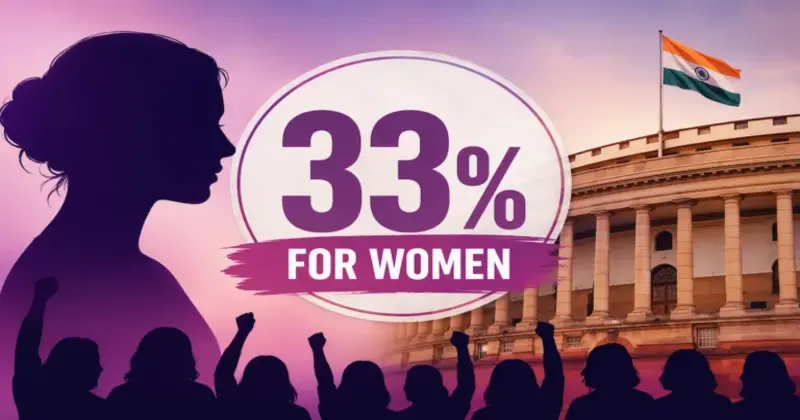
Recently, the Nari Shakti Vandan Bill(the 131st Constitutional Amendment Bill), introduced to provide 33 per cent reservation for women starting from the 2029 elections, failed to pass in Parliament due to the lack of a two-thirds majority. This ambitious vision of the central government fell victim to political calculations. The incident compels us to reconsider the complexities and priorities of Indian politics. It is worth reflecting: is women’s representation merely an electoral issue?
The question of women’s reservation has remained pending for decades. It is not just a legislative proposal but a revolutionary step toward gender equality. Despite this, does the bill’s failure not indicate that women’s empowerment is still being weighed on the scale of political gains and losses? While the ruling party attempted to demonstrate its commitment through the Prime Minister’s appeal and the Home Minister’s clarifications, the stance of the opposition has left several serious questions unanswered: Was the opposition truly committed to women’s empowerment? Were technical issues like delimitation more important than women’s representation? Was the politics of “opposition for the sake of opposition” a compulsion or a deliberate strategy? Do regional party leaders fear that implementing reservation would weaken their family-based political dominance?
Some sections of the opposition argued that there should be separate provisions within the reservation for women belonging to PDA. While this argument may hold theoretical importance, was it justified to reject the entire bill on this basis? Is outright rejection of reform the solution?; Political parties could have supported the bill while ensuring internal mechanisms within their own organizations to provide representation to backward, Dalit and tribal communities.
It appears that opposition parties viewed this not as a matter of social justice but merely as a political maneuver. This outcome in Parliament compels the entire nation to reflect: is our political class mentally prepared to embrace the ideal of constitutional equality? In my view, without granting women their rightful place in policy-making, the dream of a truly “empowered India” can never be realized.