Samajbadi vs Namazbadi: Vote bank over women’s rights?
September 20, 2026
  • Read Ecopy
  • Circulation
  • Advertise
  • Careers
  • About Us
  • Contact Us
Android AppiPhone AppArattai
Organiser
  • ‌
  • Bharat
    • Assam
    • Bihar
    • Chhattisgarh
    • Jharkhand
    • Maharashtra
    • View All States
  • World
    • Asia
    • Europe
    • North America
    • South America
    • Africa
    • Australia
  • Editorial
  • International
  • Opinion
  • RSS @ 100
  • More
    • World Hindu Congress 2026
    • Op Sindoor
    • Analysis
    • Sports
    • Defence
    • Politics
    • Business
    • Economy
    • Culture
    • Special Report
    • Sci & Tech
    • Entertainment
    • G20
    • Azadi Ka Amrit Mahotsav
    • Vocal4Local
    • Web Stories
    • Education
    • Employment
    • Books
    • Interviews
    • Travel
    • Law
    • Health
    • Obituary
  • Subscribe
    • Subscribe Print Edition
    • Subscribe Ecopy
    • Read Ecopy
  • ‌
  • Bharat
    • Assam
    • Bihar
    • Chhattisgarh
    • Jharkhand
    • Maharashtra
    • View All States
  • World
    • Asia
    • Europe
    • North America
    • South America
    • Africa
    • Australia
  • Editorial
  • International
  • Opinion
  • RSS @ 100
  • More
    • World Hindu Congress 2026
    • Op Sindoor
    • Analysis
    • Sports
    • Defence
    • Politics
    • Business
    • Economy
    • Culture
    • Special Report
    • Sci & Tech
    • Entertainment
    • G20
    • Azadi Ka Amrit Mahotsav
    • Vocal4Local
    • Web Stories
    • Education
    • Employment
    • Books
    • Interviews
    • Travel
    • Law
    • Health
    • Obituary
  • Subscribe
    • Subscribe Print Edition
    • Subscribe Ecopy
    • Read Ecopy
Organiser
  • Home
  • Bharat
  • World
  • Operation Sindoor
  • Editorial
  • Analysis
  • Opinion
  • Culture
  • Defence
  • International Edition
  • RSS @ 100
  • Magazine
  • Read Ecopy
Home Politics

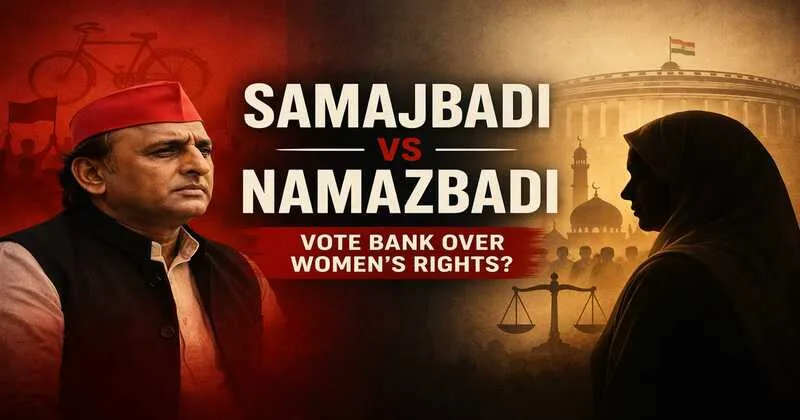
Samajbadi vs Namazbadi: Vote bank over women’s rights?

At a moment when India appeared to be moving towards a rare political consensus on the long-pending Women’s Reservation Bill, an unexpected divergence has reopened a deeper ideological faultline. The position adopted by Akhilesh Yadav and the Samajwadi Party(SP) linking support for the Bill to a separate quota for Muslim women has triggered a debate that goes beyond legislative nuance and enters the terrain of political intent

Adv Karan ThakurAdv Karan Thakur
Apr 18, 2026, 07:50 pm IST
inPolitics, Bharat, Analysis
Follow on Google News
Facebook
Twitter
WhatsAppTelegramEmail

As India moves toward a historic milestone in women’s political representation, the Samajwadi Party’s conditional support, demanding religion-based sub-quotas, raises a larger question: is this a principled stand for inclusion or a strategic play to recalibrate electoral loyalties at the cost of a broader reform?

At a moment when India appeared to be moving towards a rare political consensus on the long-pending Women’s Reservation Bill, an unexpected divergence has reopened a deeper ideological faultline. The position adopted by Akhilesh Yadav and the Samajwadi Party(SP) linking support for the Bill to a separate quota for Muslim women has triggered a debate that goes beyond legislative nuance and enters the terrain of political intent.

The Bill, which seeks to reserve 33 per cent of seats in the Lok Sabha and State Assemblies for women from 2029 onward, represents a historic step in correcting structural underrepresentation. Decades in the making, it has enjoyed broad, cross-party endorsement. However, the SP’s insistence that the legislation must incorporate religion-based sub-quotas raises a fundamental question: is this an expansion of social justice or a recalibration of identity politics?

This is not merely a disagreement over policy design; it is a conditional opposition. By tying support to a specific community-based demand, the SP has effectively reframed a gender-centric reform into a communal debate. Such a shift is significant, particularly in a constitutional framework that has historically resisted religion-based reservations. The Constituent Assembly, after extensive deliberation, consciously rejected such provisions, wary of their potential to reintroduce divisions that the Republic sought to transcend.

A closer look at the SP’s own political record complicates its current stance. Over more than three decades, the representation of Muslim women within the party’s parliamentary ranks has remained minimal. The numbers tell a story of limited structural inclusion. If genuine empowerment was the objective, internal party mechanisms ticket distribution, leadership grooming, organizational representation could have reflected that commitment long ago. The present insistence, therefore, appears less as a sustained reformist position and more as a situational political intervention.

The broader political context cannot be ignored. In a competitive electoral landscape, particularly in states like Uttar Pradesh, the contest over minority vote consolidation remains intense. The positioning of the SP, alongside similar articulations from other parties, suggests a calibrated attempt to signal ideological alignment with specific voter blocs. In this framing, the Women’s Reservation Bill becomes not just a policy instrument, but a political platform.

Also Read: Why Women’s Reservation Bill Failed Despite a Majority: Two-Thirds ‘Special Majority’ in Constitution Bill Explained!

This pattern is not unprecedented. Major reforms in India have often encountered conditionalities that dilute their universality. The introduction of additional criteria especially those rooted in identity segmentation risks fragmenting what is otherwise a unifying legislative objective. Women’s representation, by its very nature, cuts across caste, class and religion. To tether it to a singular identity axis risks undermining its transformative potential.

There is also a deeper concern. When political discourse consistently frames rights through the lens of “who gets how much”, it subtly shifts the narrative from empowerment to entitlement competition. This not only complicates policymaking but also affects social cohesion. A rights-based framework anchored in constitutional morality must strive for inclusion without reinforcing divisions.

None of this negates the genuine challenges faced by Muslim women or any other marginalized group. Their concerns merit attention, policy innovation and targeted welfare interventions. But the question is one of method and timing. Should a foundational reform be contingent upon additional layers of identity-based negotiation? Or should it be enacted first, creating a broader platform upon which further refinements can be built?

Ultimately, the Women’s Reservation Bill is a milestone in India’s democratic evolution. Its success lies in its ability to transcend narrow political calculations and deliver substantive representation. Any attempt to reframe it through sectarian lenses risks diluting both its intent and its impact. The current debate, therefore, is not just about one Bill or one party. It is about the direction of Indian politics itself, whether it moves toward broader inclusion rooted in constitutional values or continues to oscillate within the familiar confines of identity-driven mobilization.


Topics: Lok SabhaSamajwadi PartyAkhilesh YadavpoliticsWomen Reservation Bill
Share
Tweet
SendShareSend
✮ Subscribe Organiser YouTube Channel. ✮
✮ Join Organiser's WhatsApp channel for Nationalist views beyond the news. ✮
Previous News

Nashik TCS Jihad: Is Diversity, Equity and Inclusion policy the underlying source of the problem?

Next News

Beyond the Migration Binary: Maximising national potential by narrowing information gaps

Related News

AI Generated Representative Image

“Let Go” — But only when it suits you? Exposing the double standards of Kashmir’s political leadership

The Bottle, the Broom & the Cockroach: How intoxication makes history and suffering disappear!

Akhilesh meets CJP co-convener Ashutosh Ranka behind closed doors

Akhilesh Yadav’s secret 90 minute meet with CJP’s Ashutosh Ranka: What’s brewing behind closed doors?

Representative Image

The Battle for the Narrative: Bharat and the Politics of Perception

AI Generated Image

Vande Mataram and the Politics of Appeasement: Is Congress repeating the Khilafat mistake of 1919?

Jadavpur University: When politics collides with a nationalist legacy

Load More

Latest News

BMS launches National Organisation for Digital Employees (NODE) for IT workforce; aims to strengthen employee welfare

GalaxEye’s US patent for OptoSAR marks a major boost for India’s private space sector, advancing its global Earth-observation ambitions

GalaxEye secures US patent for OptoSAR technology, boosting India’s private space and deep-tech ambitions

The arrested Bangladeshi national

Keralam: Series of Bangladeshi arrests raises questions over alleged support ecosystem of fake IDs, jobs and shelter

The Indian Army has launched AASHVAST to detect hidden software and electronic vulnerabilities in military drones

Indian Army strengthens drone security with AASHVAST lab to detect software vulnerabilities & Chinese components

Nileema Mishra’s grassroots work empowered women and helped transform more than 200 villages across Maharashtra

Nileema Mishra: The woman who transformed more than 200 villages across rural Maharashtra

Shree Stambheshwar Mahadev Mandir in Gujarat

Shiva Mandir that disappears into the sea and returns with the tide: The fascinating story of Stambheshwar Mahadev

Vishwa Hindu Parishad (VHP) spokesperson Surendra Jain (file photo0

VHP condemns Hamid Ansari over remarks citing Nehru on Hindu right-wing communalism

Ganesh murti visarjan incidents raise concerns over radical Islamic intolerance and law and order in Tamil Nadu

ABVP registers 3-0 win in Delhi University Students’ Union elections; wins president, secretary, joint secretary posts

Ganapati murti visarjan procession at T. Narasipura on September 18

Karnataka: Ganapati procession follows approved mosque route in T Narasipura amid allegations of police high-handedness

Load More
  • Privacy
  • Terms
  • Cookie Policy
  • Refund and Cancellation
  • Delivery and Shipping

© Bharat Prakashan (Delhi) Limited.
Tech-enabled by Ananthapuri Technologies

  • Home
  • Search Organiser
  • Bharat
    • Assam
    • Bihar
    • Chhattisgarh
    • Jharkhand
    • Maharashtra
    • View All States
  • World
    • Asia
    • Africa
    • North America
    • South America
    • Europe
    • Australia
  • Editorial
  • Operation Sindoor
  • Opinion
  • Analysis
  • Defence
  • Culture
  • Sports
  • Business
  • RSS @ 100
  • Entertainment
  • More ..
    • Sci & Tech
    • Vocal4Local
    • Special Report
    • Education
    • Employment
    • Books
    • Interviews
    • Travel
    • Health
    • Politics
    • Law
    • Economy
    • Obituary
  • Subscribe Magazine
  • Read Ecopy
  • Advertise
  • Circulation
  • Careers
  • About Us
  • Contact Us
  • Policies & Terms
    • Privacy Policy
    • Cookie Policy
    • Refund and Cancellation
    • Terms of Use

© Bharat Prakashan (Delhi) Limited.
Tech-enabled by Ananthapuri Technologies