Samajbadi vs Namazbadi: Vote bank over women’s rights?
June 23, 2026
  • Read Ecopy
  • Circulation
  • Advertise
  • Careers
  • About Us
  • Contact Us
Android AppiPhone AppArattai
Organiser
  • ‌
  • Bharat
    • Assam
    • Bihar
    • Chhattisgarh
    • Jharkhand
    • Maharashtra
    • View All States
  • World
    • Asia
    • Europe
    • North America
    • South America
    • Africa
    • Australia
  • Editorial
  • International
  • Opinion
  • RSS @ 100
  • More
    • Op Sindoor
    • Analysis
    • Sports
    • Defence
    • Politics
    • Business
    • Economy
    • Culture
    • Special Report
    • Sci & Tech
    • Entertainment
    • G20
    • Azadi Ka Amrit Mahotsav
    • Vocal4Local
    • Web Stories
    • Education
    • Employment
    • Books
    • Interviews
    • Travel
    • Law
    • Health
    • Obituary
  • Subscribe
    • Subscribe Print Edition
    • Subscribe Ecopy
    • Read Ecopy
  • ‌
  • Bharat
    • Assam
    • Bihar
    • Chhattisgarh
    • Jharkhand
    • Maharashtra
    • View All States
  • World
    • Asia
    • Europe
    • North America
    • South America
    • Africa
    • Australia
  • Editorial
  • International
  • Opinion
  • RSS @ 100
  • More
    • Op Sindoor
    • Analysis
    • Sports
    • Defence
    • Politics
    • Business
    • Economy
    • Culture
    • Special Report
    • Sci & Tech
    • Entertainment
    • G20
    • Azadi Ka Amrit Mahotsav
    • Vocal4Local
    • Web Stories
    • Education
    • Employment
    • Books
    • Interviews
    • Travel
    • Law
    • Health
    • Obituary
  • Subscribe
    • Subscribe Print Edition
    • Subscribe Ecopy
    • Read Ecopy
Organiser
  • Home
  • Bharat
  • World
  • Operation Sindoor
  • Editorial
  • Analysis
  • Opinion
  • Culture
  • Defence
  • International Edition
  • RSS @ 100
  • Magazine
  • Read Ecopy
Home Politics

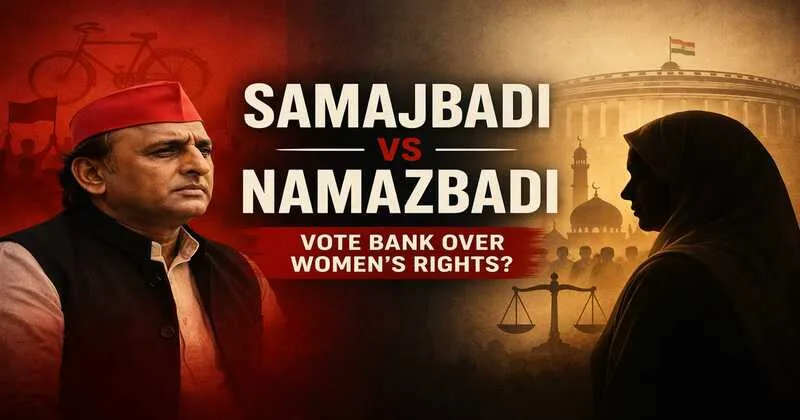
Samajbadi vs Namazbadi: Vote bank over women’s rights?

At a moment when India appeared to be moving towards a rare political consensus on the long-pending Women’s Reservation Bill, an unexpected divergence has reopened a deeper ideological faultline. The position adopted by Akhilesh Yadav and the Samajwadi Party(SP) linking support for the Bill to a separate quota for Muslim women has triggered a debate that goes beyond legislative nuance and enters the terrain of political intent

Adv Karan ThakurAdv Karan Thakur
Apr 18, 2026, 07:50 pm IST
in Politics, Bharat, Analysis
Follow on Google News
FacebookTwitterWhatsAppTelegramEmail

As India moves toward a historic milestone in women’s political representation, the Samajwadi Party’s conditional support, demanding religion-based sub-quotas, raises a larger question: is this a principled stand for inclusion or a strategic play to recalibrate electoral loyalties at the cost of a broader reform?

At a moment when India appeared to be moving towards a rare political consensus on the long-pending Women’s Reservation Bill, an unexpected divergence has reopened a deeper ideological faultline. The position adopted by Akhilesh Yadav and the Samajwadi Party(SP) linking support for the Bill to a separate quota for Muslim women has triggered a debate that goes beyond legislative nuance and enters the terrain of political intent.

The Bill, which seeks to reserve 33 per cent of seats in the Lok Sabha and State Assemblies for women from 2029 onward, represents a historic step in correcting structural underrepresentation. Decades in the making, it has enjoyed broad, cross-party endorsement. However, the SP’s insistence that the legislation must incorporate religion-based sub-quotas raises a fundamental question: is this an expansion of social justice or a recalibration of identity politics?

This is not merely a disagreement over policy design; it is a conditional opposition. By tying support to a specific community-based demand, the SP has effectively reframed a gender-centric reform into a communal debate. Such a shift is significant, particularly in a constitutional framework that has historically resisted religion-based reservations. The Constituent Assembly, after extensive deliberation, consciously rejected such provisions, wary of their potential to reintroduce divisions that the Republic sought to transcend.

A closer look at the SP’s own political record complicates its current stance. Over more than three decades, the representation of Muslim women within the party’s parliamentary ranks has remained minimal. The numbers tell a story of limited structural inclusion. If genuine empowerment was the objective, internal party mechanisms ticket distribution, leadership grooming, organizational representation could have reflected that commitment long ago. The present insistence, therefore, appears less as a sustained reformist position and more as a situational political intervention.

The broader political context cannot be ignored. In a competitive electoral landscape, particularly in states like Uttar Pradesh, the contest over minority vote consolidation remains intense. The positioning of the SP, alongside similar articulations from other parties, suggests a calibrated attempt to signal ideological alignment with specific voter blocs. In this framing, the Women’s Reservation Bill becomes not just a policy instrument, but a political platform.

Also Read: Why Women’s Reservation Bill Failed Despite a Majority: Two-Thirds ‘Special Majority’ in Constitution Bill Explained!

This pattern is not unprecedented. Major reforms in India have often encountered conditionalities that dilute their universality. The introduction of additional criteria especially those rooted in identity segmentation risks fragmenting what is otherwise a unifying legislative objective. Women’s representation, by its very nature, cuts across caste, class and religion. To tether it to a singular identity axis risks undermining its transformative potential.

There is also a deeper concern. When political discourse consistently frames rights through the lens of “who gets how much”, it subtly shifts the narrative from empowerment to entitlement competition. This not only complicates policymaking but also affects social cohesion. A rights-based framework anchored in constitutional morality must strive for inclusion without reinforcing divisions.

None of this negates the genuine challenges faced by Muslim women or any other marginalized group. Their concerns merit attention, policy innovation and targeted welfare interventions. But the question is one of method and timing. Should a foundational reform be contingent upon additional layers of identity-based negotiation? Or should it be enacted first, creating a broader platform upon which further refinements can be built?

Ultimately, the Women’s Reservation Bill is a milestone in India’s democratic evolution. Its success lies in its ability to transcend narrow political calculations and deliver substantive representation. Any attempt to reframe it through sectarian lenses risks diluting both its intent and its impact. The current debate, therefore, is not just about one Bill or one party. It is about the direction of Indian politics itself, whether it moves toward broader inclusion rooted in constitutional values or continues to oscillate within the familiar confines of identity-driven mobilization.


Topics: Lok SabhaSamajwadi PartyAkhilesh YadavpoliticsWomen Reservation Bill
ShareTweetSendShareSend
✮ Subscribe Organiser YouTube Channel. ✮
✮ Join Organiser's WhatsApp channel for Nationalist views beyond the news. ✮
Previous News

Nashik TCS Jihad: Is Diversity, Equity and Inclusion policy the underlying source of the problem?

Next News

Beyond the Migration Binary: Maximising national potential by narrowing information gaps

Related News

Aligarh police arrest Anwar Hussain, brother of Samajwadi Party leader in beef smuggling case

Beef Smuggling Case in Uttar Pradesh: Samajwadi Party leader Sarwar Hussain’s brother Anwar arrested in Aligarh

Purvanchal’s industrial rise under the double-engine government reflects growing investment, ODOP exports, factories, and jobs across eastern UP

How UP’s double-engine government transformed Purvanchal from an industrial backwater into a rising economic powerhouse

Former Chief Minister Siddaramaiah and his wife Parvathi is accused in MUDA site allotment case

Karnataka: Congress govt under fire over Yathindra’s appointment amid pending MUDA-linked controversy

An eternal civilization cannot be eradicated! The Sanatana Dharma debate beyond politics and ideology

Uttar Pradesh Chief Minister Yogi Adityanath

Two terms, one transformation: How Yogi Adityanath rewrote rules of governing Uttar Pradesh

Prateek Yadav, Mulayam Singh Yadav’s younger son, passes away in Lucknow

Prateek Yadav, Akhilesh’s stepbrother and BJP leader Aparna Yadav’s husband, dies at 38; Yogi condoles

Load More

Latest News

Female recruitment in Jihadist networks emerges as major security concern

Khadija Terror Case: Female recruitment, online radicalisation in Jihadi networks poses major security concern

Outcry grows after Dalits in Theeyathur village carry deceased woman across paddy fields due to lack of burial access

Tamil Nadu: Dalits forced to carry deceased woman through paddy fields as Pudukkottai village lacks road access

ASI transfers Rakhigarhi skeletal remains to Anthropological Survey of India for detailed examination

Rakhigarhi’s ancient secrets to be unveiled as human skeletal remains reach AnSI for advanced scientific analysis

Dr Syama Prasad Mookerjee: A Life That Still Guides Bharat’s National Resolve

(Left) Maoist Arms seized (Right) Security personnel with the seized arms of Maoists

Odisha: Major Maoist arms cache recovered in Koraput, sixth such seizure within two weeks

Delhi Chief Minister Rekha Gupta paid tribute to Bharatiya Jana Sangh founder Syama Prasad Mookerjee on his death anniversary

Article 370 abrogation was the greatest tribute to Syama Prasad Mookerjee: Delhi CM Rekha Gupta

Prime Minister Narendra Modi

Viksit Bharat: PM Modi slams Congress — ‘Blocks development, claims credit’

(Left) Petrol bomb hurled at BJP leader’s clinic opposite newly inaugurated RSS office in Bhatinda (Right) BJP leader Dr Tarsem Garg

Punjab: Petrol bomb hurled at BJP leader’s clinic opposite newly inaugurated RSS office in Bhatinda

Functionaries of Akhil Bharatiya Rashtriya Seva Bharati on the stage release Rashtriya Seva Sadhana–2026

Tamil Nadu: Seva Bharati reviews service initiatives, charts roadmap for future expansion

PM Modi Pays Homage to Jan Sangh Founder Syama Prasad Mookerjee

Balidan Diwas: PM Modi pays tribute to Jan Sangh founder Syama Prasad Mookerjee, hails his nationalist legacy

Load More
  • Privacy
  • Terms
  • Cookie Policy
  • Refund and Cancellation
  • Delivery and Shipping

© Bharat Prakashan (Delhi) Limited.
Tech-enabled by Ananthapuri Technologies

  • Home
  • Search Organiser
  • Bharat
    • Assam
    • Bihar
    • Chhattisgarh
    • Jharkhand
    • Maharashtra
    • View All States
  • World
    • Asia
    • Africa
    • North America
    • South America
    • Europe
    • Australia
  • Editorial
  • Operation Sindoor
  • Opinion
  • Analysis
  • Defence
  • Culture
  • Sports
  • Business
  • RSS @ 100
  • Entertainment
  • More ..
    • Sci & Tech
    • Vocal4Local
    • Special Report
    • Education
    • Employment
    • Books
    • Interviews
    • Travel
    • Health
    • Politics
    • Law
    • Economy
    • Obituary
  • Subscribe Magazine
  • Read Ecopy
  • Advertise
  • Circulation
  • Careers
  • About Us
  • Contact Us
  • Policies & Terms
    • Privacy Policy
    • Cookie Policy
    • Refund and Cancellation
    • Terms of Use

© Bharat Prakashan (Delhi) Limited.
Tech-enabled by Ananthapuri Technologies