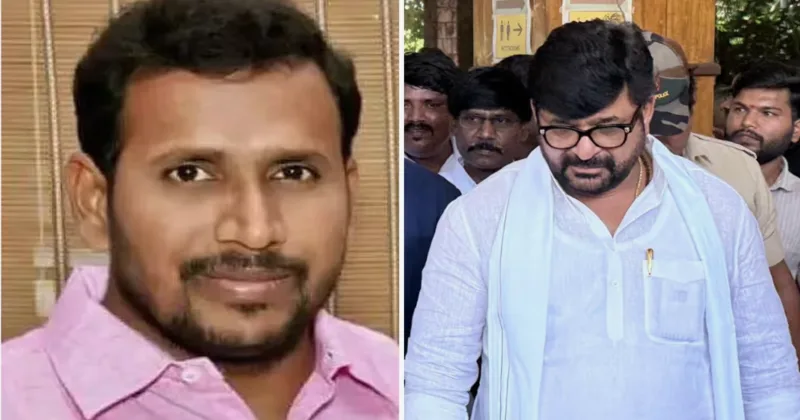
DHARWAD: In a landmark judgment that has sent shockwaves across Karnataka’s political landscape, a special court for elected representatives has sentenced Congress leader and MLA Vinay Kulkarni to life imprisonment in connection with the murder of BJP leader Yogesh Gowda.
The court, which had on April 16 convicted 17 accused in the case, pronounced sentencing on April 17 awarding life imprisonment to 16 individuals, including Kulkarni. Another accused, Channakeshava Tingarikar (A19), was sentenced to seven years in prison. The court also upheld the approver status of prime accused Basavaraj Muttagi.
Additionally, the court directed that a compensation of Rs 16 lakh be paid to the family of the deceased Yogesh Gowda, offering some relief to the bereaved family after nearly a decade-long legal battle.
The verdict has major political ramifications, particularly for Kulkarni, whose MLA post now faces disqualification under the Representation of the People Act. Legal experts say the conviction could automatically lead to his removal from the assembly, marking a significant fall for the senior congress leader.
Out of the 21 accused in the case, two had turned approvers. The court found 19 accused guilty, while two others A20 Vasudev Nilekani and A21 Somashekar were acquitted earlier. Interestingly, A17 Shivanand, who had initially turned approver, later gave a hostile statement, prompting the CBI to move an application seeking to treat him again as an accused.
The court also imposed fines under various sections of law on the convicted individuals. Following the sentencing, Kulkarni’s counsel Sunil made a request before the court, stating that the MLA had been wearing the same clothes for three days and sought permission to change attire. The judge directed prison authorities to provide clothing as per jail manual provisions.
Case background and political turn
The case dates back to June 15, 2016, when Yogesh Gowda, a former Zilla Panchayat member, was brutally hacked to death by assailants inside a gym in Saptapur locality of Dharwad. The murder, carried out with lethal weapons, had triggered widespread outrage at the time.
Initially investigated by Dharwad suburban police, the case was believed to be linked to a property dispute, and a charge sheet was filed against six individuals. However, the victim’s family alleged a larger conspiracy and demanded a more thorough probe.
Responding to sustained pressure, the case was handed over to the Central Bureau of Investigation (CBI) in 2019. The CBI’s investigation took a dramatic turn, concluding that the murder was politically motivated. This shifted the trajectory of the case and brought Kulkarni under the scanner.
On November 5, 2020, CBI officials arrested Kulkarni, alleging his involvement in orchestrating the crime. A comprehensive charge sheet was subsequently filed against 21 accused, including the MLA. Though Kulkarni later secured bail, the case continued in the special court designated for public representatives.
Wider implications
The conviction and sentencing mark a crucial moment in Karnataka politics, underlining the increasing scrutiny of criminal cases involving elected representatives. The ruling is likely to intensify political debates, especially between the ruling and opposition parties.
For the Congress party, the verdict poses both legal and political challenges, while the BJP is expected to leverage the development to target its rival. Meanwhile, legal proceedings may continue, with appeals in higher courts likely.
As the dust settles, the case stands as a significant example of how prolonged legal battles in politically sensitive incident can eventually reach a decisive conclusion, reshaping careers and sending strong signals about accountability in public life.