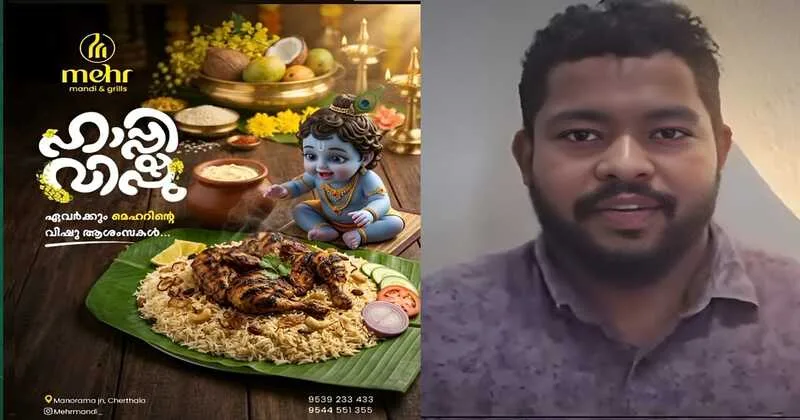
Alappuzha: A Vishu-themed promotional campaign by Meher Mandi & Grills, a hotel group based in Cherthala in Keralam’s Alappuzha district, has triggered strong reactions for depicting Bhagwan Krishna alongside a non-vegetarian dish. Mehr, an organisation operating near the Cherthala North Market Central Juma Masjid, has come out with an advertisement that incites communal hatred.
The controversial hotel is owned by Mohammed Shemir, son of a leader associated with the Indian Union Muslim League in Cherthala; Shemir, along with Arshad and Shamnad, is among the nine owners of the restaurant. The advertisement, released during one of the most sacred Hindu festivals in Keralam, has intensified concerns over what is increasingly seen as a continuing pattern of disregard towards Hindu traditions in the name of freedom of expression.
Vishu, the Malayalam New Year, is not merely a cultural event but a deeply spiritual occasion rooted in ritual purity, symbolism, and devotion. The day begins with Vishukkani, an arrangement of auspicious items such as rice, fruits, vegetables, gold, and sacred objects, viewed at dawn as the first sight of the new year. Bhagwan Krishna holds a central place in many Vishu observances, with households offering prayers seeking prosperity, harmony, and divine blessings for the year ahead.
Within this sacred framework, the use of a stylised image of Krishna in close proximity to a meat-based dish has been widely perceived as a violation of religious sanctity. For many devotees, festivals like Vishu are observed with strict adherence to purity, including vegetarian practices and ritual discipline. The placement of a revered deity next to a non-vegetarian platter is therefore seen not as a neutral creative choice, but as a deliberate crossing of cultural and religious boundaries.
Leaders condemn Vishu ad, call it deliberate insult to Hindu faith
Reacting strongly to the issue, Hindu Aikyavedi leader KP Sasikala teacher, said that “This is the Vishu greeting card of the establishment ‘Meher Mandi & Grills’, located on the north side of Manorama Junction in Cherthala in Alappuzha district. They have placed biryani in front of Bhagwan Krishna and put fried chicken on top of it, and released it as a Vishu greeting card. Is this merely a Vishu greeting card? This kind of shameless act should not be tolerated. That shop has not been opened just for business; like what was seen in the TCS incident, there is malicious intent behind this. Therefore, it can be expected that the authorities themselves will shut down that shop. Otherwise, devotees of Krishna will have to take up that task. That will not be a pleasant arrangement.”
Reacting to the controversy, VHP State General Secretary Anil Vilayil said that this cannot be dismissed as a mere greeting card or an act of freedom of expression by an organisation run by Mohammed Shemir and his associates in Cherthala. He stated that the advertisement appears to have been created after deliberate thought and planning. He further remarked that this reflects a broader pattern seen in recent days, where references to beef, pork, and related issues have been repeatedly invoked in ways that provoke and offend. He questioned whether such actions could be seen as anything other than deeply indecent, and asked why there is a growing tendency to portray Hindu places of worship and deities in a manner that many find disrespectful.
According to him, the persistence of such incidents raises a larger concern about the perceived silence of sections of society, which, he suggested, may be enabling the continuation of such acts. Protests are set to be held today in front of the hotel, led by Hindu organisations including the VHP.
Debate deepens over sacred symbols and selective freedom of expression
The episode is being viewed in the context of a broader and recurring trend where Hindu symbols, deities, and festivals are used in ways that appear to disregard their sacred meaning. The justification often offered in such instances is that of freedom of expression or artistic liberty. However, the selective nature of such expressions has raised questions about whether similar portrayals would be considered acceptable in relation to other religious traditions.
Bhagwan Krishna, one of the most widely worshipped deities in Hinduism, represents dharma, compassion, and divine playfulness. His imagery carries profound spiritual significance and is embedded in centuries of devotion, literature, and cultural practice. Reducing such a figure to a decorative or promotional element, particularly in a context that contradicts established norms of reverence, is seen as diminishing that significance. Vishu, in particular, is a festival where faith is expressed through discipline, symbolism, and continuity of ancestral practices. Any perceived distortion of these elements is not viewed in isolation but as part of a larger erosion of respect for sacred traditions.
The controversy surrounding the advertisement has once again brought attention to the boundaries between expression and responsibility. Freedom of expression, while fundamental, does not exist in a vacuum and carries with it an obligation to avoid causing offence to deeply held beliefs. As Vishu is celebrated across Keralam with devotion and ritual observance, the incident underscores a growing unease about how sacred symbols are being engaged with in public spaces. It raises a larger question of whether the repeated use of Hindu religious imagery in contentious contexts is an oversight, or part of a continuing pattern that normalises insensitivity towards one of the world’s oldest living traditions.