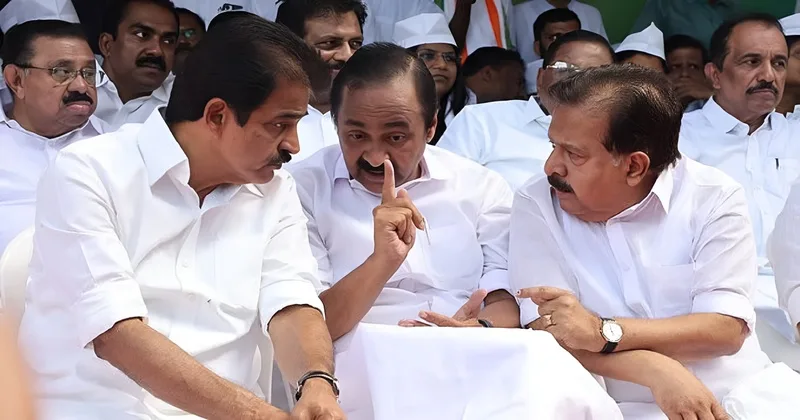
Kannur: The Congress has begun positioning itself for the Chief Minister’s post, confident that the UDF will return to power when the election results are declared on May 4. What was earlier kept under wraps has now turned into an open contest, with multiple senior leaders entering the fray and exposing clear signs of infighting within the party.
Apart from Opposition Leader V. D. Satheesan, who contested in the Assembly elections, and former Opposition Leader Ramesh Chennithala, AICC General Secretary K. C. Venugopal has also emerged as a strong contender for the top post. In a significant political development, former KPCC president K. Sudhakaran has come out with open support for Venugopal.
Sudhakaran’s open backing sparks debate
Sudhakaran publicly endorsed Venugopal for the Chief Minister’s position, stating that he hopes “KC will rise as a leader who gives direction to the administration.” He emphasised that Venugopal has the ability to lead Keralam’s politics with clarity and purpose, adding that he is eagerly awaiting such leadership.
The endorsement has raised eyebrows within party circles, especially because Sudhakaran had earlier strongly advocated for Ramesh Chennithala as the Chief Ministerial candidate. His sudden shift in support towards Venugopal has surprised many and added to the growing perception of factional manoeuvring within the Congress.
At the same time, Sudhakaran’s remarks are being interpreted as carrying subtle criticism aimed at V. D. Satheesan. His observation that only leaders who have grown through the grassroots and experienced every level of organisational work can truly understand the mindset of party workers is widely seen as an indirect dig at Satheesan’s leadership style.
Grassroots credentials vs emerging leadership
Sudhakaran further argued that the last Assembly elections demonstrated the importance of Venugopal’s presence in Keralam politics. Despite his significant responsibilities at the national level as a trusted confidant of Rahul Gandhi, Venugopal was able to energise grassroots workers and instil confidence among candidates. He expressed confidence that Venugopal could lead the state by following the legacy of stalwarts such as K. Karunakaran, A. K. Antony, and Oommen Chandy. According to Sudhakaran, true leadership is defined not by positions held but by a tradition of work and deep connection with the party base, qualities he believes Venugopal embodies.
Highlighting Venugopal’s strengths, Sudhakaran noted that his steadfastness during crises and humility towards workers distinguish him from others. “His strength lies in being a companion to workers rather than merely a leader,” he said. He concluded by expressing hope that Venugopal would inspire both the people and party workers of Keralam while providing direction to future governance, just as he continues to strengthen the national leadership.
Post-poll scenario fuels open contest
During the election campaign, the Congress leadership deliberately avoided discussing the Chief Ministerial candidate. The official line was that the party high command would take a final decision after the results. This strategy was aimed at preventing internal discord and avoiding potential protests from party workers that could weaken the UDF’s electoral prospects. However, once polling concluded on April 9, the internal competition has become increasingly visible. Leaders who were earlier cautious have now begun actively staking their claims, and the factional undercurrents have surfaced more openly. A vigorous campaign has also emerged on social media platforms, primarily in support of Satheesan and Venugopal. Venugopal, in particular, is being projected by his supporters as a “real leader” who guided the party through crises and played a key role in devising electoral strategies.
Signals from party leadership
KPCC President Sunny Joseph, who is himself contesting in the elections, did not dismiss Venugopal’s chances while addressing the media. He pointed out that the AICC follows its own procedures in selecting the Chief Minister and that multiple names could be considered for the post. “The decision is not based solely on the majority opinion of MLAs, though their views will also be taken into account,” Sunny Joseph stated. Notably, he became KPCC president last year with the backing of Venugopal, adding another layer to the internal political dynamics.
Meanwhile, in Ernakulam, Satheesan’s home district, DCC President Mohammed Shias made a pointed remark, stating that the next Chief Minister should come from Ernakulam. “We hope that there will be a Chief Minister from Ernakulam. The party has to take the final decision,” he said, clearly indicating support for Satheesan.
Chennithala Camp Reasserts Claim
Following these developments, Ramesh Chennithala addressed the media, expressing confidence in a UDF victory. He credited Rahul Gandhi for leading the campaign, fostering unity among party leaders, and closely monitoring election activities. At the same time, Chennithala reiterated that the decision on the Chief Minister would rest with the party high command and should not be debated publicly in Keralam. He also cautioned against taking social media narratives too seriously.
Within the party, Chennithala continues to be seen as the most senior among the contenders. He served as Opposition Leader from 2016 to 2021 and was widely considered the natural choice for Chief Minister had the Congress won the 2021 Assembly elections. However, the party’s defeat led to his exit from the position.
Supporters in the Chennithala camp argue that he deserves another opportunity. “He is the most senior among them. Satheesan and Venugopal were once his loyalists, and he played a key role in nurturing them within the Congress. Many of his contemporaries at the national level have gone on to become Chief Ministers in other states,” a party leader noted. Several senior leaders, including P. J. Kurien, have already publicly backed Chennithala. However, the stance of newly elected MLAs will be crucial, and many of them are believed to be aligned either with Satheesan or Venugopal, further intensifying the internal contest.
Legacy of factionalism haunts
Congress The ongoing tussle has once again highlighted the Congress party’s long-standing issue of internal divisions in Keralam. Over the decades, Congress-led governments in the state have frequently been marked by factional rivalries and leadership struggles.
Notably, no Congress Chief Minister in recent decades has been able to complete a full five-year term without facing internal challenges. The last Congress government, which ruled from 2011 to 2016 under Oommen Chandy, was also affected by intense power struggles.
Although Chandy remained Chief Minister throughout the term, a faction led by Chennithala later staked claim to the post. The competition for leadership created sustained pressure within the government and contributed to perceptions of instability. Chennithala’s community organisation, the NSS, had also demanded that he be elevated to the Chief Minister’s position during that period. While Oommen Chandy completed the term, his tenure was overshadowed by corruption allegations and controversies linked to factionalism.
As the results day approaches, the Congress finds itself at a critical juncture. What was initially a controlled and strategic silence has now given way to an intense leadership battle, with multiple camps vying for dominance.
The outcome of this internal contest will not only determine who becomes the Chief Minister if the UDF comes to power, but also shape the future direction of the party in Keralam. Whether the high command can manage these competing ambitions without triggering further divisions remains to be seen.