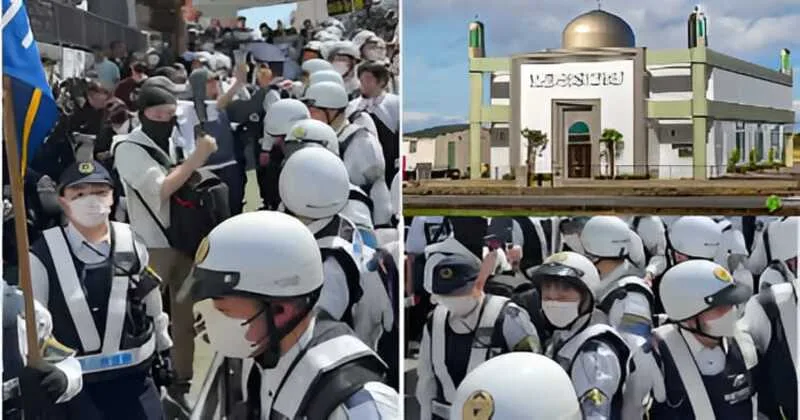
Tokyo: Thousands of residents gathered in the coastal city of Fujisawa in Japan to protest a proposed first mosque project in the Miyahara district, triggering a wider national debate over demographic change and the preservation of Japan’s cultural character. The demonstration reflected growing unease among locals who fear that the construction could alter the identity and rhythm of their neighbourhood in ways that may not be easily reversed.
Rising local opposition and cultural concerns
Protesters voiced strong objections to what could become the city’s first major mosque, with some openly declaring, “We don’t want a single mosque, or Muslim cemetery here!” and arguing that its scale and function would stand in stark contrast to the surrounding environment. Many residents pointed to a nearby Shinto shrine, regarded as an important cultural landmark, and expressed concern that a significantly larger structure could overshadow traditional spaces that embody local heritage. Beyond symbolism, residents raised practical issues. Concerns included increased traffic congestion during prayer times, potential noise associated with religious activities, and unfamiliarity with Islamic customs that could disrupt the established social fabric. For many, the issue is not merely about a building, but about safeguarding a way of life rooted in continuity, predictability, and long-standing cultural norms.
Public meetings on the project have reportedly become tense, with heated exchanges between supporters and opponents occasionally requiring police presence to maintain order. These confrontations highlight the depth of anxiety among residents who feel their voices are not being adequately prioritised in decisions that directly affect their daily lives.
Authorities approve project despite public sentiment
Despite the visible opposition, city authorities have maintained that the mosque proposal complies fully with zoning and development regulations. Officials reiterated that religious buildings are subject to the same planning standards as any other construction, and that legal compliance remains the determining factor in granting approval. The organisation behind the project, often referred to as Fujisawa Masjid, has stated that it intends to follow all local rules and operate responsibly. Representatives have suggested measures to reduce disruption, including keeping the adhan (Islamic call to prayer) indoors and arranging staff to manage traffic during peak hours. However, many residents remain unconvinced, questioning whether such assurances can fully address long-term impacts once the facility becomes operational.
People in Japan have taken to the streets to stop a mosque from being built!
Thousands of Japanese residents in Fujisawa have united in protest against the proposed mosque.
The same old pattern is starting in Japan too — build a mosque, then slowly take over the area and… pic.twitter.com/EqLbfnt2od
— Alpha Wolf 🐺 (@Crazyunfill94) April 12, 2026
Authorities have also reviewed petitions opposing the project but concluded that adherence to legal frameworks must take precedence over public objections. This stance has further intensified frustration among locals who believe that procedural approval should not override the broader responsibility to preserve the character and harmony of established communities.
Demographic shifts and expanding religious infrastructure
The controversy in Japan reflects wider demographic changes. Experts note that the country’s Muslim population has grown significantly over the past decade, increasing from around 110,000 in 2010 to approximately 420,000 by the end of 2024. The number of mosques has also risen sharply, from about 50 in 2008 to more than 160 in recent years.
This growth has largely been driven by international students, migrant workers, and technical trainees from countries such as Indonesia and Pakistan. As these numbers increase, so too does the demand for dedicated prayer spaces, leading to similar construction proposals across Japan. However, several of these projects have faced resistance from local communities concerned about cultural differences and the practical implications of such developments.
In Fujisawa, tensions have been further heightened by political messaging surrounding the issue. Some campaign materials opposing the mosque have warned of potential risks to neighbourhood safety and tranquillity, though critics argue that such claims may be exaggerated. Regardless, these narratives have resonated with sections of the public already uneasy about rapid and visible changes in their surroundings. The planned mosque itself is described as a modest facility on a roughly 1,000-square-metre plot, potentially including a two-storey prayer hall. Supporters frame it as a necessary space for religious practice, but opponents argue that even a modest structure can have disproportionate cultural and social effects in a tightly knit residential area. Observers note that similar disputes in other parts of Japan have sometimes eased over time through dialogue. However, in Fujisawa, many residents remain firm in their position that preserving local culture and maintaining the traditional character of their neighbourhood should take priority over accommodating new developments that may fundamentally alter it.