Dr BR Ambedkar is fiercely independent in his views and practices, and that trait led him to remain outside the Congress party and the freedom movement led by It. His only aim was to achieve social status for his own community, which was kept away from mainstream society. Ambedkar felt that by joining any existing political party, he would become subservient to that party’s leadership and his agenda would be diluted. Moreover, he believed that he could gain greater benefits for his community from the British rulers rather than by joining any party likely to succeed the British. Ambedkar’s pro-British and anti-Congress line suited the colonial masters too.
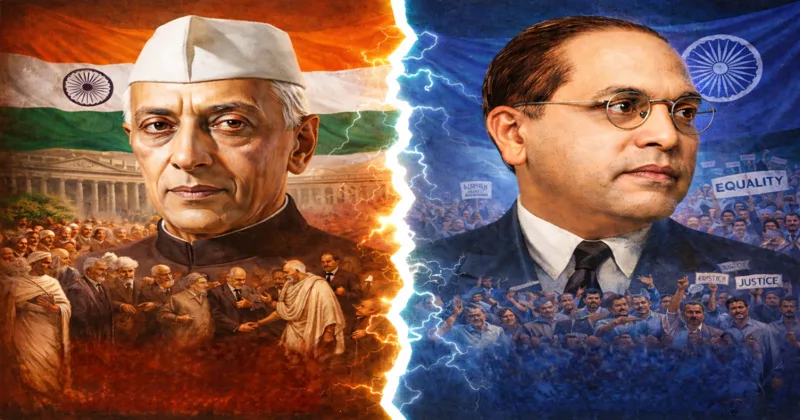
Ambedkar is not impressed with Mahatma Gandhi’s initiatives for the upliftment of Harijans, such as temple entry for Harijans, as he believed they were only cosmetic and fell far short of his aspirations for political empowerment and a share in power. He differed with both Gandhi and Nehru and their ways of running the party. So he took his independent line for political empowerment through his special demand for separate electoral rolls for Scheduled caste people and also for special reserved constituencies where only those designated caste candidates will contest, and only those caste people will vote. That was not acceptable to Gandhi, and he undertook a fast unto death, and Ambedkar was forced to agree, through the Poona Pact, to abandon his idea and settle for reserved constituencies for SCs by signing the pact. The regret of downscaling his demand remained with Ambedkar in subsequent life. He felt his independent line of fighting for the welfare and upliftment of SCs ended with that Poona pact.
Sabita Ambedkar, the wife of B.R. Ambedkar, in her autobiography BABASAHEB-My life with Dr Ambedkar, wrote that “by 1946 his political status had turned quite pitiable” as his demands had been altogether ignored in the document prepared by the Cripps mission and Ambedkar felt that “all his efforts made on behalf of the untouchables had been washed away”. He felt that his own political party, the Scheduled castes Federation (SCF), had fallen into doubt. His contention that he was outsmarted and his agenda was manoeuvred, hijacked by the Congress party.
Amedkar’s big break came when he was elected to the constituent assembly with the indirect support of a group of Congress members other than Nehru. It was on Gandhi’s insistence that Nehru took Ambedkar into his ministry. Gandhi wanted the 1947 government to be a nationalistic one with representatives of all parties that had a role in the freedom struggle. Nehru obliged. Other than the Communists, the Hindu Mahasabha, the Justice Party, the Muslim League, and the Akali Dal were included in the ministry. Perhaps the Communists’ negative role during the Quit India movement was still fresh in Congress’s memory.
The post of chairman of the Constitution Drafting Committee was offered to Ambedkar, and he accepted it solely to protect the interests of SCs, which remained at the top of his agenda throughout. Having successfully completed the onerous task of drafting the Indian Constitution, at the cost of his own health, and getting the approval for every provision he incorporated, Ambedkar took on himself as the next target of codifying the Hindu. On seeing the reluctance of Nehru on the codification at one go, Ambedkar came out of the cabinet, and he almost verbally fought with Nehru for his right to make a statement for resigning from the cabinet, as he argued that in the absence of such an explanation, the fabricated version would go into public. That Ambedkar obtained the right to address the parliament on the resignation became a norm in India subsequently.
Nehru has not taken Ambedkar’s rebellion against him into account, as reflected in the subsequent actions of the Congress party. In 1952, when India held its first general election, one expected a royal entry for Ambedkar into the Lok Sabha, unanimously, as a privilege for the drafter of the constitution. Ambedkar announced his candidature from the reserved North Bombay constituency. What happened from then on is explained by Mrs Sabita Ambedkar in her book, and it is worth quoting.
“Congress had marked it a prestigious seat … and Prime Minister Nehru himself was keeping an eye on the constituency. What we heard then was that Nehru, SK Patil and SA Dange decided that they would do all that was required, use whatever strategy suited for the occasion, but they determined not to let Dr Ambedkar win”. They finally selected Narayanarao Kajrolkar, a chamar, one-time close confidante of Ambedkar, with the promise of membership in the Lok Sabha as the Congress candidate against Ambedkar. It was the moment when the Congress party sowed the seeds of division among SC communities, aiming to break the unity of those communities under the leadership of Ambedkar. It was the first challenge for Ambedkar in independent India, as he was still then considered the unchallenged leader of SC communities. The combined efforts of Nehru and the CPI’s S. A. Dange succeeded in defeating Ambedkar in the election by around 14,000 votes. Sabita Ambedkar and her husband concluded then that “there is no place in the Congress for colossal scholarship, calibre, and abilities. Ambedakr expected his win would compel Nehru to offer him a berth in the cabinet so he could serve the country, but his defeat had an extremely harmful impact on Ambedakr’s health. With the rejection in the election, Ambedkar felt not only disappointed but also led to depression and began despairing for life.
Subsequently, Ambedkar was elected to the Rajya Sabha from Bombay State with the support of other opposition parties, not the Congress. Though he was performing his duties as MP, Ambedkar always wanted to be a people’s elected Member of Parliament. Then came the chance for the Congress party to rectify the mistake of opposing Ambedkar in the election, but the Congress under Nehru continued with its policy of ‘no place for Ambedkar in the Lok Sabha’.
In 1954, came the Bhandara constituency by-election in the Vidharbha area, and Ambedkar announced his intention to contest. In his election campaign, Ambedkar came down heavily on Nehru’s leadership, his method of governance and also his foreign policy. Nehru’s step-motherly attitude towards untouchables was highlighted by Ambedkar. Nehru knew the potential threat to him if Ambedkar were in the Lok Sabha. The Congress party, under Nehru’s instructions, picked up Bhaurao Borkar to stand against Ambedkar. SCs came in large numbers for Babasaheb’s meetings, but Ambedkar lost the election by 8,381 votes. This was the second electoral shock for Ambedkar, and that was so unbearable that he died in the next two years.
Ambedkar had doubts about how elections were conducted, and he lost. Expressing his fears of vote chori, Ambedkar wrote to the elections commission, thus becoming the first candidate to file an election petition. Nehru saw that the petition was not taken up by the ECI. That is how the Congress party treated Ambedkar while he was alive.