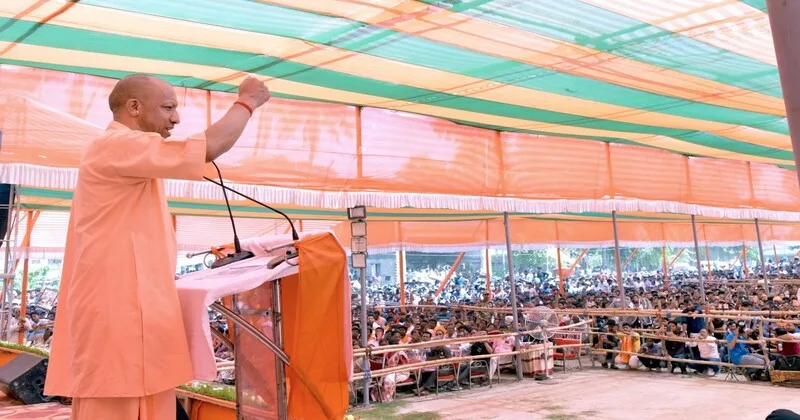
KOLKATA: UP Chief Minister Yogi Adityanath is campaigning in West Bengal ahead of the 2026 Assembly elections; he not only delivered a political speech. He held up a mirror that reflected the possibilities of governance when law, order and development walk together. His words are sharp and unflinching, which draw a genuine comparison between what Bengal was, what it could be again, and what Uttar Pradesh has become after escaping the trap that Bengal now finds itself in.
“Those who say Urdu will be spoken in Bengal will be thrown out,” Yogi warned the Mamta government at the rally, “tell them to go where Urdu is spoken. In Bengal, only Bangla will be spoken.” The remark was a direct response to the Kolkata mayor, who has publicly suggested that half of Bengal’s population would speak Urdu. A statement that sent shockwaves through Bengali cultural circles and gave Yogi’s speech its most resonant moment. The CM challenge was not about language alone. It was about identity, sovereignty and the civilisational soul of a land that gave India Netaji, Vivekananda, Tagore and Bankimchandra.
Bengal’s Glorious Past vs. Its Present Crisis
There is a deep irony in Bengal’s present condition. Once the intellectual, cultural and economic capital of India, contributing over 10 per cent of the national GDP in 1960-61. Bengal today accounts for a mere 5.6% of India’s economy. According to data from the Economic Advisory Council to the Prime Minister, Bengal’s per capita income, which stood at 127.5 per cent of the national average in 1960-61, has now fallen to 83.7 per cent, lower even than traditionally laggard states like Rajasthan and Odisha.
This was once the land of Rabindranath Tagore, Sri Aurobindo, Bankimchandra Chattopadhyay, Raja Ram Mohan Roy, Jagadish Chandra Bose, Ishwar Chandra Vidyasagar, Swami Vivekananda and Dr Shyama Prasad Mookerjee, who famously declared that one nation cannot have two Prime Ministers, two Constitutions and two flags. That same land today suffers from a corporate exodus of historic proportions. Between April 2011 and March 2025, over 6,688 companies shifted their registered offices out of West Bengal more than one company leaving every single day. Among them were 110 listed firms. Capital formation in the state has crashed from 6.7% (2010) to just 2.9 per cent in recent years.
The situation took a turn for the worse in April 2025, when the TMC government scrapped all industrial incentives granted over the past three decades through the Revocation of West Bengal Incentive Schemes Bill 2025. Corporate giants, including Dalmia and Birla Groups, have estimated combined losses of Rs 430 crore, and several companies have challenged the act in the Calcutta High Court as unconstitutional. Union Finance Minister Nirmala Sitharaman said in Parliament, “There are no jobs, no factories, no vision in Kolkata.”
The Crime Conversation: Law and Order
Any comparison of crime between UP and Bengal must begin with an honest acknowledgement of population. Uttar Pradesh, with a population of over 230 million roughly the size of Brazil. Earlier, it recorded the highest absolute number of crime cases in India. But absolute numbers do not tell the full story. What matters are trends, categories and the political will to act.
According to the National Crime Records Bureau (NCRB), West Bengal’s violent crime rate stands at 46.1 per one lakh population, higher than the national average, and the state consistently ranks among the top contributors to violent crime in India. In 2020, West Bengal recorded more than 51 violent crime incidents per lakh persons. In the 2023 NCRB data, West Bengal is listed among states with violent crime rates exceeding the national average.
The pattern of political violence that defines Bengali public life. The 2024 rape and murder at R. G. Kar Medical College and Hospital in Kolkata convulsed the nation, laying bare the rot in women’s safety under TMC governance. Women face harassment across public transport and urban areas with inadequate protection. TMC-linked criminal elements, from syndicate operations to cut-money extortion, operate with near-impunity. Multiple TMC MLAs carry pending criminal cases. Prime Minister Modi, campaigning in Asansol, stated bluntly, “Bengal tops in acid attack cases.”
While UP of 2026 is not the UP of 2016. Yogi Adityanath’s zero-tolerance policy against crime has produced measurable outcomes. In 2025, UP has established 1,500 new police stations, increasing arrests by 20 per cent. The state recruited and trained 60,200 police personnel, simultaneously described by FICCI leadership as an achievement. A UP Police conviction rate of 72 per cent, combined with the legal machinery’s aggressive pursuit of mafia elements, has fundamentally changed the culture of impunity that once defined the state.
Yoginomics vs. TMC Economics of Appeasement
The contrast in economic governance between the two states is crystal clear. When Yogi Adityanath took office in 2017, UP’s annual budget was a mere Rs 2 lakh crore. Today it stands at Rs 8.08 lakh crore a four-fold increase. The state’s GSDP has surged from Rs 12.75 lakh crore in 2017 to Rs 27.51 lakh crore in 2025, growing at 11.6% in 2023-24, outpacing India’s national GDP growth of 9.6%.
UP Global Investors Summit attracted investment proposals worth Rs 40 lakh crore. In FY 2024-25 alone, nearly 4,000 new factories were set up in UP, bringing total industrial units to 27,000 as compared to an average of 500 per year before 2022-23. The state has attracted Rs 17,003 crore in FDI between 2019 and 2025. In terms of ease of doing business, UP rose from rank 14 in 2016-17 to the top achiever nationally. As of 2024-25, UP now accounts for 9% of India’s national GDP, up from 8.6% the previous year, a figure that is rising even as Bengal’s share continues to shrink.
During the campaign, Yogi also highlighted that the UP MSME sector grew, creating employment for 3 crore youth, with 65 lakh jobs added in large industries and 9 lakh-plus in government employment during his tenure. Infrastructure tells its own story UP now has 55 per cent of India’s expressway network, metro rail projects in six cities and India’s first inland waterway between Varanasi and Haldia. What was once derided as the BIMARU state of India is now being called the nation’s growth engine.
While Bengal offers a cautionary tale of what happens when governance prioritises appeasement over aspiration. TMC social welfare expenditures ballooned from 9.6 per cent of total expenditure in pre-2014 election years to 28.2% just before the 2024 elections, a pattern that analysts describe as vote-purchase, not development. The state’s capital formation, the engine of real growth, has collapsed. Over 2,200 companies have left Bengal in five years alone.
The Demographic Threat and the Identity War
Yogi’s speech touched on a concern that transcends electoral politics, the demographic transformation of Bengal. The Central government had sanctioned funds for 570 kilometres of fencing along the Bangladesh border, but the TMC state government has refused to grant clearance. Why? Critics and BJP leaders argue that the answer lies in vote-bank arithmetic, that Bangladeshi infiltrators are being welcomed as electoral foot soldiers.
The concern took on a sharper edge after the fall of Sheikh Hasina’s government in Bangladesh in July 2024. The subsequent rise of extremist forces, including the revival of Jamaat-e-Islami and the persecution of Hindu minorities in Bangladesh, has intensified anxieties about border security. Reports suggest that following the July 2024 revolution, a fresh wave of infiltration across Bengal’s porous borders has accelerated. The geopolitical stakes were underscored when the Bangladesh interim government displayed a map claiming Northeast India and West Bengal as “Greater Bangladesh” a direct challenge to Indian territorial integrity.
The language controversy of a mayor openly championing Urdu over Bangla is not a trivial cultural spat. It is a symptom of a deeper appeasement politics that is reshaping Bengali demography and undermining its civilisational heritage. Yogi’s declaration that no son of a mother in India can tamper with Bengal’s culture resonated deeply with a Bengali Hindu electorate that feels increasingly cornered.
The Electoral Stakes: 2026 and the Soul of Bengal
The West Bengal Assembly elections of 2026 is not a contest between political parties. It represents a referendum on two fundamentally different visions of India. One is the vision of TMC of identity politics, syndicate governance, cut-money culture and a demographic engineering that is gradually erasing the Bengali Hindu’s sense of belonging in his own homeland. The other is the vision articulated by the BJP’s double-engine model of law and order as the foundation of prosperity, of cultural pride alongside economic growth.
PM Modi, who has campaigned extensively in the run-up to 2026, echoed Yogi’s narrative in Asansol by supporting “Bengal’s contribution in national GDP has slid to a mere 5 per cent from 12 per cent earlier.” He noted that the Centre allocated Rs 45,000 crore for industrial revival in the Asansol-Durgapur belt, cities with the potential to become megacities but held back by TMC’s hostility to capital.
Yogi Adityanath’s roadshow in Bengal is not about one politician lending support to another. It is about demonstrating, in the flesh, that governance works when there is will. That the same land which produced Vivekananda’s spiritual nationalism, Netaji’s revolutionary patriotism and Bankimchandra’s immortal Vande Mataram, need not be condemned to the servitude of syndicate raj and communal appeasement.
The Bulldozer and the Ballot Box
In 2017, Uttar Pradesh was written off as ungovernable, plagued by riots, mafia, corruption and hopelessness. Today it is India’s second-largest economy, a magnet for investment and a model for law-and-order governance. Criminals have fled or been crushed. Women are safer. Farmers have water and fair prices. Investors have confidence. The transformation is not accidental it is the product of a political will anchored in accountability.
West Bengal’s voters face a stark choice in 2026. They can continue under a regime that has presided over fifteen years of economic stagnation, corporate flight, political violence, demographic manipulation and cultural assault. Or they can choose a government that has proven in the most populous and historically troubled state of India that development and dignity are not just slogans. Yogi Adityanath’s message for Bengal is simple what UP’s bulldozer has built, Bengal can also inherit.