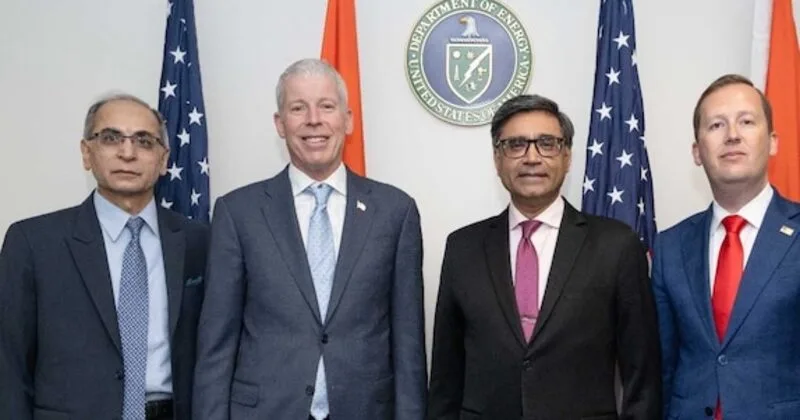
Washington/New Delhi: Indian Foreign Secretary Vikram Misri’s recent visit to the United States (April 8-10) has marked a significant step forward in strengthening India’s long-term energy security and strategic partnership with Washington. In a key meeting with US Energy Secretary Chris Wright, both sides agreed to deepen cooperation in the civil nuclear sector, signalling a new phase in bilateral energy collaboration.
A major foundation for this shift is India’s recently enacted SHANTI (Sustainable Harnessing and Advancement of Nuclear Energy for Transforming India) Act, passed in December. The legislation represents a transformative move in India’s nuclear policy landscape, dismantling longstanding regulatory constraints and opening the sector to greater domestic and international participation. By enabling private-sector involvement, the Act creates new opportunities for foreign investors and American nuclear firms to enter and operate in India’s nuclear energy ecosystem.
SHANTI Act reshapes nuclear cooperation
The SHANTI Act introduces provisions allowing private companies to build and operate nuclear power plants, a domain previously under government control. This policy shift is expected to significantly enhance investment flows, technological collaboration, and project execution capacity in the sector. During discussions between Misri and US Ambassador Sergey Gore, it was emphasised that these legal reforms would elevate the India–US energy partnership to unprecedented levels. The changes are designed not only to accelerate India’s nuclear energy expansion but also to foster a stable and predictable investment climate for international stakeholders.
The importance of these developments was further underscored during a high-level meeting held at Mar-a-Lago, Florida, where broader strategic cooperation between the two countries was discussed. Beyond nuclear energy, the United States has also expressed readiness to collaborate with India in areas such as LPG exports and coal gasification, expanding the scope of bilateral energy ties. These initiatives align closely with India’s ambitious target of achieving 100 gigawatts of nuclear power capacity by 2047, a goal that will require substantial investment, technological innovation, and international cooperation.
Expanding strategic and technological partnership
Misri’s visit was not limited to energy discussions. It encompassed a wide-ranging dialogue on trade, defence, artificial intelligence, and regional security, reflecting the multi-dimensional nature of the India–US strategic partnership. A key outcome of the visit was the confirmation of an upcoming trip to India by US Secretary of State Marco Rubio, indicating sustained diplomatic engagement at the highest levels.
Talks with US Under Secretary for Economic Affairs Jacob Helberg focused on trade, energy cooperation, and pro-innovation AI policies. A notable highlight was India’s role in Pax Silica, a strategic initiative aimed at securing AI infrastructure, aligning regulatory frameworks, and accelerating the deployment of trusted technologies.
India’s accession to Pax Silica in February underscores its growing importance in the global AI-driven economic order. The discussions highlighted the need to address regulatory challenges while fostering innovation and technological collaboration between like-minded partners.
On the defence front, Misri held consultations at the Pentagon with Under Secretary of War for Policy Elbridge Colby and other senior officials. These talks covered developments in the Indo-Pacific and West Asia, defence industrial cooperation, and supply chain integration. The discussions built upon earlier engagements under the India–US Defence Policy Group, demonstrating continuity and deepening alignment in addressing evolving regional and global security challenges.
Energy diversification and coal gasification push
Amid geopolitical uncertainties arising from the ongoing crisis in West Asia, India is recalibrating its energy strategy by accelerating cooperation with the United States in coal gasification. This technology is increasingly seen as a critical tool for reducing dependence on energy imports and enhancing economic resilience. India possesses nearly 400 billion tonnes of coal reserves, among the largest in the world, making coal a central pillar of its energy mix. Currently, coal accounts for approximately 55 per cent of total energy consumption and nearly 74 per cent of electricity generation in the country. With annual coal demand already nearing one billion tonnes and projected to rise significantly by 2047, the need for cleaner and more efficient utilisation of coal has become urgent.
The United States brings considerable expertise in coal gasification technologies, offering India an opportunity to scale up the use of cleaner coal. As one official noted, American experience in this domain can support India’s efforts to expand its capabilities to produce energy and industrial inputs from coal more sustainably.
Coal gasification itself is not a new technology. It was extensively used by Germany during World War II to produce synthetic fuels such as petrol and diesel through the Fischer–Tropsch process. The technology later gained prominence in the United States during the oil shocks of the 1980s, with applications ranging from power generation to ammonia and chemical production.
Today, China leads the world in coal gasification, converting an estimated 340 to 350 million tonnes of coal annually into products such as methanol, ammonia, hydrogen, and petrochemicals. India’s collaboration with the United States in this field could help bridge technological gaps and enhance domestic production capacities.
In parallel with these developments, India has also demonstrated progress in indigenous nuclear technology. The recent operationalisation of the fast breeder reactor at Kalpakkam in Tamil Nadu marks a significant milestone in the country’s nuclear programme. The combination of India’s technological advancements and US investment potential is expected to reduce energy import costs, strengthen energy security, and support sustainable economic growth in the coming decades.
Overall, Misri’s visit has reinforced the strategic convergence between India and the United States across multiple domains, with energy cooperation, particularly in nuclear power and coal gasification, emerging as a central pillar of this evolving partnership.