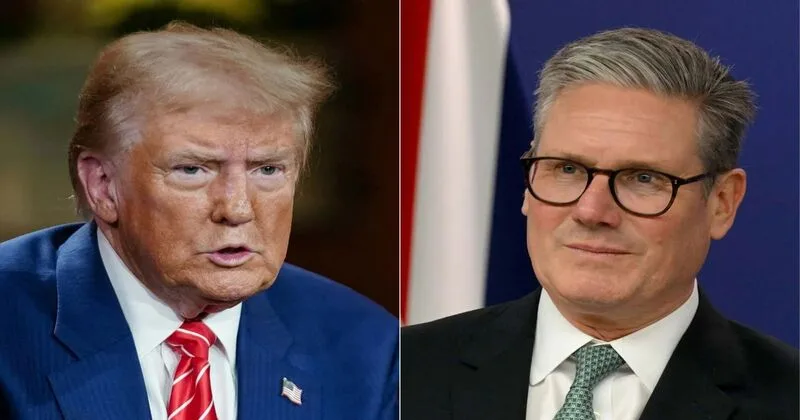
London: British Prime Minister Keir Starmer has made it clear that he does not support US President Donald Trump’s move to block the Strait of Hormuz after peace talks in Islamabad failed. Britain’s decision to distance itself from what it views as a fear-inducing escalation in West Asia has exposed widening cracks within the NATO alliance. The United States has announced that it will completely block the passage of Iranian ships through the Strait of Hormuz starting Monday. Trump took this step following the collapse of 21 hours of negotiations with Iran in Pakistan. The Strait of Hormuz, a critical artery for global oil transport, plays a vital role in the international energy market, and any disruption is expected to have far-reaching economic consequences.
Western divide over Hormuz strategy
Downing Street has stated that it will not support Trump’s sanctions, emphasising that Britain prioritises the principle of freedom of navigation at sea. While London opposes what it describes as Iran’s illegal attempts to impose “tolls” in the region, it is unwilling to participate in a unilateral US military move. Starmer is instead working to build a diplomatic coalition with like-minded nations, including France. His approach reflects a broader effort to avoid military escalation while ensuring maritime security through multilateral engagement.
Trump has responded with sharp criticism of Britain’s stance. In remarks that drew historical parallels, he compared Starmer to Neville Chamberlain, accusing him of weakness. Speaking to Fox News, Trump mocked Britain’s position as cowardly and claimed he had expected the UK to deploy minesweepers. He further alleged that Britain had betrayed its allies by refusing to support the US-led move.
Escalation and Military Readiness According to the US Central Command, all ship traffic to and from Iranian ports will be blocked from 10 a.m. on April 13. Officials clarified that the sanctions would not affect vessels bound for ports in other countries. However, the US Navy has announced plans to conduct intensified inspections along Iran’s coastline.
US Vice President J. D. Vance attributed the failure of the Islamabad talks to Iran’s rigid stance on its nuclear programme. In response, Iranian representative Mohammad Baqer Qalibaf accused Washington of derailing negotiations through excessive pressure tactics. The unwillingness of both sides to compromise is now pushing West Asia closer to a broader conflict. Meanwhile, Israel has heightened its military alert to monitor Iranian activity. IDF Chief of Staff Eyal Samir stated that the Israeli military is prepared for direct confrontation with Iran. Israeli forces have continued strikes on Hezbollah targets in Lebanon, with hundreds reported killed in recent days.
Diplomatic efforts and global concerns
Amid rising tensions, Starmer held phone discussions with French President Emmanuel Macron and Omani Sultan Haitham bin Tariq al-Said. The leaders agreed that maintaining peace in the region is of utmost importance. Gulf nations have also expressed concern over the breakdown of talks and the risk of further escalation. Economists have warned that any blockade of the Strait of Hormuz will lead to a sharp increase in global fuel prices. Such a development would significantly raise the cost of living in Britain and other countries dependent on energy imports. In response, the Starmer government is actively pursuing diplomatic solutions rather than aligning with Washington’s military strategy.
The US move comes as a two-week temporary ceasefire is set to expire on April 22. Washington has maintained that no agreement on the nuclear issue is possible without concrete guarantees from Iran. Tehran, however, insists on its right to pursue civilian nuclear development. In an effort to de-escalate the crisis, Britain is set to host a virtual meeting of around 40 countries later this week. This initiative is being seen as a last-ditch attempt to secure a negotiated settlement. London’s broader strategy involves forming an international coalition to ensure the safe passage of oil tankers through the region.
Every development in West Asia is now reshaping global geopolitics. As sanctions come into force on April 13, global concerns are mounting that the situation could spiral into a major conflict.