LUCKNOW: The Special Intensive Revision (SIR) of electoral rolls in Uttar Pradesh (2025-26 cycle) has triggered one of the biggest voter database clean-ups in recent years. The Election Commission of India’s exercise has not just “updated” the rolls, it has restructured the electoral base in several constituencies, especially in urban-rural mixed districts like Lucknow, Kanpur, Varanasi, and western UP belts. Importantly, the process was carried out under the administrative support and monitoring of the Government of Uttar Pradesh, led by Chief Minister Yogi Adityanath (Bulldozer Baba).
According to official data released by the Chief Electoral Officer, Uttar Pradesh’s final electoral roll now stands at around 13.39 crore voters, which was 15.44 crore before the revision process began in October 2025. This shows a net correction of over 2 crore entries removed after verification of duplicate, deceased, migrated, or invalid records. To be clear, SIR exercise has led to a significant reshaping of the state’s electorate:
- Total voters after revision: 13.39 crore
- Earlier voter base: 15.44 crore
- Net reduction: 2.04 crore voters (approx 13 per cent)
This is not a minor correction, it is a double-digit contraction of the voter universe, which directly impacts constituency-level arithmetic in Uttar Pradesh.
Data Comparison in Uttar Pradesh

As shown in the above table, the voter list earlier had around 15.44 crore voters, but over time many errors had built up due to reasons like people migrating, duplicate registrations, and deaths not being updated. During the revision process, about 2.91 crore entries were identified as problematic. This included around 1.27 crore people who had shifted, 84.7 lakh who were found absent, 46 lakh who were deceased, and about 23.7 lakh duplicate entries.
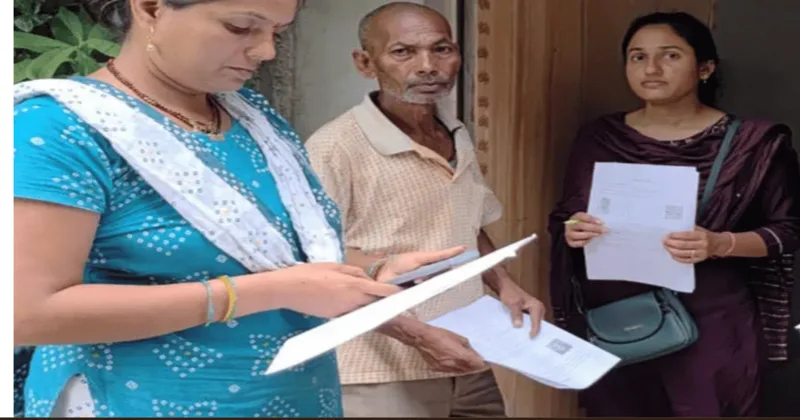
The revision process (draft) involved house-to-house verification by Booth Level Officers (BLOs), during which more than 1 crore voters were served notices for verification. As a result, around 3 crore names were deleted at the draft stage. The process also included a proper system of claims and objections, document verification, and public scrutiny to ensure accuracy.
After the SIR process, the electoral roll became cleaner and more accurate, with the final number of voters at around 13.39 crore. This means the exercise was not just about deleting names but also about correcting errors and adding genuine voters to create a more reliable and updated database.
The Special Intensive Revision (SIR) of voter lists in Uttar Pradesh has become an important exercise before elections, and has led to a political debate and major changes in the electoral system. The revision was conducted under the supervision of the Election Commission of India, and has led to a substantial correction in the voter database. The removal of over 2 crore entries is a decisive attempt by the Election Commission of India to bring accuracy and credibility back into the electoral system. While opposition parties have raised concerns about large deletions, the government and election officials say it is a necessary clean-up so that elections become more fair and reliable.
The main idea behind SIR was simple: elections can only be fair if voter lists are correct. Over time, in a big and changing state like Uttar Pradesh, voter lists can develop errors due to migration, city growth, and population changes. Without periodic intensive revision, these discrepancies can distort voter turnout data and create loopholes which may be exploited during elections. Thus, by undertaking a house-to-house verification process through Booth Level Officers (BLOs), the Election Commission is trying to remove errors and make sure every voter is real and actually lives in the area. This transition from inflated lists to verified databases moves elections from just having more names to having accurate and genuine voters.
The impact of this revision is particularly visible in urban constituencies such as Lucknow, Ghaziabad, and Kanpur, where high mobility and rental populations often result in multiple or outdated registrations. For example, Lucknow North has the highest number of deleted voters at 1.54 lakh, followed by Lucknow East and Sarojini Nagar at 1.43 lakh and 1.42 lakh respectively as per the constituency wise data.
In these areas, the SIR exercise has led to sharper corrections, as voters who have permanently relocated or were registered in multiple places have been removed. This has significantly reduced what political analysts call as “floating voter distortions”, a phenomenon where parties assume the presence of voters who are no longer part of the constituency. This reduces confusion about “extra” voters, so parties now need to focus on real people instead of outdated data.
In rural and semi-urban areas like Bakshi Ka Talab, Malihabad, and Barabanki, the changes have been smaller because people move less and voter lists were already more stable. SIR has mainly helped make voter details more accurate at the booth level. This shows that local connections and regular contact with people are now more important in elections. Cleaner voter lists will likely make elections more competitive and better reflect what people truly think.
Western Uttar Pradesh presents a unique case, where labour migration and inter-district mobility have historically complicated voter registration patterns. Constituencies in districts like Meerut, Saharanpur, and Bareilly have undergone significant reshaping under SIR, with corrections in migrant-heavy pockets leading to a more realistic voter distribution. For instance, in Pilibhit district (Bareilly division) approx 2 lakh voters were removed mainly due to migration, duplication, and unverified entries. Agra has more than 29.6 lakh voters, while about 6.3 lakh voters were removed.
This change has political impact, as parties now have to rethink their voter strategies based on current realities instead of old data. SIR is not just a routine process, but it has pushed parties to be more active and responsible in their campaigning this time.
Even though the revision improves the system, it has led to political debate. Opposition parties say that many voters may have been wrongly removed, but the government says the process is fair and includes proper checks, public review, and chances to fix errors. Citizens whose names were removed have the option to reapply or update their details so that no eligible voter is permanently excluded.
This difference in views shows a larger political divide. The opposition sees SIR as possibly excluding voters, while the government says it is needed for fair elections. The government also links it to better governance, where accurate data supports schemes like DBT, Aadhaar services, and digital welfare under Narendra Modi and Yogi Adityanath. A clean voter list complements this ecosystem by ensuring that demographic data used for policymaking is both reliable and up to date.
The impact of SIR goes beyond just elections. By removing wrong entries, it makes voter turnout more accurate and reduces chances of fraud like duplicate or fake voters. Overall, it is a step towards making India’s election system more modern and reliable.
At the constituency level, cleaner voter lists can change election results, as even small vote margins may shift after removing inactive voters. This means parties now need to focus more on booth-level work, real voter contact, and strong ground presence instead of relying on old data.
For voters, SIR changes are important because a clean voter list means every vote counts equally and results are genuine and real participation. This builds trust in the election system, and even if there is political debate now, the long-term impact is likely to make elections more transparent and reliable.
By removing over 2 crore doubtful entries, authorities have addressed a long-standing issue affecting both governance and democracy. While political reactions differ, the main goal is clear, to ensure elections are based on accurate and reliable data. As future elections approach, the impact of these changes will become more visible, influencing both political strategies and voter participation. In this way, SIR is not just changing electoral numbers, but also strengthening the foundation of democracy.