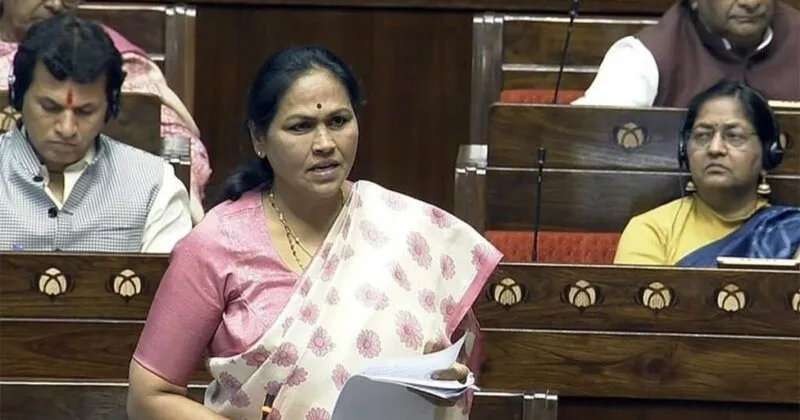
Bengaluru: Union Minister and Bengaluru North MP Shobha Karandlaje has strongly objected to the Karnataka government’s newly introduced Permanent Resident Certificate (PRC) rules, alleging that the policy could facilitate illegal Bangladeshi immigrants and other foreign nationals in securing official residential status in the state. Describing the notification as unconstitutional and a potential threat to national security, Karandlaje has written to Union Home Minister Amit Shah urging the Centre to immediately intervene, suspend the implementation of the rules and conduct a comprehensive constitutional and legal review.
In her letter, the Union Minister stated that the Karnataka government’s notification introducing the Karnataka Permanent Resident Certificate (PRC), 2026 raises serious constitutional, legal and national security concerns that warrant urgent attention from the Union government. She urged the Home Ministry to examine the notification in detail before its implementation, arguing that the proposed framework has far-reaching implications for the country’s constitutional structure and internal security.
Karandlaje contended that the Constitution of India guarantees a single citizenship for all Indian citizens and does not recognise separate categories of permanent residents except where specifically provided by law. She alleged that by creating a distinct category of “permanent residents” through an executive notification, the Karnataka government is attempting to establish a legal classification without constitutional or statutory authority. According to her, such a move violates the principle of equality before law guaranteed under Article 14 of the Constitution and creates an arbitrary distinction among citizens.
The Union Minister further argued that the state government has no legislative competence to introduce a separate residential status that may indirectly confer benefits beyond those available to ordinary residents. She maintained that such powers fall within the constitutional framework governing citizenship and cannot be exercised unilaterally by a state government.
A major concern highlighted in her letter relates to the verification mechanism proposed under the PRC rules. Karandlaje alleged that the eligibility criteria appear to rely largely on local revenue verification, residence certificates and state-level documents without making verification of Indian citizenship by competent central agencies mandatory. She warned that such a system could be misused by illegal Bangladeshi immigrants and other foreign nationals residing unlawfully in the country to obtain Permanent Resident Certificates using fabricated or fraudulently procured local documents.
According to her, once such certificates are issued, they could potentially be used to gain access to various government welfare schemes, educational admissions, employment opportunities, public services and other official documentation. She claimed that such a development would effectively legitimise the presence of illegal immigrants and make it significantly more difficult for central agencies to identify and deport them.
Karandlaje also expressed concern that the notification could undermine ongoing efforts by the Union government to detect illegal immigrants and strengthen border security. She argued that granting permanent residential status without thorough citizenship verification could create long-term administrative and security challenges while weakening the country’s immigration enforcement framework.
The Union Minister emphasised that matters relating to citizenship, immigration, foreigners and internal security fall exclusively within the jurisdiction of the Union government under the Constitution. She argued that any state-level decision having implications for citizenship or permanent residential status could interfere with the constitutional distribution of powers and adversely affect national security and public order.
She further maintained that allowing individuals to obtain Permanent Resident Certificates without robust verification could enable illegal immigrants to integrate into the state’s administrative system and claim legal entitlements that are meant exclusively for Indian citizens. Such a situation, she cautioned, may have far-reaching consequences for governance, law enforcement and public administration.
In her communication to Amit Shah, Karandlaje has sought four immediate interventions from the Ministry of Home Affairs. She requested the Centre to examine the constitutional validity of the Karnataka Permanent Resident Certificate (PRC), 2026, direct the Karnataka government to keep the notification in abeyance until the review is completed, seek a detailed report from the state government explaining the constitutional and statutory authority under which the notification has been issued, and ensure that no Permanent Resident Certificate is granted unless the applicant’s Indian citizenship is comprehensively verified through competent central agencies.
She concluded that safeguarding the constitutional framework, preserving the principle of single citizenship and protecting national security must remain the highest priority. Karandlaje urged the Centre to take immediate corrective measures to prevent any misuse of the proposed PRC framework and ensure that no mechanism inadvertently facilitates illegal immigration or compromises the country’s internal security.