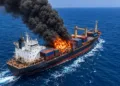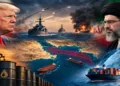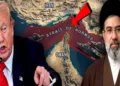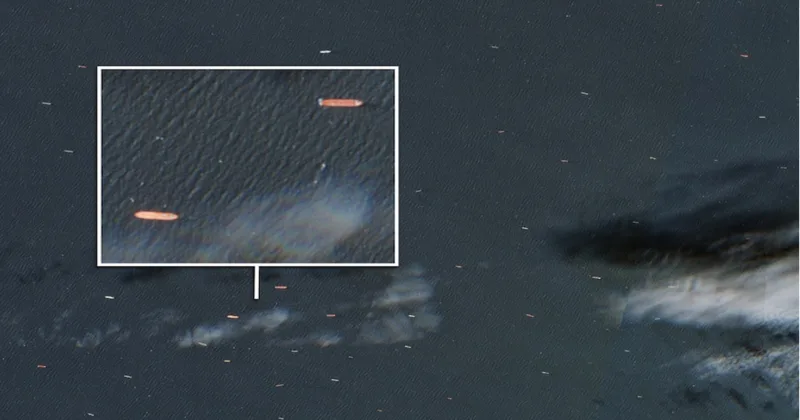
The world holds its breath over a narrow strip of water just 39 kilometres wide. Since late February 2026, when the United States and Israel launched coordinated strikes on Iran, the Strait of Hormuz the jugular vein of global energy trade has been reduced from a superhighway of 130-plus ships a day to a ghost lane of barely seven. A two-week ceasefire announced on the night of April 7 has offered a flicker of hope. But as of Thursday, April 9, only few ships shown dare to move.
Is Hormuz actually open? Not quite
When Iran’s Foreign Minister Abbas Araghchi announced on April 8 that “safe passage through the Strait of Hormuz will be possible via coordination with Iran’s Armed Forces” for a two-week window, global oil markets exhaled and Brent crude dropped as much as 16% overnight. But the physical reality on the water told a far more cautious story.
According to ship-tracking data analysed by ABC News, Bloomberg and MarineTraffic only seven vessels made the journey through the strait in the 24 hours after the conditional lifting of the blockade. Of those six were bulk cargo carriers that avoided the standard shipping lane entirely, through Iran’s coastline along what critics have called a toll booth route. Three were Chinese-owned, three Greek-owned. A seventh vessel a Chinese-owned oil and chemical tanker vanished from tracking maps.
Bloomberg reported that on Wednesday alone, just three ships were observed leaving the region. In normal times, roughly 135 ships cross daily. More than 800 freighters are trapped inside the Persian Gulf. The situation was further complicated when Iranian state media reported that oil tanker traffic remained halted following fresh Israeli strikes on Lebanon, a direct challenge to the fragile ceasefire. The Iranian Revolutionary Guard Corps (IRGC) was reportedly broadcasting radio warnings to vessels that any attempt to pass without permission and you will be destroyed. Defense Secretary Pete Hegseth stated at a press briefing that “the strait is open,” but the ships anchored outside suggest a rather different reality.
The toll booth and the $2 million question
The guns fall silent but commerce may not flow freely. Iran’s 10-point peace proposal a summary of which was shared by Iran’s Supreme National Security Council includes two explosive clauses about the strait controlled passage only in coordination with Iran’s armed forces, and the establishment of a safe transit protocol that explicitly ensures Iran’s dominance.
The New York Times reported that the proposal includes a $2 million fee per ship, to be shared with Oman, which sits on the southern flank of the strait. Iran is also reportedly planning to demand these fees in cryptocurrency, according to CNBC. The White House was quick to push back press secretary Karoline Leavitt stated that the ceasefire requires the strait to be opened without limitation, including tolls. President Trump declared it must reopen COMPLETE, IMMEDIATE and SAFE in capital letters on Truth Social.
The shipping industry, is reading the fine print carefully. Maersk the world’s second-largest container shipping operator, said the ceasefire “may create transit opportunities, but it does not yet provide full maritime certainty.” The conflict has been costing Maersk roughly $55 million per week. The International Maritime Organization (IMO) has called the situation a priority and is engaging in diplomatic efforts to restore the Traffic Separation Scheme, the internationally agreed shipping lane through the strait which has been in place since 1968.
India’s Quiet Battle: Operation Urja Suraksha
For India, the Strait of Hormuz is not just a geopolitical flashpoint, it is an energy lifeline. Before the conflict erupted on February 28, approximately 90 per cent of India’s LPG imports passed through the narrow waterway. With the blockade India faced an acute cooking gas shortage, forcing the government to invoke emergency powers and directing refiners to maximise LPG production.
At the outset of the crisis, 24 Indian-flagged vessels with over 600 seafarers found themselves trapped in the western Persian Gulf. India response was swift, calibrated and deliberately quiet. Launched under the codename “Operation Urja Suraksha”(i.e. Energy Protection), the mission was described by Indian government sources as proceeding with the highest degree of caution and minimal publicity.
According to a detailed report more than five Indian Navy warships were dispatched including destroyers and frigates. None of them entered the Strait of Hormuz itself. Instead, they stationed themselves in the Gulf of Oman, near the strait’s exit, in constant radio communication with the merchant vessels inside. After New Delhi secured permission from Tehran for specific ships to transit, naval officers guided each vessel individually with precise routing instructions by instructing captains on the alternate northern route running close to Iran’s coastline, far from the standard lane.
The diplomatic backbone of this operation was Prime Minister Narendra Modi direct call with Iranian President Masoud Pezeshkian, in which Modi specifically raised the transit of India-bound energy shipments. Iran Ambassador to India, Mohammad Fathali, subsequently confirmed that Tehran had granted Indian vessels as a rare exception to the blockade.
The results were tangible. On March 14, two Indian-flagged LPG tankers crossed safely the first confirmed Indian transit since the crisis began. They crossed the Strait of Hormuz early morning safely and were en route to India,” Rajesh Kumar Sinha, Special Secretary of India’s Ministry of Ports, Shipping and Waterways, confirmed at a press briefing. Between March 14 and 24, five Indian-flagged LPG carriers were evacuated in three separate operations. By April 5, the tanker Green Asha carrying 15,400 tonnes of LPG became the eighth Indian carrier to exit the strait, sailing close to the Iranian coast and maintaining a steady speed of 12.8 knots.
As of April 9, 16 to 17 Indian-flagged vessels and approximately 460 Indian seafarers remain in the western Persian Gulf. India has explicitly stated it will not join any US-led naval coalition in the strait, with New Delhi’s foreign ministry clarifying that “India has not engaged in bilateral discussions with the US regarding deploying naval vessels” for strait protection, a careful balancing act between its energy dependence, its relationship with Iran and its broader strategic autonomy.
Today’s Scenario: A fragile ceasefire, a tense strait
The crisis of the 2026 Strait of Hormuz crisis describes as the largest disruption to the energy supply since the 1970s energy crisis, has seen Brent crude surge to a peak of $126 per barrel. Iran made 21 confirmed attacks on merchant ships by March 12 alone. Hundreds of vessels remain anchored in a growing traffic jam over 800 ships trapped, according to Bloomberg and roughly 20,000 seafarers stranded.
Even energy analysts warn that a return to normal traffic cannot undo months of damage overnight. “We will need to see a constant flow of crude coming out before they can re-inventorise the very, very depleted crude stocks in the Asian refineries tanks,” Sparta Commodities senior oil market analyst June Goh told ABC News. She estimated a minimum of three months before product supply normalises.
As peace talks are scheduled in Pakistan this weekend between the US and Iranian delegations, the world’s most important shipping lane hangs in a diplomatic limbo technically open, practically uncertain and politically explosive. Iran insists on ‘continued Iranian control.’ Trump insists on ‘complete and immediate’ opening with no tolls. And somewhere between those two positions, hundreds of ships loaded with the world’s energy supplies wait for a signal that it is safe to move.
For India which has walked the tightrope of diplomacy with remarkable agility, securing passage for its ships through a combination of back-channel engagement with Tehran and quiet naval escort the immediate priority is getting the remaining vessels home. The bigger question, one that will outlast any two-week ceasefire, is what the new rules of Hormuz will look like once the smoke finally clears.