BENGALURU: The controversy surrounding the release of funds under Karnataka’s much-publicised guarantee schemes has escalated into a major political flashpoint, with the Election Commission of India stepping in and seeking a detailed explanation from the state government. The development has further fuelled allegations that the ruling dispensation is misusing public welfare schemes to influence voters ahead of the crucial by-elections in Davanagere South and Bagalkot.
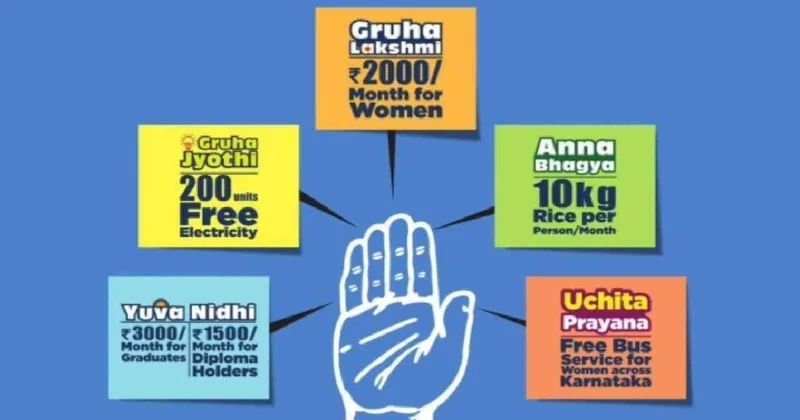
At the heart of the issue is the timing of the fund disbursement under flagship programmes such as the Gruha Lakshmi Scheme and the Gruha Jyothi Scheme. Critics allege that the government deliberately withheld payments for nearly three to four months, only to suddenly release them after the Model Code of Conduct (MCC) came into force, a move widely seen as an attempt to woo voters.
The Election Commission’s notice to the Chief Secretary has now brought these allegations into sharper focus. By seeking constituency-wise details of funds released after the MCC enforcement, the poll panel has effectively questioned the intent and timing of the government’s actions. It has also asked whether prior approval was obtained before releasing the money — a mandatory requirement during the election period.
Political observers say the EC’s intervention is significant, as it indicates prima facie concerns over possible violations of electoral norms. “The timing raises serious questions. If funds were pending for months, why release them only during elections?” is a question now being widely raised in political circles.
The issue has also reached the Karnataka High Court, where an Independent candidate from Davanagere South, Gautam Kumar Jain, has challenged the government’s move. In his petition, he has alleged that the sudden release of funds is nothing but a calculated attempt to influence voters and tilt the electoral balance in favour of the ruling party.
Jain has argued that such actions undermine the very essence of free and fair elections. He has sought directions to halt all payments under guarantee schemes in poll-bound constituencies until the completion of the bypolls, contending that the government did not obtain prior approval from the Election Commission before disbursing funds.
Despite mounting criticism, the state government has denied any wrongdoing. Representing the government, Advocate General Shashikiran Shetty dismissed the allegations, stating that there is no evidence to prove that payments were intentionally delayed. However, this defence has done little to quell the growing perception that welfare schemes are being weaponised for electoral gain.
Opposition leaders have launched a sharp attack, accusing the government of engaging in “appeasement politics” and using taxpayers’ money to secure votes. They argue that if the schemes were genuinely meant for public welfare, the funds would have been released consistently rather than in a politically sensitive window.
The controversy has also reignited a broader debate on the ethical use of welfare schemes. While such programmes are designed to support economically weaker sections, their timing and implementation during elections often come under scrutiny. In this case, the sudden release of funds, coupled with an alleged increase in beneficiaries, has only deepened suspicions.
Legal experts point out that any financial disbursement during the MCC period without the Election Commission’s approval may constitute a violation. If proven, it could invite strict action, including directions to halt further payments and even potential consequences for officials involved.
Meanwhile, the Election Commission’s firm stance has put the state government in a tight spot. By demanding transparency and accountability, the poll body has signalled that it will not hesitate to act if electoral norms are breached.