On February 27, 2026, the Madras High Court, through a detailed judgment by Justice P. B. Balaji, put an end to a long-running property dispute that had its roots over a century ago. The matter, registered as Civil Revision Petition No. 877 of 2023, was between the legal heirs of M. Sirajudeen Sayeed, Zarina Sayeed and Shabana Sayeed and the Tamil Nadu Waqf Board, which had claimed the family’s ancestral property as a public waqf.
At its core, the case revolved around a simple but important question: was this property meant for the public in the name of religion, or was it always a private family property? The answer depended on how old documents from 1910 and 1951 were to be understood.
The dispute goes back to a partition deed dated February 14, 1910. In this document, some properties were listed under a section called “D Schedule.” Later, another partition deed in 1951 referred back to this same arrangement.
The Waqf Board argued that because these documents used words like “waqf” and “mosque,” the property must have been dedicated for religious purposes and therefore should be treated as a public waqf.
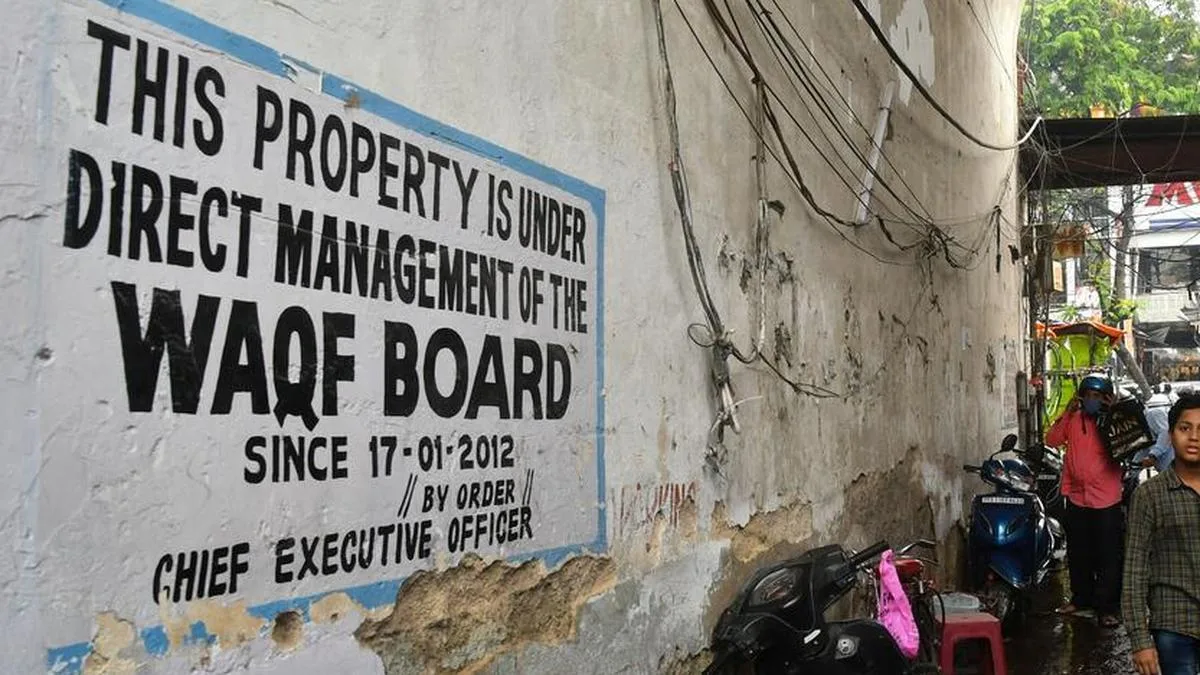
Based on this understanding, the Board registered the property as waqf in 2008 under the Waqf Act, 1995. This meant that the Board claimed the right to control and manage the property.
However, the family strongly objected, saying that the property had always remained with them and was never meant to be given away for public religious use.
This disagreement led to a long legal battle. In 2009, the High Court had already stepped in once and cancelled the Waqf Board’s action, asking it to conduct a proper and fair inquiry. But instead of doing a detailed examination, the Board again passed an order on November 3, 2009, declaring the property as a public waqf.
The Court observed that the Board’s order was a “non-speaking order,” lacking reasoning, analysis, and transparency. In a pointed observation, the judge remarked that decisions affecting property rights “cannot be made mechanically without disclosing the basis on which such conclusions are reached,” emphasising that statutory authorities must act with responsibility and diligence.
The litigation then moved through multiple stages. The family filed a writ petition in 2010, while another petition was filed in 2011 by an individual linked to the Siruvadi Mosque. Both matters were heard by a Division Bench of the High Court, which, on February 18, 2015, directed the parties to approach the Waqf Tribunal for adjudication.
Acting on this direction, the family filed O.S. No. 23 of 2022 before the Tamil Nadu Waqf Tribunal in Chennai. However, on October 11, 2022, the Tribunal dismissed the family’s claim and upheld the Waqf Board’s position.
This decision brought the matter back to the High Court through the present revision petition.
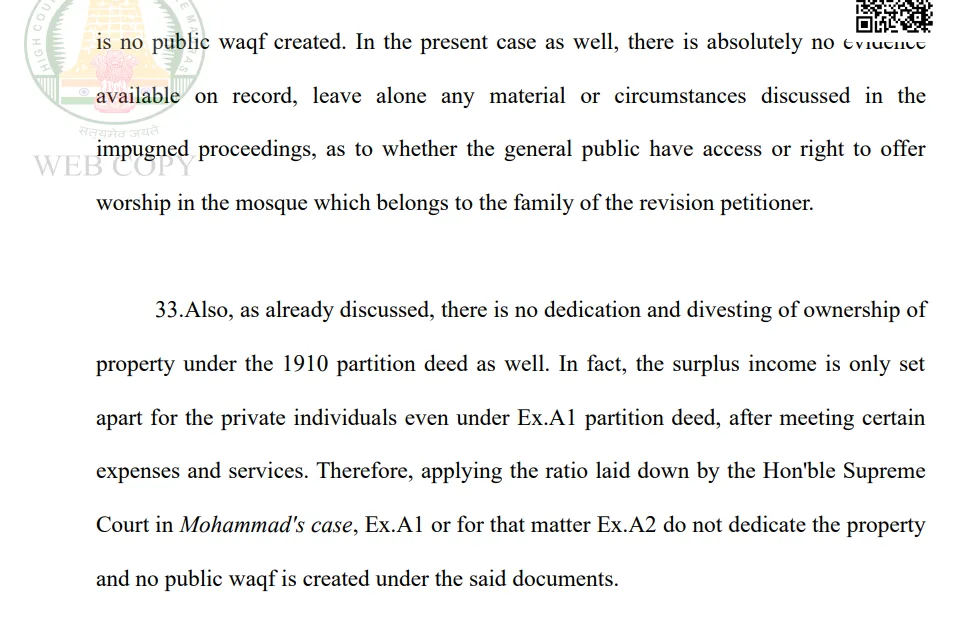
A crucial turning point in the case came when the High Court undertook a close examination of the original documents from 1910 and 1951. While acknowledging that the documents contained references to “waqf” and “mosque,” the Court made it clear that such terminology alone is not sufficient to establish a public waqf.
In one of the most important observations, Justice Balaji said that “mere use of expressions like ‘waqf’ or ‘mosque’ in a document does not by itself create a public waqf unless the intention to dedicate the property absolutely and irrevocably is clearly established.”
This means that there must be clear proof that the owner gave up the property fully and permanently for public religious use.
The Court further emphasised that for a valid public waqf to come into existence, the person creating it must completely divest ownership and dedicate the property for public religious or charitable purposes. However, in the present case, the documents revealed no such complete dedication.
In this case, the Court found no such proof. Instead, the documents showed that the family continued to control the property. They managed it, used it, and even enjoyed the extra income that came from it after certain expenses were met. The Court noted that if a family is still benefiting from the property, it cannot be treated as a public waqf.
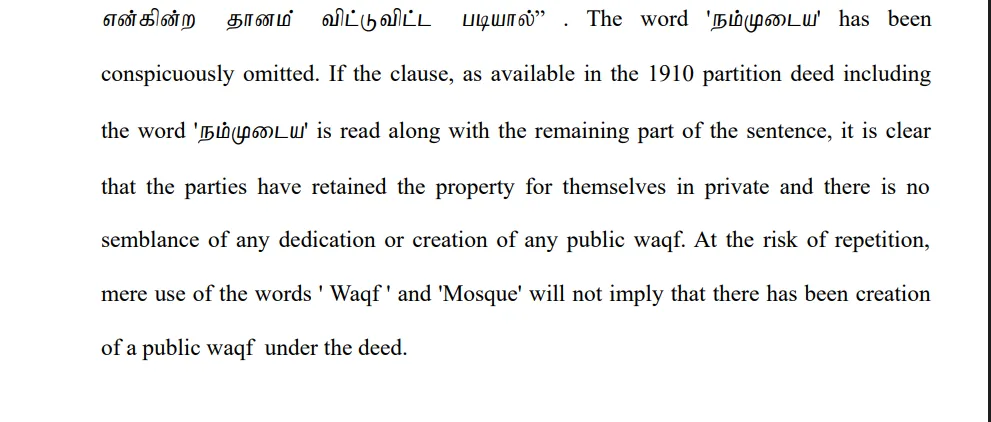
Another important issue highlighted by the Court was a mistake made by the Waqf Tribunal. While reading the 1910 document, the Tribunal had left out an important word from the original Tamil text. This small omission changed the meaning of the entire clause and led to a wrong conclusion.
The High Court corrected this and pointed out that even a small error in reading old documents can have serious legal consequences.
The Court also looked at how the property had been treated over the years. For nearly 100 years, the property had remained with the family. There was no sign that the public was using it or that any authority was managing it as a religious endowment. This long history of private use strongly supported the family’s claim.
On the issue of delay, the Waqf Board argued that the family had approached the court too late and that their case should be dismissed. However, the Court rejected this argument. It noted that the family had been continuously fighting the case since 2009 and had followed the legal process step by step. The judge observed that “a party diligently pursuing remedies cannot be non-suited on technical grounds of delay,” meaning that genuine efforts to seek justice should not be rejected on technicalities.
After examining all the facts, the Court came to a clear conclusion. The property is not a public waqf. At most, it could be considered a private waqf meant for family members, also known as waqf-alal-aulad.
The High Court then set aside the Tribunal’s 2022 decision and cancelled the Waqf Board’s 2009 order. It also directed that the authorities should not interfere with the family’s possession of the property.
Legal context and similar judgments
While the decision was mainly based on facts and documents, it also followed well-established legal principles laid down by the Supreme Court of India.
In the 1981 case of Sri Radhakanta Deb vs Commissioner of Hindu Religious Endowments, the Supreme Court explained that if a property mainly benefits a family, it is considered a private arrangement, not a public religious trust.
In another case, Mohammad vs Mohammed Beke (1996), the Court clearly said that a valid waqf requires complete surrender of ownership. If the owner continues to control the property, it cannot be treated as a public waqf.
The High Court also looked at earlier rulings like Tamil Nadu Waqf Board vs Larabsha Darga Panruti and Tamil Nadu Waqf Board vs Hathija Ammal, which stressed that proper inquiry and clear evidence are necessary before declaring any property as waqf.
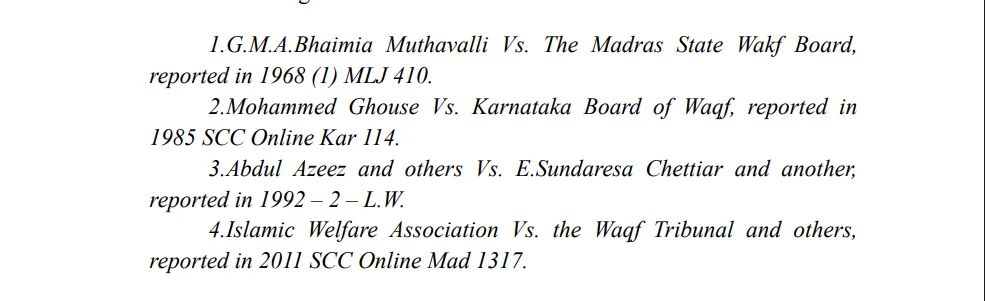
An older case, G.M.A. Bhaimia Muthavalli vs Madras State Wakf Board (1968), was also considered, but it did not support the Waqf Board’s argument in this matter.
This judgment is important not just for this one family, but for many others facing similar disputes. It clearly says that property cannot be taken over just because of certain words used in old documents. What matters is the real intention behind those documents.
The Court has drawn a strong line between assumption and proof. It has also reminded authorities that they must follow proper procedure and give clear reasons for their decisions.
For ordinary citizens, this ruling offers reassurance. It shows that courts will carefully examine facts, protect property rights, and ensure that justice is not denied due to technicalities or careless decisions.
In the end, this judgment strengthens trust in the legal system. It shows that even after a long and difficult legal battle, fairness and truth can prevail.