
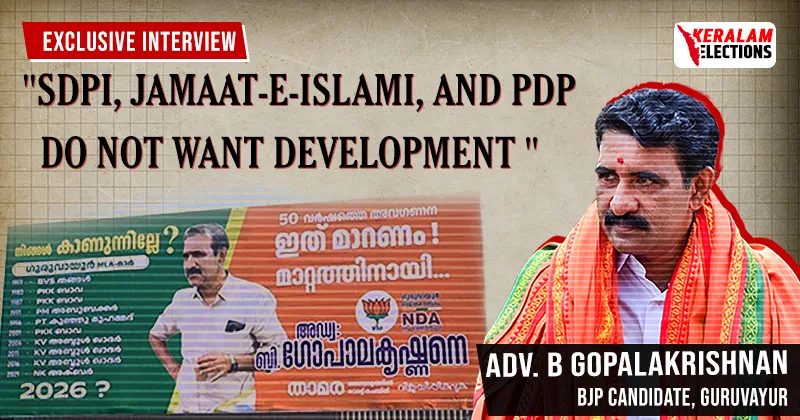
Guruvayur has always been more than a constituency. It is the spiritual address of millions — the home of Lord Guruvayurappan, one of the most visited Krishna temples in the country, a town where the air smells of camphor before the sun rises and pilgrims arrive in the dark to join queues that stretch through the morning. But ahead of the 2026 Assembly elections, it has become something else too: the place where fifty years of carefully maintained political silence has finally been broken.
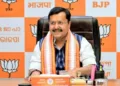
The man who broke it is Adv. B. Gopalakrishnan, the BJP candidate for Guruvayur — a devoted bhakta who offers Shayana Pradakshinam at the temple every month and who walked into this campaign carrying a vigilance report in one hand and a flex board full of names in the other.
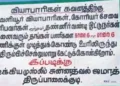
The board listed every MLA Guruvayur had elected since 1977. Name, party, community. Gopalakrishnan installed it near Chavakkad junction without ceremony and waited. The data spoke for itself: since 1976, across five decades and multiple elections, neither the Congress-led UDF nor the CPI(M)-led LDF had once fielded a Hindu candidate in a constituency where Hindus form 52 percent of the electorate. The town has not stopped talking about it since.
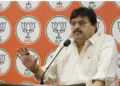
“I put the names up on a board and asked — is there a pattern here? That question apparently terrified both fronts enough that they ran to the courts and the police station. If I had shown a false chart, they would have corrected it. They could not. So they filed cases instead.”
— Adv. B. Gopalakrishnan, BJP candidate, Guruvayur
The panic that proved the 50 Year point
The political establishment’s response was swift — and, for the BJP, more useful than any campaign speech. Three FIRs were filed against Gopalakrishnan. On the morning, he went to submit his nomination papers, advocates reportedly linked to both the UDF and the LDF appeared before the returning officer and argued jointly that his candidacy should not be accepted.
Two rival fronts, briefly setting aside their rivalry — to keep one BJP candidate off the ballot. No factual error in the board was ever pointed out. No code of conduct violation was cited. The data, after all, was public record.
The reaction rippled inward. In CPI(M) branch meetings across Guruvayur, local workers reportedly began raising the same question their leadership could not answer: since 1980, why has not a single Hindu name appeared on the Left’s candidate list here? It has not been publicly denied.
The BJP has positioned this squarely as a question of democratic representation. In a constituency named after Lord Guruvayurappan, with a Hindu-majority electorate, the systematic exclusion of Hindu candidates by both fronts is not, the party argues, a coincidence. It is a pattern — and patterns have architects.
“There is a Hidden Agenda for the LDF-UDF Candidate Pattern”
Gopalakrishnan is direct about who he believes those architects are. He argues that for decades, extremist outfits — Jamaat-e-Islami, SDPI, PDP and affiliated groups — have quietly shaped candidate selection in Guruvayur by delivering bloc support to whichever front accommodated their interests. Both the LDF and the UDF, he says, have been willing participants. The result has been a succession of MLAs with no personal stake in the temple, the pilgrims, or the town’s Hindu identity — and every incentive to look the other way as the rot set in.
He further argues that this is not a Guruvayur-specific phenomenon. These forces, in his reading, specifically target constituencies around major temples and Hindu pilgrimage centres — precisely because weakening their identity and administration serves a larger purpose. Guruvayur, as one of the most prominent such centres in the country, has been a primary target.
“An MLA who has faith in the Guruvayur temple would fight for it. These candidates had no faith in it. That is why the corruption went unchecked, the facilities were never built, and the pilgrims were left to suffer. It was not negligence. It was by design.”
— Adv. B. Gopalakrishnan
Guruvayur- A sacred town left to decay
Walk the lanes around the temple complex on any morning and the neglect Gopalakrishnan describes is not rhetorical. Pilgrims who have queued since before dawn sit on open benches, mosquitoes circling, waiting twenty hours or more with no access to clean drinking water, no functional rest facilities, no shade.
A hospital was started near the temple years ago. However, it was closed as the hospital lacked doctors, equipment and other supporting staffs. Today, it is seen as little more than another example of systemic neglect and mismanagement. The Devaswom Board — staffed by political appointees of successive governments — is the subject of a vigilance report that Gopalakrishnan produces on request. Gold has gone missing from the temple treasury. The High Court has flagged irregularities. Chandanam and kumkumam allocations have been found wanting.
No clear waste management systems. The Devaswom Board, he argues, has the resources to fix every one of these failures — and has chosen not to. “Guruvayur has enough wealth. Why can’t they give a cup of tea to a pilgrim who has waited twenty hours? Why can’t they build a proper hospital for the common man?” the BJP Candidate asks.
Gopalakrishnan argued- “For fifty years, the answer has been the same: the MLAs sent here had no faith in this place and no reason to fight for it. One belonged to a party whose stated theology regards the temple lamp as forbidden. The other operated from a worldview that holds no belief in any deity. Neither would go to the mat for the pilgrims, the temple, or the town — because neither had any stake in it. “That is not negligence,” says Gopalakrishnan. “That is a deliberate choice made by people who had other priorities.”
2024 signal for BJP and what followed
The Lok Sabha result of 2024 announced that the political arithmetic here had changed. When Union Minister Suresh Gopi crossed 45,000 votes in the Guruvayur assembly segment alone, it broke every assumption both fronts had relied on for decades. It was not a wave. It was a statement that had been taken for granted for fifty years and had finally decided to be counted.
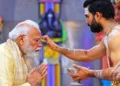
According to Gopalakrishnan, the Modi government’s visible work in the constituency has given that statement a material foundation. The car parking crisis near the temple — requested for years and ignored by successive state governments — was resolved after a memorandum to the Centre when PM Modi came for darshan in Guruvayur. Funds were sanctioned. The facility was built. The local train service from Thrissur to Guruvayur, long demanded by devotees, was started under Central government initiative. Proposals for rail connectivity to Thiruvananthapuram and Chennai are now in progress. “Every development activity in Guruvayur has come from the Centre,” says Gopalakrishnan. “The state government and the Devaswom Board have contributed nothing.”
The SDPI pact and what it reveals
As polling day approaches, the LDF’s reported acceptance of electoral support from the SDPI has stripped away whatever remained of the Left’s secular veneer. The SDPI is the surviving political front of the PFI — the organisation the central government banned in 2022 for its links to radicalisation and violence.
Senior CPI(M) leaders, including Prakash Karat, have publicly described such support as tactically acceptable. In Guruvayur, where five to six RSS karyakarthas have been killed over the past decade by outfits operating in this network, the calculation is not abstract. The LDF knows who stands behind those deaths. It is still taking their votes.
The UDF’s position is no less troubling. The Muslim League is no longer the Congress’s junior coalition partner — it is, by Gopalakrishnan’s account and by the evidence of candidate selection and policy positioning, the dominant force in the alliance. If the UDF wins, he argues, the League becomes the first party in all but name, with the Congress reduced to a secondary role.
There are already reports of League leaders making quiet overtures to LDF figures — a reminder, he says, that the two fronts are driven less by ideology than by a shared interest in keeping BJP out and keeping their respective arrangements intact.
What BJP Candidate Gopalakrishnan is promising for Guruvayur
Against this backdrop, his agenda is grounded and specific. A decentralised waste treatment plant to end the solid and liquid waste crisis choking the temple corridor. Full implementation of the Jal Jeevan Mission for clean drinking water across the constituency — already funded by the Centre, stalled at the state level by a government that has shown no will to execute it.
A properly equipped hospital with functional facilities for the common man. Beyond these immediate priorities, a larger vision takes shape: transforming the Guruvayur temple precinct, the historic St. Thomas Syro-Malabar Catholic Church at Palayoor, and the nearby Chavakkad beach into an integrated international pilgrimage and tourism hub—one that generates livelihoods for local residents and finally delivers the infrastructure the town’s significance has long deserved.
For fifty years, Guruvayur sent to the assembly people who regarded this town as a political unit to be managed, not a sacred space to be protected. The flex board near Chavakkad junction is still standing. The names are still there. The question they raise has not been answered. And for the first time since 1976, the constituency has a candidate whose answer is not silence.