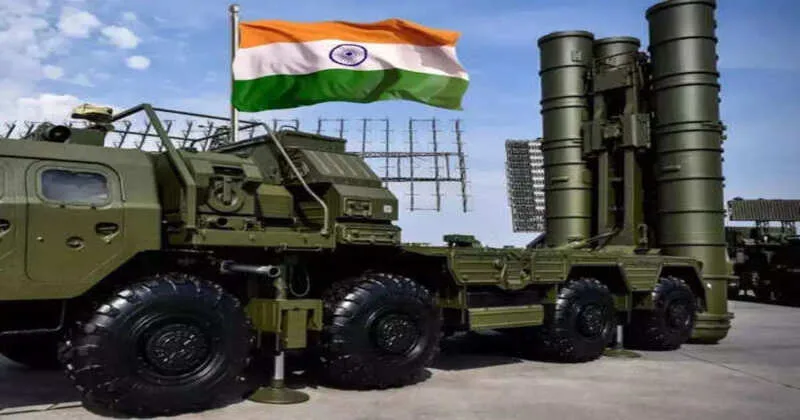
New Delhi: In a major breakthrough for India’s defence sector, the indigenously developed ‘Project Kusha’, also known as the Extended Range Air Defence System (ERADS), is currently under development. Considered more powerful than the Russian-made S-400 missile system and available at less than half its manufacturing cost, the system is expected to significantly enhance the capabilities of the Indian Air Force.
India had earlier spent around Rs 45,000 crore in 2018 to procure five squadrons of the S-400 system. In contrast, five squadrons of Project Kusha are estimated to cost approximately Rs 21,700 crore. The cost advantage extends to the missiles as well. Each S-400 missile costs nearly Rs 100 crore, whereas the interceptor missiles developed under Project Kusha are priced between Rs 40 crore and Rs 50 crore. This substantial cost efficiency marks a major step towards India’s goal of achieving self-reliance in air defence systems.
Project Kusha features three categories of interceptor missiles. The M1 variant has a range of 150 km and has already completed successful testing earlier this year. The M2 variant, with a range of 250 km, and the M3 variant, with a range between 350 and 400 km, are scheduled for testing in the coming months. The system is capable of neutralising enemy cruise missiles, stealth fighter aircraft, and drones at distances up to 250 km, while also defending against large aircraft at ranges of up to 350 km.
A key advantage of Project Kusha lies in its indigenous design, which gives the Indian Air Force complete control over its software and mission algorithms. This ensures operational independence during strategic conflicts, eliminating concerns associated with foreign-controlled systems.
The system is being developed by the Defence Research and Development Organisation (DRDO). Missile production will be handled by Bharat Dynamics Limited, while radar systems will be manufactured by Bharat Electronics Limited. Project Kusha is designed to integrate seamlessly with indigenous platforms such as the HAL Tejas Mark 2 and airborne warning systems.
The Indian Air Force has already placed orders for five squadrons, which are expected to be inducted between 2028 and 2030. With Project Kusha, India is poised to emerge as a strong competitor in the global air defence market, challenging established Russian systems.