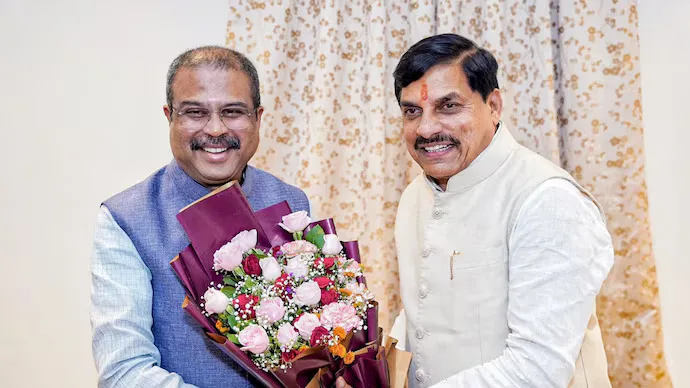
A fresh debate has quietly but powerfully taken shape after Union Education Minister Dharmendra Pradhan suggested something that, at first, sounds almost unimaginable, though not new: what if the world stopped following Greenwich Mean Time and instead looked towards India, towards Ujjain, as the centre of global time?
This idea, called Mahakal Standard Time (MST), was introduced during the ‘Mahakal: The Master of Time’ conference in Ujjain in April 2026. The setting itself felt symbolic, scholars, leaders, and thinkers gathering in one of India’s oldest spiritual and scientific cities to talk about time, something that connects every human being on Earth.
At its heart, the proposal is simple, yet profound. It asks a basic question: why should the world continue to measure time from Greenwich in the United Kingdom, when centuries ago, Indian astronomers were already studying time, space, and planetary movements with remarkable precision and often from Ujjain?
Why Ujjain? Story rooted in history and science
To understand this idea, one must go back in time, long before colonial maps and global agreements fixed Greenwich as the centre of time.
Supporters of MST say Ujjain was once one of the most important hubs of astronomy in the world. Ancient Indian texts like the Surya Siddhanta are often cited as proof. These were not simple observations, they contained detailed calculations about planetary motion, eclipses, and time cycles that still amaze scholars today.
Ujjain was not chosen randomly. It held a special place in ancient Indian astronomy as a reference point for longitude. Its location, close to the Tropic of Cancer, made it geographically significant as well. For centuries, scholars looked at Ujjain not just as a city, but as a centre for measuring time itself.
Those backing the proposal often say this is not about creating something new, but about recognising something very old that was gradually forgotten or overshadowed. Long before Greenwich became the global standard in the 19th century, Indian scholars were already using Ujjain to observe the skies and measure time.
More than Science
But this proposal is not only about science or geography, it carries emotion, history, and even a sense of civilisational pride.
Many supporters argue that GMT became the world’s standard during a time when colonial powers dominated global systems. In that sense, they see it less as a purely scientific choice and more as a result of political influence.
For them, Mahakal Standard Time is a way of reclaiming India’s intellectual and scientific legacy. It is about reminding the world and perhaps even reminding ourselves, that India once played a leading role in understanding time and the universe.
Madhya Pradesh Chief Minister Mohan Yadav has also backed the idea, saying that traditional Indian methods of timekeeping based on sunrise, sunset, and planetary positions are closely connected to nature and the Earth’s rhythms.
Even the name “Mahakal” carries weight. It refers to Shiva as the god of time, giving the proposal a spiritual touch. In a way, it blends science with culture, facts with faith, a combination that is deeply Indian.
If it happens, what would change?
Now comes the difficult part, what would it actually mean if the world accepted this idea?
If Mahakal Standard Time were ever implemented, it would mean shifting the prime meridian, the zero-degree line used to measure longitude, from Greenwich to Ujjain. That sounds simple in theory, but in reality, it would affect almost everything.
Time zones across the world would need to be recalculated. Flight schedules, satellite systems, financial markets, global communications, even the internet, everything that depends on precise timing would need to adjust.
Right now, the world follows Coordinated Universal Time (UTC), which is built on GMT and maintained using atomic clocks and international agreements. It is deeply woven into the functioning of modern life.
Supporters believe that with today’s technology, artificial intelligence, advanced computing, such a transition is technically possible. But experts warn that the scale of change would be enormous, and not without disruption.
Is it even possible?
This is where reality steps in.
Despite the passion behind the proposal, most experts agree that replacing GMT or UTC is extremely unlikely. The current system is not just a habit, it is the backbone of global coordination.
Changing it would require agreement from almost every country in the world. And in today’s complex geopolitical environment, reaching such a consensus is easier said than done.
Voices from the opposition, have also raised concerns. They argue that while the historical and cultural points may be valid, the practical challenges are simply too big to ignore.
Yet, whether or not Mahakal Standard Time ever becomes reality, it has already done something important, it has started a conversation.
It has made people pause and think about India’s past, about its contributions to science, and about how history is remembered or sometimes forgotten.
For some, this proposal feels like a long-overdue recognition of India’s place in the world of knowledge. For others, it raises questions about balancing pride with practicality.
But perhaps the real significance lies somewhere in between.
Because in talking about time, we are also talking about identity, history, and the way a nation sees itself in the modern world.
Whether MST remains an idea or becomes something more, one thing is certain, the discussion it has sparked is not going away anytime soon. And maybe, in that sense, it has already achieved something meaningful.