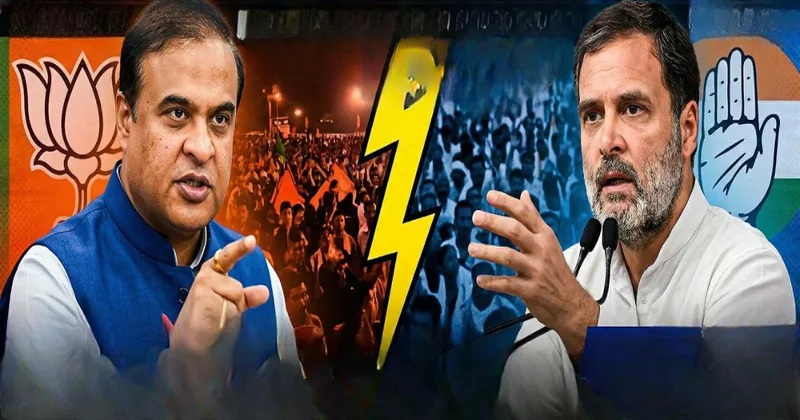
In the 126 member Assam Assembly 64 seats are required for government formation. In the outgoing Assembly the Bharatiya Janata Party (BJP) led alliance enjoys a majority with 75 seats. The tally, BJP 60, Assam Gana Parishad (AGP) 9, United People’s Liberal Party (UPPL) 6. The Indian National Congress led Opposition has 47 seats. Congress 29, All India United Democratic Front (AIUDF) 16, Raijor Dal 1, Communist Party of India(CPI) 1. The politically flexible Bodoland Peoples’s Front(BPF) has 4 seats and Independents 1 seat.
As Assam approaches the 2026 Assembly elections, it is becoming increasingly clear that the contest is focused around two contrasting political realities. On one side is the incumbent BJP led government seeking a renewed mandate on the basis of governance, stability, infrastructure development and welfare delivery over the past five years. On the other is a Congress led fragmented Opposition whose most visible point of convergence is the shared objective of removing the BJP from power.
Unlike wave elections defined by a single overriding emotion, this contest will be a layered and locally differentiated battle. Delimitation has reshaped the State’s electoral terrain influencing constituencies, political contests and community representation. Although the total strength of the Assembly has remained at 126 seats, boundary changes and reclassification of constituencies have altered the demographic and political equation in key areas.
One significant shift is the increase in reserved seats for Scheduled Tribes and Scheduled Castes aimed at demographic equity. Overall, delimitation will have electoral implications for representation, party strategy and community politics affecting traditional support bases and ticket allocation decisions. The electorate, however, is unlikely to decide purely on slogans. Voters will measure performance, credibility and coherence. The 2026 verdict may be less about ideology and more about comparative confidence.
Assam rarely votes uniformly. Instead it is like several sub-regions voting simultaneously. Different demographic blocs play a significant role in deciding the outcome. In Upper Assam Tea Tribe voters and rural Assamese communities play a decisive role. In Lower Assam and parts of Central Assam Minority voters influence the result in many seats. In the Bodoland Territorial Region(BTC), politics are influenced more by local issues and party alignments than by State-wide narratives. In Barak Valley identity politics, citizenship debates and economic concerns intersect. While in the Autonomous hill districts of Karbi-Anglong and Dima-Hasao ethnic identity and State policies on tribal autonomy are crucial issues.
Muslim voters, concentrated in Lower and Central Assam, form the backbone of the Opposition’s base. Their turnout levels and the degree of consolidation behind a single candidate in each seat could influence upwards of twenty constituencies. The Tea Tribe communities in Upper Assam historically aligned with the Congress have shifted noticeably toward the BJP. Even a partial swing back could upset all calculations. Indigenous rural Assamese voters outside the tea belt represent another pivotal bloc.
Their votes are influenced by land rights, identity concerns and economic opportunity which will determine how they vote. In the Barak valley the BJP has a strong presence. Alliances in the fifteen BTC seats could significantly affect post-election arithmetic, especially in the event of a hung assembly. Women voters, cutting across communities, have increasingly tilted the electoral scales. Welfare schemes, direct benefit transfers and household economics influence their choices. Any shift in this bloc could have ripple effects across many seats. Urban middle-class voters concerned with governance and stability may opt for continuity.
The BJP government has the advantage of incumbency and organizational depth. Over the past five years it has focused on infrastructure expansion prioritizing road connectivity, building bridges, rural electrification and uplift. Welfare delivery through direct benefit transfers, housing schemes and targeted support for women and economically weaker sections has strengthened its grassroots network. Administrative assertiveness has also been a hallmark. The government has projected a strong law-and-order posture, pursued anti-encroachment drives and framed its policies around identity protection and development. For many voters, especially in urban and semi-urban areas, this has translated into a perception of stability and decisiveness.
However, governance is never judged on achievements alone. Employment remains a major problem particularly among youth. While recruitment drives have been conducted, unemployment and underemployment remain a cause of dissatisfaction. High food prices and rising costs of living affect both rural and urban voters. Development and growth have also not been uniform or inclusive across the State. Thus, the BJP’s electoral proposition rests on a straightforward argument that continuity ensures stability and sustained development. Whether that argument resonates widely enough will depend on how voters weigh tangible improvements against unresolved concerns.
The Congress remains the principal opposition force, but its organizational footprint is uneven. It retains influence in pockets of Upper Assam and parts of Central and Lower Assam. AIUDF continues to command significant support in minority-dominated constituencies particularly in the Assam-Bangladesh border districts. Raijor Dal and Asom Jatiya Parishad, though smaller in scale, have influence in specific Upper Assam areas and among segments of youth voters sensitive to regional identity issues. But coordination among these parties is inconsistent.
Seat-sharing negotiations, mutual distrust and overlapping ambitions complicate alliance-building. In several constituencies, Opposition parties have historically contested against one another, splitting votes and weakening their collective strength. Even where they agree on common candidates, grassroots workers may not seamlessly transfer support.
More fundamentally, the Opposition narrative often appears reactive rather than programmatic. While “change” can be a powerful rallying cry, it rarely suffices without a clear governance blueprint. Voters may want change. But change to what and under whose leadership? Assam’s political history shows that dissatisfaction does not automatically translate into regime change. It must be channeled through credible alternatives.
Elections are not decided by arithmetic or rhetoric alone. Perceptions of momentum, leadership credibility and campaign energy influence fence-sitters. The result may hinge less on headline rhetoric and more on disciplined alliances, micro-level social shifts and turnout patterns across distinct voter blocs. Ultimately, Assam 2026, may be a comparative referendum on governance, delivery and development against the Opposition’s cohesion, credibility and commitment.