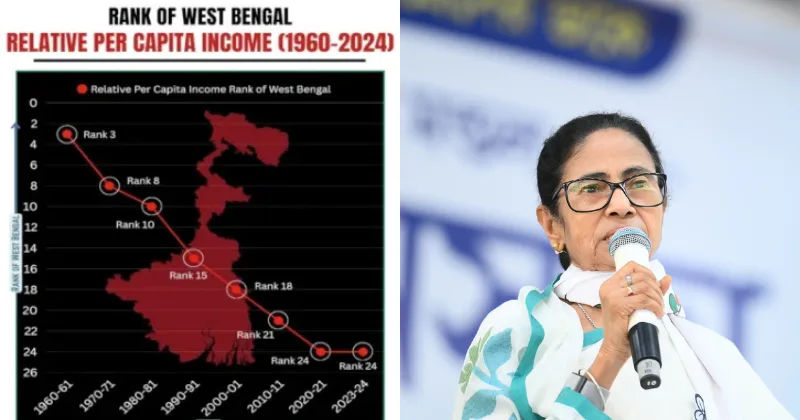
The member of the Prime Minister’s economic advisory council Professor Shamika Ravi’s recent X post on West Bengal’s ultra-slow growth on monthly per capita consumption expenditure started a debate. She, showing a data chart of annualized real growth rate of monthly per capita expenditure across States of Bharat for the period between 2011-12 and 2023-24 in both rural and urban areas, asked, “What is holding West Bengal back?”
While some criticized her treatment & representation of data, some argued even change in representational approach would keep the ultimate takeaway i.e. West Bengal’s inexplicable slowdown constant.
Looking through the data from a commoner’s perspective, I found something noticeable behind West Bengal’s extraordinary slowdown of annualized growth rate of monthly per capita expenditure. While the EAC-PM data showed the urban growth rate of West Bengal near about 1.2%, total consumption expenditure of West Bengal did not appear to be that low from the available information in public domain.
Kolkata logged the highest year-on-year monthly car registrations for the fifth straight month in May 2025 (Ref: auto.economictimes, June 2025) On the contrary, the whole West Bengal State accounted for only 2.7% of India’s total car sales in 2025, a higher share than only Bihar (2%) & Andhra Pradesh (2.5%). (Ref: Hindustan Times, November 2025).
Apart from vehicles, Kolkata’s smartphone market too did well having Kolkata as one of the top 5 cities of India that held 25% of the market. (Ref: telecom.economictimes, October 2020). Moreover, West Bengal contributes around 5% of the national sales of room air conditioners of which 60% comes from Kolkata alone. (Ref: TOI & economictimes)
Keeping all such facts in view, it may appear to some that West Bengal’s consumption base is too high to register a faster growth rate. However, such hypothesis doesn’t match with West Bengal’s total GST collection profile which is low in comparison to other high consumption States. In certain months in 2021, the State’s collection almost equated with Odisha’s which seemed inexplicable given the assumption that West Bengal’s consumption base was historically high.
The only other viable explanation of such slowdown could be disproportionately faster rise of West Bengal’s urban population. EAC-PM data serves food for thought if such slow per capita expenditure growth is another indicator of huge immigration in West Bengal’s urban areas. While looking at growth, people may miss out the ‘per capita’ factor. While immigrants themselves may not consume significantly, they indeed add to the denominator reducing the quotient.
Another article came in ‘The Indian Express’ that mentioned West Bengal did well in social indicators such as high Female Literacy (93.1%), low Total Fertility Rate (1.3) and a very low population growth rate (0.5% per annum). On the other hand, West Bengal witnessed a 66% increase in the number of registered voters between 2002 & 2025 as per the data of the Election Commission of India — from 4.58 crore to 7.63 crore which didn’t match with a low TFR & a very low population growth rate. Such disparity doesn’t leave the observers with many choices but one to explain the phenomenon of West Bengal slowdown— likely presence of accounted for immigrants in the State as part of the State’s consumption chain but not really the production chain.
As only legit locals of the State are to feature in the private corporates’ choice list of employees, West Bengal Government appears disinclined to attract or retain private investment & firmly pose against preference towards legit locals instead of immigrants. Mamata Banerjee distinctly signaled the State’s aversion for private investment by passing the ‘Revocation of West Bengal Incentive Schemes and Obligations in the Nature of Grants and Incentives Bill, 2025’ in April 2025 revoking a range of fiscal incentives to industries apparently in order for utilizing the same resources for welfare schemes’ revenue expenditures. This poses to hint that the State is ultra-protective about its populace & doesn’t want them to pass through domicile screening by any private corporate.
West Bengal’s sluggish agrarian growth (2.9% AAGR) too seems congruent with the same explanation of disproportionately high population due to the presence of immigrants. Let’s have a look. While the State is a major producer of several crops including various vegetables too, a research paper by the Agro-economic Research Centre of Visva-Bharati, Santiniketan in 2011 states as follows. ‘the gross cropped area (GCA) has increased significantly over the years while net sown area (NSA) has remained more or less the same. …area put to non-agricultural uses seem to rise signifying transfer of land from agriculture to other uses…’.
Decrease of agro land due to residential expansion and for aquaculture is indicative of nothing but population burden. Not to forget the Sandeshkhali model of land grab by inundating agro-land with salt water from the Bay of Bengal in the deltaic region of North and South 24 Parganas converting such lands into fishing lakes (‘bheris’).
Not even to forget the stream of a complete river Ichhamati flowing between West Bengal and Bangladesh near the Basirhat border of North 24 Parganas is being blocked by alleged local land mafias who are allegedly encroaching on riverbanks to build illegal fishing lakes, choking the life out of the waterway. The river is hence, shrinking with flow blocked that would soon result in flood havocs affecting the agrarian growth of the State.
In spite of all these, West Bengal is a major producer of several crops because of soil fertility. The fact that number of marginal farmers with less than 1 hecter cultivation area and area under marginal holding are increasing fast in West Bengal while semi-medium, medium & large farmers are on a decline both in number as well as in area under operation appears to indicate, again, high on-ground population. From where is such population coming if West Bengal’s population growth rate is 0.5% pa?
The riddle gets solved also by looking at the intermediary-heavy supply chain of vegetables that leaves for the farmer only around a third of the selling price the consumer pays in lieu. West Bengal Government could not arrange for an intermediary-free wholesale vegetable market in every block. While the State government tried to build a value chain of vegetables ‘SUFAL Bangla’, the carts went only to a particular religious group from whom many consumers chose not to buy, limiting the success of the value chain.
All such facts appear to indicate presence of accounted for immigrants in the State as part of the State’s consumption chain but not really the production chain. Such takeaway goes in congruence with the craze of people for even a meagre Rs. 1500.00 of ‘Lakshmir Bhandar’ too. Immigrants having no significant daily fund in hand are being given dole support for subsistence resulting in huge debt of the State’s public account.
West Bengal’s consumption is high, but number of consumers seems far higher comprising a large number of immigrants yielding a very low per capita consumption expenditure & the growth rate thereof.