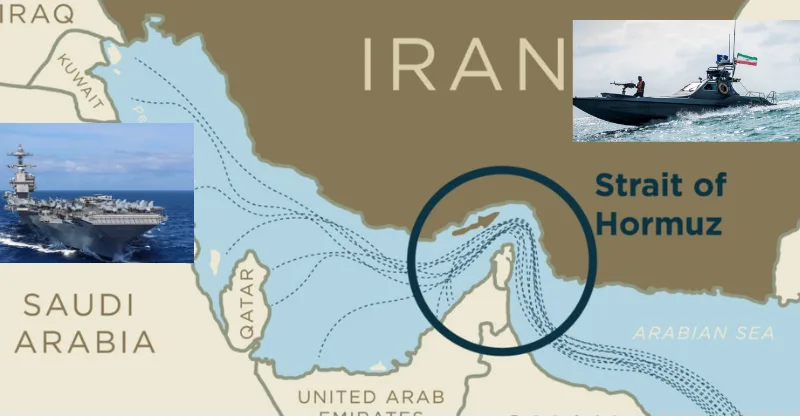
With the United States & its ally Israel pounding Iran with incessant onslaughts, the West Asian nation is using Strait of Hormuz, where 20 per cent of global oil passes, as a strategic geographical location to block its adversaries. The Strait has emerged as world’s most critical maritime chokepoint. To neutralise military confrontation, Iran can block the Strait & use guerrilla-style maritime tactics. In this geopolitical context, it’s time to examine purpose of the US Navy’s aircraft carrier operations vis a vis Iran’s Choke Point Strategy.
At present, in the 2026 Iran–United States confrontation, the Arabian Gulf and the Strait of Hormuz have emerged as the central arena of both naval and geopolitical conflict. In this context, it is essential to analyse the role of the United States (US) Navy, particularly its aircraft carrier operations, alongside Iran’s asymmetric “guerrilla-style” maritime tactics using fast attack boats. Equally important is the role of Gulf navies and the key lessons emerging from this evolving conflict.
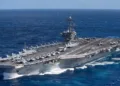
In the 2026 crisis, the backbone of US naval power lies in multiple Carrier Strike Groups. Several U.S. Navy supercarriers—such as USS Gerald R. Ford, USS Abraham Lincoln, and USS George HW Bush—have been deployed in waters close to Iran. From these positions, their aircraft can launch strikes against Iranian military bases, missile sites, and naval infrastructure.
The role of these naval forces is not limited to offensive operations; they also provide security to allied nations in the Arabian Gulf. Aircraft carriers function as mobile airbases, enabling coordinated operations involving fighter jets, electronic warfare aircraft, AWACS and strike drones. This integrated air-sea capability gives the US significant long-range strike power and operational flexibility.
Gulf Navies: Limited Role
Navies of Gulf countries such as the United Arab Emirates, Saudi Arabia, Oman, Qatar, and Bahrain are actively deployed in the Strait of Hormuz and the wider Persian Gulf region. However, their role in the conflict has largely remained cooperative and defensive.
● Logistical Support: These nations provide essential logistical support to the US and allied naval forces. Their airbases and ports serve as key hubs for sustaining operations of American supercarriers
● Coastal Security: Gulf nations have strengthened their coastal defenses as well as maintained constant patrolling to monitor threats emanating from Iranian fast attack boats
● Operational Constraints: These navies have largely avoided direct large-scale combat against Iran, focusing instead on securing maritime trade routes
Iran’s Asymmetric Maritime Strategy
Despite lacking large warships like the United States, Iran has adopted an asymmetric warfare approach in the Strait of Hormuz. The Islamic Revolutionary Guard Corps (IRGC) Navy and the Iranian Navy operate hundreds of fast attack craft (speed boats). Though small in size, these vessels are equipped with machine guns, rocket launchers, and anti-ship missiles.
Examining Iran’s War Tactics
Iran’s primary objective is to maintain constant pressure on the US as well as international naval forces.
● Harassment and Disruption: Iranian speed boats frequently interfere with commercial shipping, conducting provocative maneuvers in close proximity to vessels.
● Swarm Attacks: Multiple small boats operate in coordinated groups to surround and overwhelm larger warships. This forces adversaries to rely on defensive firepower and electronic warfare systems.
Such tactics aim not only to inflict physical damage but also to create psychological pressure and disrupt global economic stability.
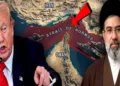
The Strait of Hormuz is one of the world’s most critical maritime choke points, through which nearly 20 per cent of global oil and gas supplies pass.
A choke point is a narrow maritime passage that handles a large volume of shipping traffic but can be easily blocked or disrupted. Much like a narrow bridge or tunnel on land, any disruption in such a route can halt global movement and force ships to take long, costly detours.
The Strait of Hormuz, only about 21 miles wide, is vital for global energy flows. In the current crisis:
● Several oil tankers have been damaged
● Insurance costs for shipping have surged
● Commercial vessels face delays and rerouting
Control over such a choke point effectively means controlling a critical lifeline of the global economy.
Iran’s geographical position along the Strait gives it a strategic advantage. Whenever subjected to sanctions or military pressure by the United States or Western nations, Iran threatens to block the Strait of Hormuz.
Choke points can be used as strategic weapons to:
● Disrupt global trade and energy supplies
● Attract international attention and exert pressure
● Block supply chains of adversaries, including fuel, food, and military resources
In essence, choke points act as maritime “strangleholds”—whoever controls them can significantly influence global economics and warfare outcomes.
Tactical Tools Used by Iran
● Fast Attack Boats and Suicide Drones: Used to swarm and threaten larger vessels
● Coastal Missile Systems: Land-based anti-ship missiles targeting vessels in transit
● Smart Sea Mines: Deployed in shipping lanes to create high-risk zones for commercial traffic
Global Impact of Iran’s Strategy
In the current conflict, Iran has carried out multiple low and high-intensity attacks on commercial vessels. Iranian speed boats and drones often circle dangerously close to oil tankers, creating a climate of fear.
As a result:
● Global oil prices have surged
● Shipping companies have altered maritime routes
● Economic and political pressure has increased worldwide
Even temporary disruptions in this region have far-reaching global consequences.
Takeaways of Naval Warfare
The situation in the Strait of Hormuz clearly indicates that future naval warfare will increasingly revolve around:
● Choke point blockades
● Drone and swarm-based maritime warfare
● Asymmetric tactics against conventional naval superiority
Iran’s use of speed boats and low-cost technologies demonstrates how smaller forces can challenge even the most advanced navies.
This conflict once again underscores the point that beyond advanced weapon systems, the most decisive factor in war remains the soldier—his training, morale, and fighting spirit.
Equally important is the role of civilians during wartime. In situations involving energy crises or shortages of essential commodities:
● Citizens must conserve fuel and resources
● Avoid panic and misinformation
● Cooperate with Government authorities
In future multi-dimensional warfare, disciplined and resilient citizens will play a crucial role in ensuring national strength and ultimate victory.