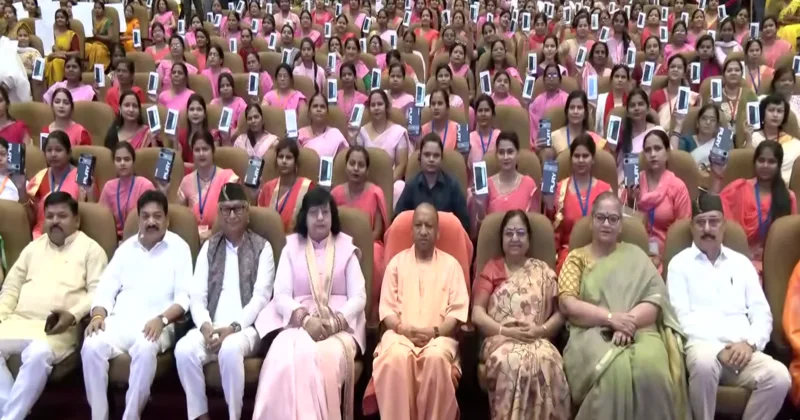
In a move to benefit over three lakh workers at grassroot level, UP CM Yogi Adityanath in Lok Bhavan, Lucknow announced a hike in honorariums for Anganwadi workers and helpers across the state. In the same event, 69,804 smartphones were also distributed to Anganwadi workers and supervisors, along with appointment letters to 18,440 workers and helpers. There were also the inauguration and foundation laying of child development and women welfare projects of more than Rs 450 crore.
To benefit the smart and tireless role of Anganwadi workers play in nation-building, CM Yogi declared that the honorarium of these workers must be smart. Signalling a substantial upward revision in their pay structure, he assured Anganwadi workers that they would receive a respectable and minimum guaranteed honorarium soon.
Who Are These Anganwadi Workers and Why Do They Matter?
Before understanding the significance of Yogi’s announcement, one must know about these Anganwadi workers and also the irreplaceable role they play in our daily lives particularly in semi-urban localities and villages.
The meaning of Anganwadi is courtyard shelter. The aim of Anganwadi Services (ICDS) is holistic development of children under the age of six years, with beneficiaries including children of this age group, pregnant women and lactating mothers. These centres are in every corner of India, mostly the first point of formal contact between the state and the most vulnerable sections of society.
Anganwadi centres are run by Anganwadi workers who are women. These workers are not conventional regular government employees, they receive honorariums. But the nature of their work is extraordinary. They are nutritionists, health educators, pre-school teachers, community mobilisers and data collectors all into one. They track the growth of infants, counsel the pregnant mothers on diet and hygiene, ensure that children have received immunisations, along with distributing supplementary nutrition. During the COVID-19 pandemic, they were on frontline who conducted screenings and delivered essential services to every household.
In Uttar Pradesh, 897 child development projects are operational through about 1.89 lakh Anganwadi centres in all 75 districts. This is not a small number, but actually it is one of the largest grassroots welfare networks anywhere in the world. The women running this system have been among the most underpaid workers in the country for decades.
The Reality of Pay: How Much These Women Earn
Anganwadi workers are paid very little against the level of work and importance of the work they do. In UP on an average an Anganwadi worker generally gets a monthly honorarium of around ₹6,500 to ₹8,000, and an Anganwadi helper receives around Rs 3,500 to Rs 4,000 on monthly basis. These figures here include the contributions from the central and state governments both.
This can be put into perspective that Anganwadi workers who wakes up before dawn, walks through dusty lanes to visit households with newborns, to weigh infants, to counsel mothers, to maintain registers, to enters data but earns less than the monthly rent of a modest apartment in any of Indian cities. This disparity between their contributions and their compensation has long been a point of protest and frustration.
As part of Mission Poshan 2.0, central government provides internet connectivity charges to Anganwadi workers at ₹2,000 per year per worker enabling them to capture real-time data in the Poshan Tracker application. The workers unions have been consistently arguing that technology without adequate pay is an incomplete solution.
Why CM Yogi is Increasing Stipends Now?
CM Yogi has decided to hike honorariums due to humanitarian ground and other factors including:
The Problem of Data: CM Yogi said that real-time data from Anganwadi workers was not available earlier due to lack of smartphones. Since the data was not being uploaded, the national ranking of state remained low. A better-equipped and better-paid workforce means more accurate nutrition and health data which will directly affect how UP performs on key national indices like the National Family Health Survey and the NITI Aayog Health Index.
The Crisis of Malnutrition: More than 1 crore 70 lakh children have been connected to health check-ups and screening in the past 9 years, under the ‘Sambhav campaign’. Out of 1.5 lakh malnourished children which were identified, 80% have been freed from malnutrition. Stunting rate has come down from 48% to 37%. These gains have been largely possible due to Anganwadi workers and to sustain them as a motivated, stable workforce along with payment is required.
Expansion of the Role of Anganwadis: Under the latest National Education Policy, pre-primary education of children of 3 to 5 years of age will also be conducted at Anganwadi centres. This expands the responsibility of Anganwadi workers, who will now also have to function as early childhood educators. To attract and retain qualified women for this expanded role a higher honorarium is necessary.
Social Security Net for the Workers: To ensure social security, Anganwadi workers are getting the benefits under Pradhan Mantri Jeevan Jyoti Bima Yojana and Pradhan Mantri Suraksha Bima Yojana. Under Ayushman Bharat Scheme, more than 3 lakh workers and helpers are getting health insurance coverage of up to ₹5 lakh per year. The honorarium hike only completes this social security package.
The Smartphone Initiative: Smart Honorarium, Smart Work
Most visible part of this announcement is the distribution of 69,804 smartphones and it is not merely symbolic. Nutrition tracking, updating children’s data, monitoring pregnant women and real-time implementation of government schemes will now be possible through smartphones.
With an expenditure of Rs 236 crore, 23,697 Anganwadi centres have been developed as Saksham Anganwadi. These centres are equipped with LED screens, RO machines, ECCE (Early Childhood Care and Education) kits and also modern furniture. These centres are no longer limited to nutrition distribution only but are now becoming hubs for children’s holistic development, education, health and mental growth.
Apart from smartphones, modern equipment such as 10,553 infant meters, 1,33,282 stadiometers and 58,237 mother-child weighing scales is being distributed across the state. These devices will enable accurate monitoring of children’s height, length and weigh. Thus it will ensure timely identification and treatment of malnutrition.
CM Yogi also set an ambitious recruitment target for this year, to appoint more than 5,000 Anganwadi workers and over 60,000 helpers, with the recruitment process already underway.
What It Means for Families: The Ground Benefits
The upgradation of Anganwadi centres is not only a bureaucratic exercise but it will be the difference between a malnourished child and a healthy one, between a mother dying in childbirth and surviving it, for ordinary families in rural UP.
Due to a smartphone an Anganwadi worker will be able to upload a child’s real time growth data. A drop in weight triggers an alert. A flagged case reaches a government nutritionist, intervention happens faster and lives are saved. This is not a hypothesis only, but it is what the data shows. Levels of Anaemia declined by 5.1%, stunting by 6.6%, underweight cases by 7.4 per cent, and wasting by 0.6 per cent, between 2015-16 and 2019-21 in Uttar Pradesh, in a state that was once synonymous with child mortality.
A higher honorarium will ensure that talented, educated women do not leave the Anganwadi system in search of better-paying alternatives. Retention of experienced workers in such workforce directly translates to a better continuity of care for children and also mothers in the community.
The ‘Yashoda Maiya’ of the Nation
To Recognise the vital role they play in developing a child up to 6 years of age, Prime Minister Shri Narendra Modi has given every Anganwadi worker and helper the title of ‘Yashoda Maiya’, just like Yashoda Maiya nurtured baby Shri Krishna, these women are also shaping the future of our nation.
Anganwadi workers are the first responders in India’s fight against malnutrition, they are the first teachers of early childhood, as well as they are the first line of health support for millions of mothers. To truly ripe the benefit of India’s demographic dividend, the women who are nurturing its youngest citizens must themselves be nurtured, with dignity, technology and payment that reflects the scale of work what they do.
The Critical Perspective – Promises Must Not Be Broken
Announcements have been largely welcomed but workers groups urge that intent must be matched with implementation. In past opposition voices and union leaders have pointed out that promises of hikes in pay have sometimes taken some time to materialise on the ground. Anganwadi workers have historically been raising the concerns that their remuneration are not keeping pace with their expanded responsibilities and have been demanding the recognition of formal government employees with full benefits. With the present government motto of Sabka Sath Sabka Vikash, CM and PM will not let the Anganwadi workers left alone for their basic needs.