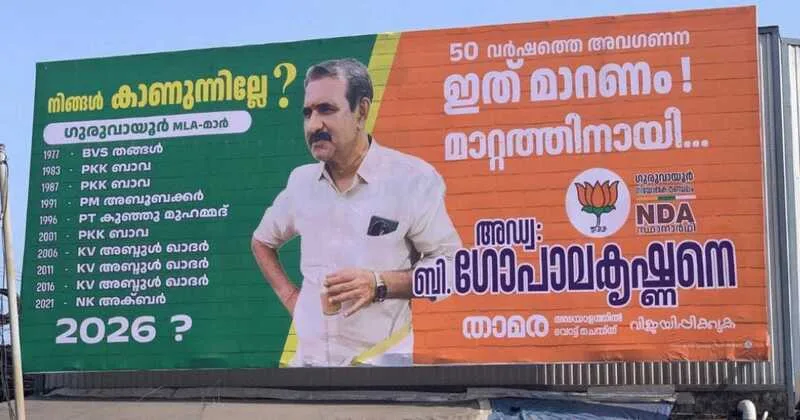
Thrissur: The politically sensitive Guruvayoor Assembly constituency in Kerala has witnessed a sharp escalation in rhetoric after BJP candidate B Gopalakrishnan reiterated his demand for a “Hindu MLA” from the temple town, triggering both political reactions and legal complaints. Known globally for the Guruvayoorappan Sree Krishna mandir, the constituency has now become a focal point of debate over representation, identity, and electoral dynamics. Located in Chavakkad Taluk, Guruvayoor reflects a distinct demographic profile. As per the 2011 Census, Muslims constitute 53.58 per cent of the population in the taluk, followed by Hindus at 41.87 per cent, while Christians make up around 4.25 per cent. These numbers have historically influenced electoral outcomes in the constituency.
Mandir identity vs electoral reality
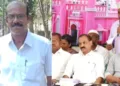
Gopalakrishnan stirred controversy with a video shot in the backdrop of the Guruvayoor Mandir, where he questioned the absence of a Hindu MLA in a globally renowned Hindu pilgrimage centre.
“Neither Left nor Right had a Hindu MLA. Guruvayoor is an international pilgrimage centre. Why is there no Hindu MLA? Guruvayoorkappan has called me to release his land from 50-year-long imprisonment by temple thieves and anti-Mandir people,” he said. He further escalated the debate by challenging the sitting Guruvayoor MLA N.K. Akbar to declare his faith in Guruvayoorappan during public speeches, framing the issue as one of cultural and civilisational representation.
In a social media post, Gopalakrishnan also pointed out that the Congress-led United Democratic Front (UDF) has not fielded a Hindu candidate in any of the constituencies in Malappuram district, except in seats reserved for Scheduled Castes. The constituency, notably, has not elected a Hindu representative since 1967. Going strictly by numbers, Muslims outnumber the sizable Hindu population. The Chavakkad Taluk encompassing Guruvayoor has roughly 54 per cent Muslims and 42 per cent Hindus, with Christians forming the remainder.
Political history and shifting power equations
Guruvayoor’s electoral history reflects a complex interplay of alliances and social engineering. Both the Left Democratic Front (LDF) and the Congress-led United Democratic Front (UDF) have held the seat over the years. In 1977, the UDF allocated the seat to its ally, the Indian Union Muslim League (IUML), which retained it uninterrupted until 1991. A dramatic shift occurred in 1994 following a political split led by IUML stalwart Ebrahim Sulaiman Sait, who formed the Indian National League (INL) after opposing IUML’s continued alliance with Congress in the aftermath of the Babri Masjid demolition.
Then Guruvayoor MLA P.M. Abubacker joined Sait and resigned, triggering a by-election. The INL chose to stay out of the contest and supported the LDF. The situation was further complicated by controversial preacher Abdul Nazar Madani, whose People’s Democratic Party (PDP) polled over 15,000 votes, significantly denting IUML’s prospects.
The LDF fielded film director P.T. Kunju Muhammed in the bypoll and secured victory. Muhammed retained the seat in 1996. Though IUML briefly regained the constituency during the 2001 UDF wave, the LDF has largely maintained dominance since then.
According to a veteran Left leader, this shift was the result of long-term social engineering initiated by CPI(M) leader Baby John in the 1980s. In 1987, John persuaded IUML state committee member and Kadappuram panchayat president P.C. Hameed Haji to defect, protesting candidate selection within IUML. Though the Left lost that election, the move weakened IUML’s stronghold in Kadappuram and eventually helped consolidate LDF’s position in Guruvayoor.
The constituency has also undergone major delimitation changes, with a sizable portion of the Guruvayoor municipality now falling under the adjacent Manalur Assembly constituency. This has further aligned Guruvayoor’s political identity with Chavakkad’s demographic structure.
Complaint, Case, and Firm Rebuttal
Gopalakrishnan’s remarks have drawn strong objections from opposition groups. The Kerala Students’ Union (KSU), the student wing of the Congress, filed a complaint with the Thrissur City Police Commissioner, accusing him of making communal statements and misusing Mandir premises for political campaigning. Based on the complaint, the police have registered a case against him.
However, Gopalakrishnan has not retreated. Instead, he reiterated and sharpened his stance, framing it as a cultural assertion. “I stand by my word. If someone can claim himself as a ‘Muslim League MLA’, why can’t I claim Hindu MLA. Hindu is a culture rather than religion,” he said. His position has sparked a wider debate on representation in constituencies with strong religious-cultural identities, especially in places like Guruvayoor, which holds immense significance for Hindu devotees globally.
Meanwhile, both major fronts have chosen to remain silent on the controversy. The LDF has fielded its sitting MLA N.K. Akbar once again, while the UDF candidate is the Indian Union Muslim League’s C.H. Rasheed. Neither has responded to Gopalakrishnan’s remarks so far. As Kerala heads toward the Assembly elections, Guruvayoor has emerged as a politically charged battleground where demographics, history, and identity intersect.