Mental illness which includes depression, anxiety, psychosis, addiction has been a grinding weight of unaddressed grief has been treated as a private failing, a family shame or an invisible burden that people were expected to carry alone. According to the World Health Organisation, the burden of mental health problems in India stands at 2,443 disability-adjusted life years (DALYs) per 100,000 population. The National Mental Health Survey of India, conducted by NIMHANS in 2015–16, found that 10.6 per cent of adults in India suffer from mental disorders, with a lifetime prevalence of 13.7 per cent. Between 70 per cent and 92 per cent of people with mental disorders in India do not receive proper treatment not because the need is not there, but because of access, awareness and the crushing weight of stigma which stands between them and help.
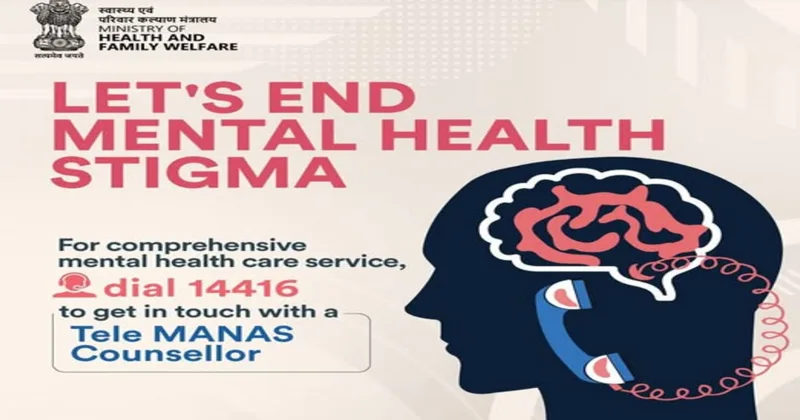
Government of India launched the National Tele Mental Health Programme (NTMHP) on October 10, 2022, World Mental Health Day with a toll-free helpline number- 14416, available 24 hours a day, seven days a week, free of cost across the country. Three years and more than 34 lakh calls, the programme’s scale and design speaks how India is approaching this long-neglected dimension of public health.
The crisis that made action unavoidable
India’s mental health burden has increased over the past decade. The Global Burden of Disease study estimates that nearly 197 million Indians roughly one in seven live with some form of mental disorder. The WHO calculates that the economic loss due to mental health conditions in India between 2012 and 2030 will amount to USD 1.03 trillion. Losses in productivity, healthcare costs and social capital that compound every year that treatment gaps go unaddressed.
The COVID-19 pandemic sharpened these numbers because of isolation, bereavement, economic anxiety and the disruption of normal social support systems drove a measurable spike in distress calls, counselling needs and psychiatric presentations across the country. Recognising this, the Union Budget 2022–23 formally announced the NTMHP, with Finance Minister Nirmala Sitharaman explicitly acknowledging the pandemic’s negative consequences for mental health.
NIMHANS, Bengaluru India’s premier institute for mental health education and research was designated the nodal centre for implementation. The International Institute of Information Technology, Bengaluru (IIIT-B) provides the technological support that enables the system to function at national scale.
What tele-MANAS is and how it works
Tele-MANAS stands for Tele Mental Health Assistance and Networking Across States. It is the digital arm of the pre-existing District Mental Health Programme(DMHP), designed to extend the DMHP reach far beyond. The programme works in two tiers. The first tier consists of trained counsellors who receive calls, conduct initial assessments, provide psychological first aid and offer short-term counselling. The second tier connects callers when necessary, to specialists including psychiatrists, clinical psychologists and other mental health professionals through audio and video consultation.
As of March 3, 2026, 30 States and Union Territories have set up 53 Tele-MANAS Cells dedicated units within state mental health infrastructure that handle calls routed through the national helpline. Services are available in 20 languages, based on the language preference of each state, ensuring that a caller in rural Assam, coastal Andhra Pradesh or a tribal district of Jharkhand can speak in the language they are most comfortable in.
Since inception more than 34.34 lakh calls have been handled on the helpline. A dedicated Tele-MANAS Cell has also been established at the Armed Forces Medical College(AFMC) in Pune, extending tele-mental health support specifically to armed forces personnel and their families. The mobile application launched on World Mental Health Day in 2024, has expanded the programme’s reach further. The app covers mental health support across a spectrum from general well-being and stress management to clinical mental disorders. It has been made available in 12 languages i.e. English, Hindi, Assamese, Bengali, Gujarati, Kannada, Malayalam, Marathi, Tamil, Telugu, Odia and Punjabi.
A referral system that closes the loop
One of the most clinically significant aspects of Tele-MANAS is what happens after a call is received. The programme is not simply a listening service, it is a structured referral gateway. Of the referrals made, 47,487 were for non-emergency in-person services cases where the caller needed face-to-face care but not immediately. A further 9,590 referrals were made for detailed clinical evaluation and 19,135 individuals were connected to Mental Health Professionals. For people whose needs intersected with other health conditions, 10,240 were referred to medical or surgical specialists.
For those in acute psychiatric crisis, 5,083 urgent referrals were made to psychiatric hospital emergencies, with another 345 directed to medical colleges and tertiary hospitals for advanced clinical management. For those needing consistent, ongoing support in their own districts, 1,319 were routed to the District Mental Health Programme for localised care. This referral architecture is the key design innovation of Tele-MANAS. It transforms what could have been a simple helpline into the entry point of a national mental health care network, ensuring that a phone call does not end at a reassuring voice but where needed, leads to a doctor a specialist hospital or a community programme.
Reaching Young India: RKSK, schools and adolescent wellbeing
Mental health problems do not respect age and the government’s approach reflects this. The Rashtriya Kishor Swasthya Karyakram (RKSK) the National Adolescent Health Programme under the Ministry of Health and Family Welfare integrates mental health into adolescent health delivery through three principal channels. Adolescent Friendly Health Clinics (AFHC) provide direct counselling services. Adolescent Health and Wellness Days (AH&WD) create community-level touchpoints for awareness and early identification. Peer Education Groups organised in clusters of 15 to 20 boys and girls, hold weekly participatory sessions of one to two hours on adolescent health including mental wellbeing. Medical Officers, Auxiliary Nurse Midwives (ANMs) and counsellors are all trained under RKSK on the identification and management of common adolescent mental health issues.
The Ministry of Education Manodarpan initiative complements this programme with an online platform offering psychosocial support to students, teachers and families through advisories, audio-visual resources and emotional wellbeing guidance. Interactive sessions named Sahyog (Support) and Paricharcha (Discussion) help students manage academic stress and emotional challenges in a structured, non-stigmatising format. The Ayushman Bharat School Health and Wellness Programme incorporate a dedicated module on Emotional Wellbeing and Mental Health, with trained Health and Wellness Ambassadors and teachers conducting weekly interactive sessions with students, promoting what the programme describes as joyful learning as a mental health intervention in itself.
Beyond the Helpline: Outreach into communities
The reach of Tele-MANAS is not confined to those who dial 14416 or download the app. Tele-MANAS teams have conducted awareness and outreach sessions across an extraordinarily wide institutional schools, colleges, hostels, Industrial Training Institutes (ITIs), universities, NGOs, old-age homes, orphanages, health facilities and professional gatherings. Special initiatives have been held for Indian Railway loco pilots and their families, reserve police personnel, income tax officials, nursing, social work students and counsellors.
This community outreach dimension addresses what public health experts have long identified as the primary barrier to mental health treatment in India stigma. When sessions are held in railway colonies for loco pilots or in police training facilities for constables, in ITI workshops for vocational students, the message being delivered is not just informational. It is that mental health is a subject that concerns every Indian in every profession and every walk of life and that seeking help is neither shameful nor unusual.
Integration into primary healthcare: Ayushman arogya mandirs
The significant development in India mental health architecture is the integration of mental health services into primary healthcare. More than 1.75 lakh Sub Health Centres and Primary Health Centres have been upgraded to Ayushman Arogya Mandirs under the government flagship health infrastructure initiative and mental health services have been formally included in the package of Comprehensive Primary Health Care delivered at these facilities. This means that for the first time, a person in a remote village does not need to travel to a district hospital to receive a mental health intervention. The nearest health centre is now a point of entry into the mental health system.
The District Mental Health Programme (DMHP) the older, ground-level component of the National Mental Health Programme now operates in 767 districts across India, providing outpatient services, assessment, counselling, psychosocial interventions, continuing care for severe mental disorders, medicines, outreach services and ambulance services. 25 Centres of Excellence have been sanctioned under the Tertiary Care component of the National Mental Health Programme to increase postgraduate seats in mental health specialties. Support has also been extended to 47 PG departments in mental health specialties across 19 government medical colleges and institutions.
Paradigm of how India sees mental health
Thirty-four lakh calls in less than four years. Twenty languages, fifty-three cells across thirty-six states and union territories. A dedicated cell for armed forces. Peer education groups in rural communities, Mental health modules in school programmes along with integration into 1.75 lakh primary health centres. They are documented, verified programme outputs from a government system that has, for perhaps the first time chosen to treat mental health not as an afterthought of public health policy but as a central priority within it.
India has fewer than one psychiatrist per 100,000 people against the WHO’s recommended 1.7 and between 70 and 92 per cent of those who need care still do not receive it. But the architecture being built the helpline, referral network, community outreach, school programmes, primary care integration, specialist centres is laying a foundation that simply did not exist three years ago.