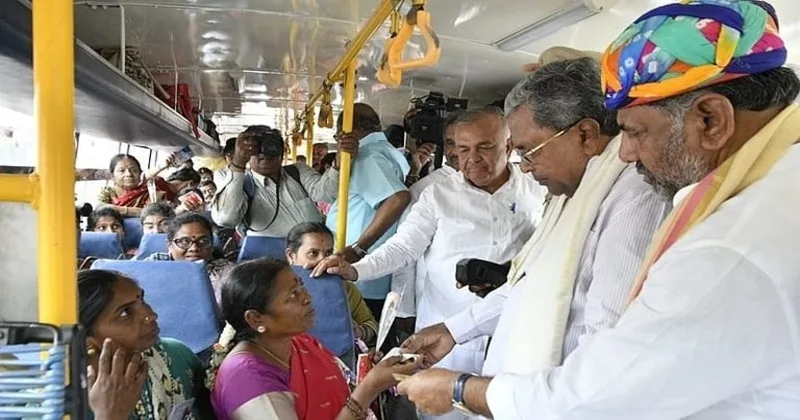
BENGALURU: The growing financial stress on Karnataka’s public transport system has once again reignited the larger debate over “freebie politics,” with critics arguing that populist welfare schemes are pushing state finances towards instability. The controversy surrounding pending dues under the Shakti Scheme has become a flashpoint, exposing the fiscal challenges faced by the Bangalore Metropolitan Transport Corporation.
While the scheme has undeniably benefited lakhs of women by offering free bus travel, its financial implications are now raising serious concerns. The state government was expected to reimburse over Rs 3,097 crore to transport corporations, but only Rs 2,247 crore has been released so far, leaving a gap of nearly Rs 850 crore. This delay has directly impacted BMTC’s cash flow, forcing the corporation to struggle with day-to-day operational expenses.
The situation highlights a broader pattern seen across several states, where large-scale welfare promises are rolled out without ensuring long-term financial sustainability. Critics argue that such schemes, often announced with electoral considerations in mind, end up burdening public institutions already operating under financial stress.
BMTC’s case is particularly concerning. Even before the implementation of the Shakti scheme, the corporation was facing liabilities of over Rs 1,300 crore, including unpaid dues to fuel suppliers, provident fund obligations, and vendor payments. The additional pressure of providing free services without timely reimbursement has only deepened the crisis.
Experts warn that continued delays in fund disbursal could lead to a decline in service quality. Maintenance schedules may be deferred, fleet expansion plans slowed, and operational efficiency compromised. In the long run, this could hurt the very commuters the scheme aims to benefit, including women who rely heavily on public transport.
The government, however, maintains that the scheme is a social investment rather than a financial burden. Officials argue that increased mobility for women contributes to economic participation and social empowerment. They also claim that funds are being released periodically and that steps are being taken to stabilise BMTC’s finances.
Yet, critics counter that welfare should not come at the cost of institutional collapse. “Freebies without fiscal discipline are a dangerous path. If the government cannot sustain payments, it risks weakening essential services,” said a policy analyst. The reliance on loans, such as the proposed Rs 589 crore borrowing support for BMTC, has further raised concerns about increasing debt burdens.
The debate is not limited to Karnataka. Across India, several state governments have been criticised for announcing free electricity, transport, and cash schemes without clear revenue backing. Economists caution that while targeted welfare is necessary, indiscriminate subsidies can distort budgets, reduce capital expenditure, and limit long-term growth.
At the same time, the Shakti scheme’s success in increasing women’s ridership cannot be ignored. It has improved accessibility and provided financial relief to many households. However, the key question remains whether such benefits can be sustained without undermining the financial health of public institutions.