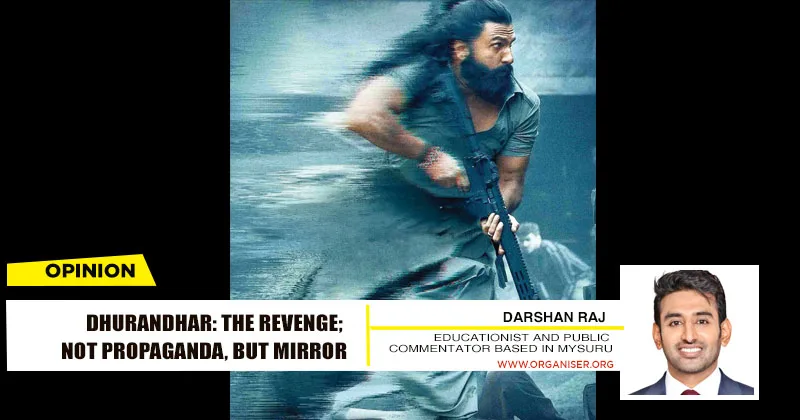
After watching Dhurandhar: The Revenge and spending the next two days cross-referencing US Treasury documents, NIA chargesheets, and court records from a Mumbai terrorism trial, I am no longer unsettled by the film. I am unsettled by how long we did not know — or perhaps, chose not to.
I will be honest. I went in a little skeptical. A nearly seven-hour Bollywood spy duology set in Karachi’s underworld, starring Ranveer Singh, directed by the man who made Uri. I expected something loud, something chest-thumping, something engineered to make me feel a certain way. What I did not expect was to walk out and spend the next two days reading US Treasury notifications, Pakistani newspaper archives from Dawn, and a Florida federal court sentencing order.
That is what Dhurandhar did to me. Not the action sequences, not the cinematography. The specificity.
Because when a film names real people — not “inspired by” composites, but actual documented individuals — and those names lead you to real records, real convictions, real police chargesheets, and a real dead body found at the bottom of a building in Karachi twenty-six days after demonetisation, you start asking a different kind of question. Not “was this a good film?” but “how much of this country’s war has been happening in rooms we were never told about?” The answers I found are uncomfortable and I want to share them.
The Politician with ISI links
The character that shook me most in the latest version of Dhurandhar is Atif Ahmed — the Allahabad-based politician who smuggles counterfeit currency from Pakistan via Nepal, who routes ISI-supplied weapons from drone drops at the Punjab border into Kashmir, who functions as a logistics node in an adversary’s war while simultaneously holding elected office. My instinct when I first watched this character was too convenient. Too on-the-nose. Too obviously designed to provoke a particular kind of audience. Then I searched for Atiq Ahmed. Same city — Prayagraj, formerly Allahabad.
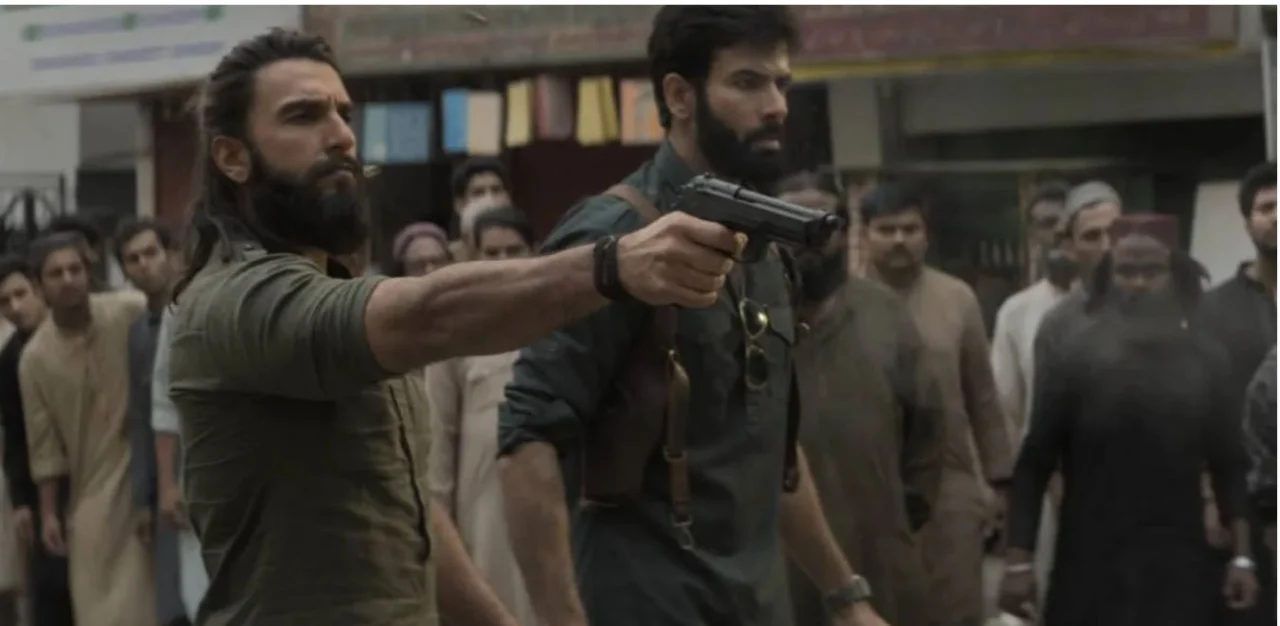
According to official Uttar Pradesh Police chargesheets and Enforcement Directorate investigations — not allegations from some partisan source, but formal investigative documents — Atiq Ahmed commanded a financial empire spanning nearly 200 bank accounts, around 50 shell companies, and dozens of benami properties. The ED seized documents and cash across multiple raids in April 2023. But more than the money, there is this: in his own recorded statement to the UP Police, Atiq Ahmed said, in words that were later reproduced verbatim in a chargesheet filed before a Prayagraj court — “I have no dearth of weapons because I have direct connections with Pakistan’s ISI and terror organisation Lashkar-e-Taiba. Weapons from Pakistan are dropped on the Punjab border with the help of drones and local connections collect them. Terrorists in Jammu and Kashmir get weapons from this consignment.”
He was a former MP, having won a Lok Sabha seat from Phulpur in 2004, and had later served as an MLA on a Samajwadi Party ticket in the State Assembly. The party eventually severed ties with him — but he had won elections, he had sat in Parliament, and by his own words in a police document, he was part of the machinery of Pakistan’s proxy war inside Bharat.
On April 15, 2023, Atiq Ahmed and his brother Ashraf were shot dead at point-blank range in Prayagraj while in police custody. Their killers had disguised themselves as journalists. The whole thing unfolded live on television. The film’s climax for this character is the same scene. Identical setup. Point-blank. Disguise. Custody. I am not making a political argument about the manner of his death, or who benefitted from it. That’s a separate conversation — and an important one. What I am saying is that a man with those documented ISI admissions held elected office for years, and we as a nation never quite had the full reckoning about what that means. Honestly, we still have not started.
The Khanani brothers
In the film, the Khanani Brothers are the financial backbone of the entire operation — Hawala operators who laundered terrorist money, printed fake Bharatiya currency, and functioned essentially as the ISI’s shadow banking system. When I watched these scenes, the detail felt almost too precise to be invented.
In November 2015, the United States Treasury Department formally designated the Altaf Khanani Money Laundering Organisation as a Significant Transnational Criminal Organisation. This is not an allegation — it is an official US Government designation, publicly available. The Treasury’s own document states that Khanani had known relationships with Lashkar-e-Taiba, Dawood Ibrahim, Al Qaeda, and Jaish-e-Mohammed. Their firm — Khanani and Kalia International — reportedly carried out an estimated 40 per cent of all foreign exchange transactions in Pakistan, according to FIA officials quoted at the time. The network ran from Karachi to Dubai to Toronto to East Africa. By any measure, this was one of the largest money laundering operations on earth.
It is fiction built on a factual skeleton that is remarkably solid. Calling it propaganda is intellectually lazy. It is the kind of label you reach for when the facts themselves make you uncomfortable
Altaf Khanani was arrested in Panama in September 2015 by the US DEA. A Florida federal court eventually sentenced him to 68 months in prison and fined him $250,000. This is in court records.
Here is the part that connects it to Bharat. David Headley — the Pakistani-American who did reconnaissance for the 26/11 Mumbai attacks — testified via video-link before a Mumbai Special TADA Court in February 2016, where he stated that his ISI handler, Major Iqbal, gave him counterfeit Bharatiya currency notes on one or two occasions in 2008, used for operational expenses. Forensic examination of currency seized from similar ISI-linked operations pointed to high-quality counterfeits. The financial infrastructure moving illicit funds through Pakistan during this period — the same network that processed narcotics money for cartels and hawala transfers for terrorist groups — was the broader Khanani ecosystem. So the system that laundered dirty money globally also operated alongside the scouting of the Taj Hotel and Chhatrapati Shivaji Terminus. Whether every rupee Headley received was moved through the Khanani pipeline specifically is difficult to confirm from open records — but the overlap of networks, targets, and time periods is documented across three countries’ worth of legal proceedings.
Bharat was being attacked economically and physically, through the same financial environment, simultaneously. And as some people are calling the film that depicts this ‘propaganda’.
On November 8, 2016, Bharat announced demonetisation of the Rs 500 and Rs1,000 notes.
On December 4, 2016 — twenty-six days later — Javed Khanani fell from an under-construction building called Saima Towers in Karachi’s Mohammad Ali Society. Pakistani police called it suicide. His family said it was an accident. No proper autopsy was conducted. Workers at the site were briefly detained and released without charge. The man who had spent two decades building and running India’s fake currency supply chain died within a month of that currency ceasing to be legal tender. This is what the records show.The cop who survived nine attempts. His driver betrayed him on the tenth. Sanjay Dutt’s character — SP Chaudhry Aslam Khan — is the one the film treats most faithfully. And the real story is, if anything, more extraordinary than what is shown.
Chaudhry Aslam joined the Sindh Police in October 1984. He eventually led both the Lyari Task Force and the Crime Investigation Department in Karachi. Pakistan’s Taliban — the TTP — named him publicly as a top target. Not a general target. Specifically him, by name. He had been shot five separate times across his career and survived at least nine assassination attempts in total. In 2012, a suicide bomber drove a truck packed with explosives into the front gate of his house in Karachi’s Defence Phase VIII area. Eight people died. He walked out.
Nine Attempts, Nine Failures
On January 9, 2014, his convoy was struck on the Lyari Expressway in the Essa Nagri area of Karachi. A car loaded with explosives rammed it directly. He died, along with two other officers, his guard, and his driver. The TTP claimed the attack the same day and specifically stated he had been on the top of their kill list for years. The investigation afterward found that his own driver — the man who sat beside him every day, who knew every route and schedule — had passed information about the convoy’s movement to the attackers. Nine times, external enemies couldn’t finish the job. The tenth time, someone inside handed them the key.
The film shows his death as a car bombing. Correct. The film implies inside information enabled it. Also correct. The only thing the film changes is attributing the orchestration to Hamza — a fictional Bharatiya operative. And here is where things get genuinely strange: in 2017, Pakistan’s military PR wing ISPR released a video of Kulbhushan Jadhav — the Bharatiya ex-navy officer arrested in Balochistan — in which he allegedly confesses that RAW orchestrated Chaudhry Aslam’s killing. India rejected the video entirely, calling it coerced and doctored.
But think about what that means. A Bollywood film depicts a fictional Bharatiya spy engineering this exact killing. Pakistan’s military, three years before that film was released, had already publicly alleged that a real Bharatiya spy engineered this exact killing. The filmmaker didn’t invent a provocative narrative from scratch. He walked into one that already existed in official Pakistani records and chose to own it cinematically.
So. Is it propaganda?
I want to be fair here, because I think it matters. Propaganda is not simply a film you disagree with politically. Propaganda is the deliberate manufacture of false threats, the fabrication of history to serve a present agenda. By that definition — the actual definition — Dhurandhar does not qualify.
Every major incident in the film is anchored in verifiable public record. The IC-814 hijacking happened. The Parliament attack happened. The 26/11 attacks happened, and Headley’s testimony about who funded what is in Mumbai court records. Rehman Dakait was real, killed in a Karachi police encounter in August 2009. Chaudhry Aslam Khan was real, died exactly as depicted in January 2014. The Khanani brothers are in US Treasury and DEA records. Uzair Baloch — shown in the film under his own name — was arrested by Interpol in Dubai in December 2014 and is currently in Karachi Central Jail. Atiq Ahmed’s ISI admissions are in UP Police chargesheets, in his own words. Zahoor Mistry, the IC-814 hijacker depicted in Part 2, was actually shot dead in Karachi in March 2022 — the research consultant who shaped the film had made a documentary on that very killing.
What the film does is insert a fictional Bharatiya operative into the centre of these verified events and ask: what if Bharat did not just watch this happen? What if someone was in the room?
That is cinematic fiction. But it is fiction built on a factual skeleton that is remarkably solid. Calling it propaganda is intellectually lazy. It is the kind of label you reach for when the facts themselves make you uncomfortable and you would rather dismiss the messenger than deal with the message.
Where the film is genuinely open to criticism is in the demonetisation sequence. The film presents the 2016 decision as a precision intelligence strike against the Khanani fake-currency pipeline. That is one documented consequence. It is not the whole picture. The broader economic disruption — the queues outside banks, the liquidity contraction, the documented hardship across the informal economy — gets no airtime. A film dealing with contested policy decisions owes its audience more rigour than a triumphant montage. That is a fair artistic and journalistic criticism, and I think it is worth making clear. But it does not make the underlying premise false. The Khanani network was real. The fake currency pipeline was real. Demonetisation did destroy whatever stockpile they held. Those three facts stand independent of whatever political framing surrounds them.