The recent donation racket in Jammu and Kashmir has shaken a lot of people and rightly so. What started as what looked like a humanitarian appeal linked to Iran has now turned into a full-blown investigation involving multiple agencies. The more information becomes available, the more obvious it is that this was more than a few individuals abusing others. It indicates a far more extensive and structured issue.
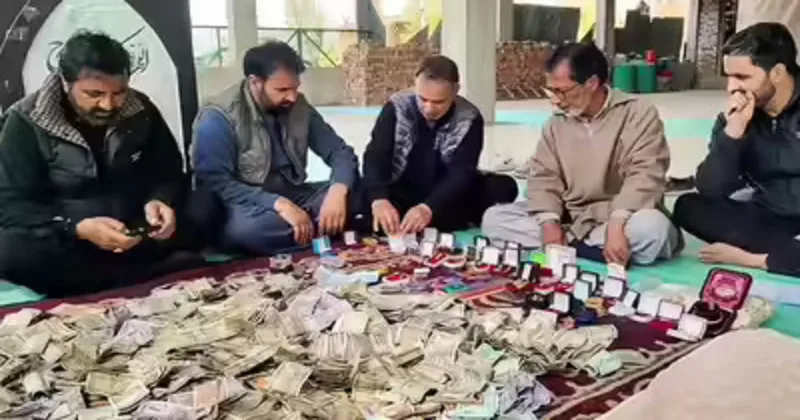
A network of middlemen swiftly seized control of a legitimate appeal that was made earlier in March, according to information provided by the State Investigation Agency and local intelligence. These people started gathering cash and valuables in various regions, concentrating on those where people had a stronger emotional connection to the cause. Cash was not the only thing collected. Gold jewelry, cattle and even home goods like copper kitchenware were donated. Many of these contributions were made by families that were already struggling financially.
The total amount collected is estimated to be close to ₹18 crore. A large portion reportedly came from districts like Budgam, Baramulla and Srinagar, but contributions were spread across several parts of the Valley. What is worrying is not just the scale, but what agencies suspect happened next. Investigators believe that these middlemen were not simply collecting and forwarding funds. They were taking cuts at multiple levels. More importantly, there are strong inputs suggesting that a portion of the money may have been redirected to sustain local influence networks and activities that go against India’s interests.
Agencies have also flagged the role of certain individuals who were acting as links between local collectors and handlers outside the region. These links made it possible for money to move in both directions. Some of the funds collected locally were allegedly routed back into Kashmir to maintain a kind of “payroll system”, where certain individuals or groups continued to receive money to keep influence alive on the ground. This is a serious concern because it shows that the money was not just being misused, but possibly being recycled into a system that thrives on instability.
Investigators have also identified a very practical issue that is frequently overlooked. The entire procedure gets complicated and opaque when donations are made in the form of tangible products rather than cash. The amount of gold obtained, its value and its storage location cannot be accurately documented. This also holds true for home goods and cattle. There is no inventory, no audit and no standard system. Because of this, it is quite simple for goods to be stolen, underreported or discreetly redirected. It is quite impossible to track these items once they leave the donor.
Another major issue is the way these collections were carried out. A lot of it happened through door-to-door visits, local stalls and informal gatherings. There was no official verification of who these collectors were. People assumed they were genuine because of the way the appeal was presented. This lack of a monitoring system created a huge gap in accountability. It allowed anyone to step in, collect money in the name of a cause and disappear without leaving a trace. If all of this sounds familiar, it is because Kashmir has seen similar patterns before.
One of the biggest examples is the misuse of the apple and walnut trade. For years, these industries were seen as a positive economic force. But over time, agencies discovered that parts of this trade were being used to move money through over-invoicing. Export values were artificially increased, which created extra funds. These funds were then diverted into networks that supported separatist activities. What looked like a normal business activity was actually being used as a financial channel in the background.
Hawala networks are another example. These systems allowed money to move without going through banks, making it very hard to trace. Funds could come from outside the country and reach local handlers quickly and quietly. Many investigations over the years have shown how these channels were used to support disruptive activities in the Valley.
There have also been cases where so-called charity drives and NGOs were found to be misused. Money collected in the name of welfare or relief was sometimes redirected. In some investigations, it was found that these funds were being used to organise protests, pay local mobilisers or keep certain networks active. Even stone-pelting incidents in the past were linked, in some cases, to organised funding where individuals were allegedly paid to participate.
The current donation racket follows the same basic structure. The only difference is the method. Earlier, trade and financial systems were used. Now, emotional appeals are being used more directly. People are being convinced that they are helping a larger cause and in that process, they are lowering their guard. This is where the real problem lies. When people stop asking questions, these systems grow stronger.
Our own traditions have always warned against this kind of blind giving. The Bhagavad Gita infact makes a simple point. Charity should be done with understanding. It should go to the right place and serve the right purpose. Giving without thinking, without checking, is not seen as a good act. It is seen as misguided. This idea is very relevant today because it reminds us that intention alone is not enough. Awareness matters just as much.
There is also a reflection of this reality in the film Dhurandhar, where the story shows how systems that people trust can be quietly used for very different purposes. Funding does not always come from obvious sources. It often flows through everyday channels that people do not question. That is exactly what makes it effective. What is happening in Kashmir right now is not just about one scam. It is about a pattern that keeps repeating. A cause is presented. People respond emotionally. Middlemen step in. Money moves without proper checks. And later, it is discovered that things were not what they seemed.
The response from agencies is important, and the crackdown is necessary. But this cannot be solved by enforcement alone. People also need to become more careful. Before donating, there has to be a basic check. Is the channel official? Is there a need to contribute? Who is collecting the money? Because once the money leaves your hands, especially in an unregulated system, you lose control over it completely.
Kashmir has already witnessed the long-term harm that these financial networks can cause, frequently in subtle but profound ways over time. It would be a grave error to permit the same pattern to recur in a different form. Honesty is what is required now, even if it is difficult. People should be able to view the complete picture of how their hard-earned money is being used. They should be aware that their gifts, whether they be funds, jewellery or even assets related to their livelihood, might not be going to the intended recipient. Such funds run a very real risk of being misappropriated in ways that will eventually be detrimental to their own community and future. No family should have to realise later that what they gave in good faith ended up strengthening forces that bring instability back into their own lives.
At the same time, there needs to be a greater awareness of where trust is invested and how quickly it can be betrayed. Manipulation becomes possible when emotion takes over and fundamental questions are neglected. In addition to making donations, people are being entangled in a type of mobilization that is based on false or inaccurate information. A society is weakened from the inside out by such an environment rather than strengthened.
A change in direction is now required. The same enthusiasm and readiness to help must be directed toward positive, open paths that genuinely help the nation and the region. Building a nation is not a catchphrase. Everyday choices, selecting reputable channels, endorsing legitimate and responsible projects, and avoiding anything that works in the shadows are all examples of how it manifests. Respect for the nation cannot remain symbolic. It has to show in choices, especially in moments like these. Standing by the country means being alert to those who misuse emotion, religion or identity to push their own agendas. It means not becoming an unwitting part of networks that thrive on division and disorder.
This is fundamentally about self-preservation and awareness. It is far more difficult to take advantage of a society that is aware of how it is being deceived. The cost of mistaken confidence has already been borne by Kashmir. That shouldn’t have to happen once again. The harsh reality is simple. The moment people stop questioning in the name of religion, they become easy to exploit. And once that exploitation begins, the damage does not stay limited to money. It spreads into society, into stability, into the future itself. This is where Kashmir must draw the line.