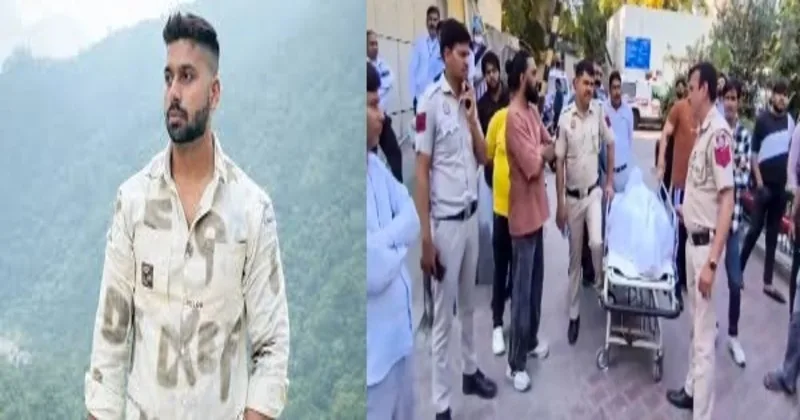
Holi, undoubtedly the festival of colours, spreads smiles. But recently it became the festival of tears, blood and political vengeance. Tarun, who was the victim of Islamic fundamentalists, lost his life over a minor issue. There is a need to understand the grounds on which he was brutally murdered. How will the fundamentalists justify his assassination? In case both families had a history of unending conflicts, even in that case, no constitutional provision has empowered anyone to murder in the name of self-defence or protecting near or dear ones.
Recently, the bulldozed-house girl, in front of the media, presented her case with political tears and claimed that it was Tarun who actually started this. Even then, why didn’t you opt for a legal trial and seek legal assistance from the local police station? It clearly reflects that the family of a bulldozed house has neither respect nor faith in the Indian Constitution, yet now they want treatment based on constitutional provisions? Now, on social media, pseudo-secularists are raising questions over the bulldozer action against them and demanding justice for the culprits. Who authorised the state to bulldoze their house?
Replying to their biased question, here is the biased-cum-unbiased befitted reply: Who permits you to kill someone? Who empowered you to pretend to be a victim? And, it is not just about the Islamic fundamentalist, it is also about anyone who is not ready to live according to the Constitutional provisions, who is not ready to follow the principles of civil society; their houses need to be bulldozed. And, everyone has witnessed that brutal, cold-blooded murder and still, they want to live in civil society after that uncivilised act?
No one is categorising every Muslim as fundamentalist and every Hindu as the legally bound, but what is quite evident needs no justification. And, the bulldozed house girl is weeping in front of the media and giving her best to make this death an act of self-defence. There is a point at which the collapse of all civilised discourse is so far advanced that language itself is the first casualty—when words of exact legalistic architecture, painstakingly crafted over several centuries of legalistic toil, are taken apart brick by brick and reassembled into something that is completely unrecognizable: a tool for narrative expediency, a philosophical escape valve for the ideologically predisposed.
We are passing through such a moment. And nowhere is such linguistic vandalism more shamelessly on display than in the current farce of pseudo-secular apologists, drawing-room activists and Twitter-verified moral authority figures scrambling, with all the speed and humility that such actions imply, to wrap the mantle of ‘self-defence’ around what the facts, the law and plain old-fashioned common-sense dictate should be subject to the full and unvarnished scrutiny of the law. Let us start, as intellectual integrity requires, with the law itself—since those who are most vociferously advancing it appear to have encountered it, at best, in some Bollywood courtroom scene.
In its classical formulation, set out in Sections 96 through 106 of the IPC and refined through decades of Supreme Court adjudication, self-defence is not a philosophical construct. It is not an emotion. It is not even remotely connected to the fevered temperature of outraged opinion or the political affiliations of the deceased. Self-defence is a legal construct with conditions so finely calibrated that they resemble the tolerances on an engineering blueprint and all of these conditions must be met simultaneously for the claim to even remotely arise.
The right of private defence, as reiterated in a string of landmark judgments by the Supreme Court in Darshan Singh v. State of Punjab to Vidhya Devi v. State of H.P., is governed by a series of cardinal principles that include the threat being imminent, i.e., present and immediate, not anticipated, not historical, not imagined. The right of private defence also requires that the action in defence is proportionate, i.e., not equal, but strictly necessary. Thirdly, there is a requirement for the absence of a reasonable opportunity to seek recourse to law, to retreat, to seek help or to avoid the incident of crime in its entirety.
And lastly, and most importantly, there is a requirement of the absence of pre-planning or prior arrangement, i.e., that there is no prior arrangement or planning, suggesting that defence was, in fact, the objective all along. And that last condition is not a mere technicality. That last condition is the entire moral and legal framework on which the doctrine is based. For self-defence is not only so by its very etymology; it is not only so by its very philosophical underpinnings. It is the compassionate recognition of the law that a human being, suddenly and face-to-face with death itself, is not in a position to reflect, to consult legal precedent and to respond with precision and care. It is the compassionate recognition of the animal imperative of survival itself.
And as soon as premeditation is injected into the equation, the instant evidence of prior assembly, prior arming, prior coordination, prior waiting, the law calls it not self-defence but, in its inimitable manner, murder. The pseudo-secular chorus, that wonderful collection of selective empathisers who find their passion for justice in a proportionality that is directly inverse to the political expediency of their victim, has gone through its well-rehearsed routine with all the elegance of a well-choreographed ballet. The words are trotted out in turn.
“Provocation,” “Fear,” “Vulnerability,” “Context”. The historical grievances are dug up and placed neatly in a row to justify. The victim’s background is examined to see if anything there might have coloured the story of innocence. The perpetrators are humanised and contextualised and their actions are rationalised as a response to a lifetime of suffering. There is a word to describe this intellectual pirouette. It is called “Motivated Reasoning”. And in a country that is ruled by law, not sympathy, not ideology, not whoever shouts the loftiest, it is not merely intellectually dishonest. It is dangerous.
Let us think about what this self-defence construct, when applied with this reckless abandon, actually requires you to believe. It requires you to believe that a group of individuals, allegedly arriving equipped, coordinated and purposeful, were actually acting spontaneously. It requires you to believe that the force applied was minimal and not maximum, that it was not an expression of an intent that had been formulated long before this encounter. It requires you to believe that retreat, dispersal, de-escalation and a host of other strategies available to any rational actor not committed to a predetermined outcome were not possible.
It requires you to believe all this in a suspension of analytical ability so complete that it is not an argument; it is a confession. A confession that the verdict came before the trial, that justice is not being served by a goddess with her eyes covered lest she act in prejudice, but a verdict arrived at before even a shred of evidence is considered. The pseudo-secular commentariat has always functioned under an unwritten but strictly adhered-to hierarchy of victims. There are deaths that warrant instant national mourning, TV debates, candlelight vigils and op-eds in global publications lamenting the death of Indian democracy.
There are deaths that are processed through a completely different set of parameters and equations—calculating with incredible rapidity the community of the deceased, the community of the alleged perpetrator and the political expediency of it all before determining the level of outrage. This is not secularism. This is its exact opposite. Real secularism, the secularism of our Constitution, the secularism of Ambedkar, is the equal application of the law to all citizens irrespective of creed, identity or political use. What is being implemented in its name is actually a highly advanced form of tribalism that, over the decades, has perfected itself in speaking the language of liberalism but actually being its antithesis.
A young life cut short. A family broken beyond the limits of language to express the extent of the damage. And the reaction of those who think of themselves as the moral arbiters of India? A legal point used not to uncover the truth, but to reach a preconceived verdict. A legal principle of real jurisprudential significance is being treated as no more than a mere fig leaf, a “get out of accountability free” card, granted on the basis of community rather than facts. Guilt will be determined by the courts. Let it be determined by them, with independence, with evidence, with all the protection that the adversarial legal system, however agonisingly slow, offers to accused and victim alike.
Let no opinion piece, however well-intentioned, well-researched and well-written, including this one, be any kind of substitute for that. Let us not forget that due process is a two-way street. It is a protection against premature conviction. It is also, with equal force, a protection against premature acquittal. It is a protection against the smug and preloaded exoneration that certain quarters have already begun to manufacture before an investigation is complete, before evidence is adduced, before a judge has heard a single argument or a single piece of testimony. Truth deserves better. And frankly, so does the doctrine of self-defence.