
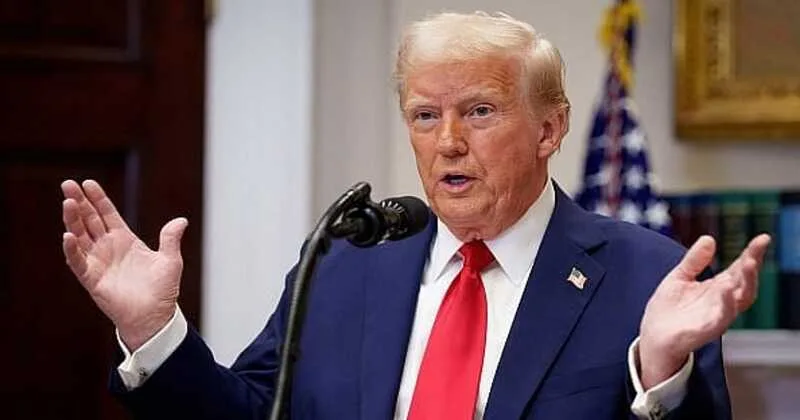
Miami: After claiming that recent US military operations in Venezuela and Iran were a major success, US President Donald Trump has issued an indirect warning suggesting that Cuba could be the next target. His remark that Cuba would be next, made during an investor conference in Miami, has triggered widespread global debate and concern.
At the event, Trump hinted that the Cuban government is on the brink of collapse, though he did not outline any specific course of action. However, his statement has raised the possibility of future military or political intervention by the United States.
Trump said he had built a powerful military and had once believed it would never need to be used, but acknowledged that there are situations where its use becomes necessary, adding that Cuba could be next. He later appeared to downplay the remark in a lighter tone, suggesting that he may not have actually said it. Cuban President Miguel Diaz-Canel confirmed that his government is engaged in talks with the United States to avoid a potential confrontation.
Communist Cuba’s deepening crisis
Cuba is currently facing a severe economic crisis, largely driven by disruptions in oil supplies. The country depends heavily on imported fuel to run its power plants and transport systems. Following the US-backed removal of Venezuelan leader Nicolas Maduro earlier this year, oil shipments from Venezuela, previously a major supplier, have been halted. The resulting shortages have led to widespread blackouts, transport disruptions, and growing economic instability across the island. Analysts note that these conditions have intensified pressure on the Cuban government and may have strengthened Washington’s position.
Earlier in March, Trump had described the possibility of a friendly takeover of Cuba, but later indicated that such a takeover might not necessarily be friendly.
NATO rift and growing tensions
Trump’s remarks on Cuba come amid increasing tensions between the United States and its NATO allies. He criticised European nations for failing to provide adequate military support during the ongoing war with Iran, which has now entered its fourth week. Trump stated that the United States had always supported its allies but questioned whether it should continue to do so if they were unwilling to reciprocate, arguing that there was no obligation to stand by partners who did not offer support in return.
The United States did not consult its European allies before launching strikes on Iran last month, prompting strong diplomatic backlash. Several NATO countries opposed the move and declined to participate in the conflict.
Trump has since indicated that the US may reconsider its commitments to the alliance if allied nations do not cooperate. His remarks have renewed concerns about Washington’s willingness to uphold NATO’s Article 5, which treats an attack on one member as an attack on all.
During the 2024 election campaign, Trump had also suggested that countries failing to meet defence spending targets might not receive full US protection, further straining transatlantic relations.
Although relations between Washington and European capitals showed some improvement in 2025, tensions have escalated again in 2026. Trump’s renewed threat to take control of Greenland, an autonomous territory under Denmark, has further complicated ties. With these developments, analysts warn that NATO could be heading towards one of the most serious crises in its history, as divisions deepen over military strategy, alliance commitments, and the future direction of US foreign policy.