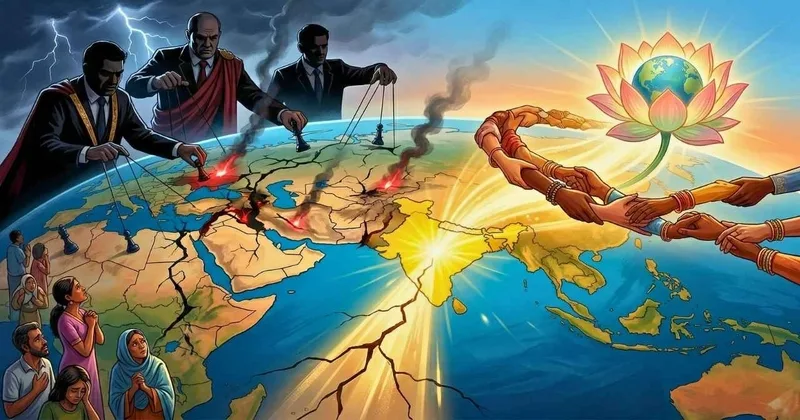
In today’s world, conflict seems less about necessity and more about assertion. Amid rising global tensions, the ancient Indian ideal of Vasudhaiva Kutumbakam offers a timely path toward peace and balance.
A World in the Age of Polycrisis
The global landscape today reflects a deep and layered crisis. Wars, geopolitical tensions, and strategic rivalries are unfolding simultaneously across regions, creating what many describe as a “polycrisis era.” In some places, conflicts are direct and violent; in others, they simmer beneath the surface through proxy wars or Cold War-like standoffs.
Despite this turbulence, one reality stands out: the common people across nations do not desire war. Instead, it is often the political ego, strategic competition, and power ambitions of leadership that push countries toward confrontation.
West Asia: A Flashpoint of Power Politics
The West Asia remains one of the most volatile regions in global politics. The growing confrontation involving the United States, Israel, and Iran is no longer confined to regional concerns but has global implications.
This conflict goes beyond security, it reflects a broader struggle for dominance, influence, and strategic leverage. The consequences are severe: civilian suffering, disrupted economies, and rising oil prices that affect countries worldwide.
Russia–Ukraine War: A Prolonged Global Conflict
The war between Russia and Ukraine has evolved into one of the most prolonged conflicts of the modern era. What began as a bilateral conflict has drawn in global powers, turning it into a wider geopolitical struggle. This war underscores that traditional power politics—territorial expansion, spheres of influence, and military assertion—remain very much alive. The real cost, however, is borne by ordinary people: lives lost, millions displaced, and economies devastated.
South Asia: Emerging Instability
Closer to home, tensions between Pakistan and Afghanistan are creating a new axis of instability. Border disputes, security concerns, and internal political challenges have deepened mistrust between the two nations.
For countries already grappling with economic and social issues, such conflicts further delay development and destabilise societies. It highlights a critical truth—when dialogue breaks down, the consequences extend far beyond borders.
The Return of Cold War Dynamics
Today’s global order increasingly resembles a new kind of Cold War. Major powers like the United States, Russia, and China are competing for influence across regions. However, this rivalry is no longer limited to military strength. It now spans technology, trade, energy resources, and diplomatic alliances. This silent competition increases global uncertainty and raises the risk of larger conflicts in the future.
Across continents, the answer is clear—people do not want war. The average citizen seeks peace, stability, and opportunity. Young populations aspire for growth, innovation, and a better future. Societies want cooperation, not confrontation.
The Real Cause: Ego and Power Politics
At the heart of many modern conflicts lies political ego and the pursuit of dominance. Wars are often used as tools to assert authority, consolidate domestic power, or project international strength.
But this pursuit comes at a heavy cost:
* Rising inflation and energy crises
* Disruptions in global supply chains
* Increasing refugee populations
* Food insecurity and resource shortages
In an interconnected world, even distant conflicts have global consequences.
India’s Role: A Voice for Balance
For a rising power like India, this moment presents both a challenge and an opportunity. India’s foreign policy has traditionally emphasised balance, dialogue, and peaceful coexistence. The philosophy of Vasudhaiva Kutumbakam, the world as one family, is no longer just an ideal; it is a necessity. By promoting dialogue, cooperation, and mutual respect, India can play a vital role in shaping a more stable and inclusive global order.
The world stands at a critical crossroads. One path leads toward escalating conflicts, instability, and destruction. The other offers dialogue, cooperation, and peace. The truth is simple yet profound: people do not want war; leaders do. And unless global leadership moves beyond ego-driven politics, the cycle of conflict will continue.