1971 Genocide: Brutality of Pakistan against Bangladesh exposed
June 15, 2026
  • Read Ecopy
  • Circulation
  • Advertise
  • Careers
  • About Us
  • Contact Us
Android AppiPhone AppArattai
Organiser
  • ‌
  • Bharat
    • Assam
    • Bihar
    • Chhattisgarh
    • Jharkhand
    • Maharashtra
    • View All States
  • World
    • Asia
    • Europe
    • North America
    • South America
    • Africa
    • Australia
  • Editorial
  • International
  • Opinion
  • RSS @ 100
  • More
    • Op Sindoor
    • Analysis
    • Sports
    • Defence
    • Politics
    • Business
    • Economy
    • Culture
    • Special Report
    • Sci & Tech
    • Entertainment
    • G20
    • Azadi Ka Amrit Mahotsav
    • Vocal4Local
    • Web Stories
    • Education
    • Employment
    • Books
    • Interviews
    • Travel
    • Law
    • Health
    • Obituary
  • Subscribe
    • Subscribe Print Edition
    • Subscribe Ecopy
    • Read Ecopy
  • ‌
  • Bharat
    • Assam
    • Bihar
    • Chhattisgarh
    • Jharkhand
    • Maharashtra
    • View All States
  • World
    • Asia
    • Europe
    • North America
    • South America
    • Africa
    • Australia
  • Editorial
  • International
  • Opinion
  • RSS @ 100
  • More
    • Op Sindoor
    • Analysis
    • Sports
    • Defence
    • Politics
    • Business
    • Economy
    • Culture
    • Special Report
    • Sci & Tech
    • Entertainment
    • G20
    • Azadi Ka Amrit Mahotsav
    • Vocal4Local
    • Web Stories
    • Education
    • Employment
    • Books
    • Interviews
    • Travel
    • Law
    • Health
    • Obituary
  • Subscribe
    • Subscribe Print Edition
    • Subscribe Ecopy
    • Read Ecopy
Organiser
  • Home
  • Bharat
  • World
  • Operation Sindoor
  • Editorial
  • Analysis
  • Opinion
  • Culture
  • Defence
  • International Edition
  • RSS @ 100
  • Magazine
  • Read Ecopy
Home World

1971 Genocide: Bangladesh pays tribute to those killed brutally by Pakistan Army

Starting on March 25, 1971, the Pakistan Army carried out one of the most horrific genocides over the next several months in what was East Pakistan then, against its own citizens. The Bengalis who were demanding their democratic rights, including the installation of Awami League chief Sheikh Mujibur Rehman as Prime Minister of Pakistan

Sant Kumar SharmaSant Kumar Sharma
Mar 26, 2026, 08:30 am IST
in World, Asia
Follow on Google News
1971 Massacre to Liberation: Bangladesh Reflects on Its Birth

1971 Massacre to Liberation: Bangladesh Reflects on Its Birth

FacebookTwitterWhatsAppTelegramEmail

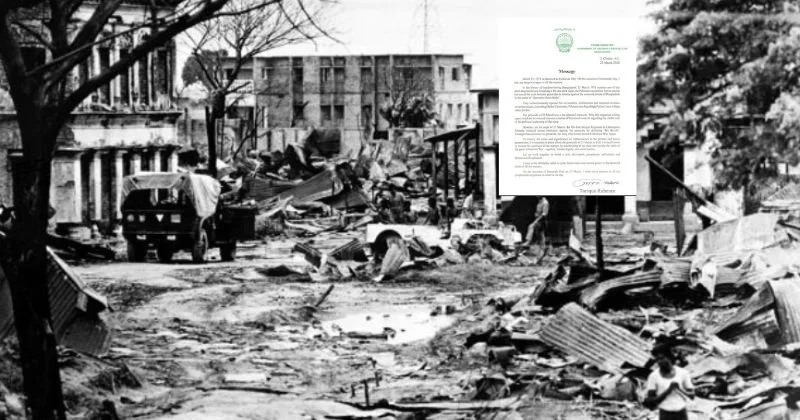
For the citizens of Bangladesh, the memories of March 25, 1971, are a nightmare which makes them shudder. It was on this day that soldiers of the Pakistani Army, predominantly composed of Punjabis drawn from West Pakistan, started mass-scale killings. Of Bengali-speaking residents of what was then East Pakistan, for demanding that Awami League leader Sheikh Mujibur Rehman be made the Prime Minister of the country.

It was no extraordinary or seditious demand as Sheikh’s party had won the 1970 elections held under the dictatorship of General Yahya Khan. These elections had been held in West Pakistan (today’s Pakistan) as well as in East Pakistan (today’s Bangladesh). Out of 300 seats at stake in both wings of Pakistan, the Awami League had won more than 160 seats, a clear and clean majority.

Instead of making Sheikh Prime Minister of the country after the declaration of results, Yahya postponed the session of the new parliament that was to be constituted. This had angered Bengalis, who participated in large-scale protests starting late December 1970. Over the next three months, these protest demonstrations engulfed the entire territory of East Pakistan. General Yahya Khan took it as a serious challenge to his authority and labelled them as anti-national, prior to a massive crackdown, which then led to genocide. This ultimately led to the birth of a new nation, Bangladesh, as East Pakistan seceded from Pakistan nine months later.

India was forced to intervene as millions of refugees, mainly Hindus but including Bagla-speaking Muslims, rushed into the northeastern states. Soon, the number of these refugees crossed 10 million (1 crore), and this threatened to destabilise these states. The Central government, headed by Indira Gandhi, tried hard to cope with the influx, imposing levies on postal services to help with the aid. When all else failed, a military intervention followed, leading to the partition of Pakistan.

On Wednesday (March 25), there were major commemoration programs of that horrifying day, and speakers recounted the horrors that the Pakistani Army inflicted on Bangla-speakers for demanding their democratic rights. The Bangladesh government organised these programmes with massive participation. Bangladesh government officials, including in Bangladesh embassies and Consulates, all over the world, participated.

The scale of these programmes and the official message from Bangladesh Prime Minister Tarique Rahman are being interpreted as a pro-Pakistan stance, similar to that seen in Dhaka over the past couple of years. The nation formally marked March 25 as Genocide Day, with Mr Rahman leading the nation and delivering a forceful message about one of the darkest chapters in the country’s history. His message read: March 25, 1971, is observed as Genocide Day. On the occasion of Genocide Day, I pay my deepest respect to all the martyrs.

In the history of freedom-loving Bangladesh, 25 March 1971 remains one of the most brutal and disgraceful days. On that dark night, the Pakistani occupation forces carried out one of the most heinous genocides in history against the unarmed people of Bangladesh in the name of `Operation Searchlight’.

The commemorative programmes were aimed at focusing on the mass killings carried out by Pakistani forces. These were also aimed at educating the younger generation about the horrors their forefathers had to undergo at the hands of Pakistanis.

The PM said the violence initiated that night was one of the most heinous genocides in modern history. The assault was not spontaneous but a carefully planned massacre executed by the Pakistan military to crush Bengali aspirations. The desire to get their due democratic rights and see their leader, Sheikh Mujibur Rehman, as the PM of Pakistan after emerging victorious in elections.

Rahman recalled how troops indiscriminately opened fire on teachers, intellectuals, students, and ordinary residents across key locations. Among the worst-hit sites were Dhaka University, a historic centre of intellectual and political activism; Pilkhana, then a major military installation; and the Rajarbāgh Police Lines, where security personnel and civilians were targeted. The coordinated attacks left countless people dead and sent shockwaves through the population, marking the beginning of a prolonged and bloody struggle for independence.

Calling the events a “pre-planned massacre,” Rahman said questions remain about why the organised killing spree could not be resisted more effectively at the time, adding that the political leadership’s visible role continues to be examined by historians. However, that very night, the 8th East Bengal Regiment decided to revolt, resist and overthrow the brutal Pakistani yoke of servitude.

That moment, he noted, marked the start of the armed struggle that evolved into the full-scale Liberation War. It had culminated in the surrender of 93,000 Pakistani troops led by Lt Gen AKA Niyazi in Dacca (as Dhaka was called then) before Lt Gen J S Aurora of the Indian Army. A new nation, Bangladesh, was born.

The PM said remembering March 25 is essential for younger generations to understand the true cost of independence. Honouring the martyrs, he added, means upholding the core ideals that defined the liberation movement — equality, human dignity, and social justice — and embedding those principles in national life. Without Indian help and the participation of thousands of soldiers of the Indian Army, the dream of independence for Bangla-speaking Muslims of East Pakistan could not have fructified.

Rahman urged citizens to work collectively toward building a just, developed, prosperous, self-reliant, and democratic nation. He paid deep tribute to those who lost their lives and offered prayers for the eternal peace of the departed souls.

Concluding his message, the Prime Minister extended his wishes for the success of all programmes organised across the country to observe Genocide Day, framing the commemoration not only as an act of remembrance but also as a reaffirmation of Bangladesh’s founding values and future aspirations.

“Let us work together to build a just, prosperous, self-reliant and prosperous Bangladesh,’’ he said. The Bangladesh PM’s Genocide Day message can be a wake-up call for Pakistanis who were trying to whitewash their crimes.
Topics: Awami LeagueSheikh Mujibur Rehmangenocide day1971 Genocide Day
ShareTweetSendShareSend
✮ Subscribe Organiser YouTube Channel. ✮
✮ Join Organiser's WhatsApp channel for Nationalist views beyond the news. ✮
Previous News

Odisha: Fight against red terror in decisive stage; Maoist Sukru formally surrenders, only 8-9 Maoists left

Next News

Fraud with Ummah? Kashmir’s Iran aid drive turns into Rs 17 crore funding scandal

Related News

Bangladesh braces for elections on February 12, 2026 (Image Source: X)

Bangladesh braces for 13th National Elections tomorrow as citizens remain hopeful with country poised for change

Awami League leader and Former MP of Bangladesh Bahauddin Nasim

Bangladesh: “Yunus govt is safe haven to terrorists while economy, security is at risk,” says Former MP Bahauddin Nasim

Awami League rejected the national elections scheduled for February 2026(File Photo)

Awami League rejects Bangladesh elections scheduled by the ‘killer fascist Yunus clique’s illegal Election Commission’

Bangladesh national elections scheduled for February 12

Bangladesh elections on Feb 12; First since the topple of Hasina regime, Set to decide political course of the country

Bangladesh Army detains 15 officers after war crimes tribunal issues arrest warrants over enforced disappearances

Chief Adviser of Bangladesh's interim government Muhammad Yunus (Left) and Former Bangladeshi Prime Minister Sheikh Hasina (Right)

Bangladesh: Sheikh Hasina hits at Muhammad Yunus for turning the country into a ‘terrorist state’, vows to return

Load More

Latest News

Remembering Shaheed Bhai Mani Singh: They cut him joint by joint, he lives in every Sikh prayer

Cache of arms and explosives recovered by Odisha Police from Rayagadha forest

Odisha: Major Maoist dump unearthed in Rayagada Forest; Arms, explosives and Maoist literature seized

Prime Minister Narendra Modi and his Slovakian counterpart Prime Minister Robert Fico

India-Slovakia elevate ties to Comprehensive Partnership; PM Modi hails cultural bond, Upanishads translation to Slovak

Centre seeks explanation from Keralam Waqf Board on Munambam land entry into Umeed Portal

In China's strategic map of threats, geography continues to give India a significance that cannot be overlooked

The Rival China Cannot Ignore: Why India matters more than Beijing admits

Addressing the second day of Vijnana Bharati’s 7th National Convention at BHU, RSS Sah Sarkaryavah Dr Krishna Gopal

Vijnana Bharati’s 7th National Convention | Scientists must work to harmonise spirituality & science: Dr Krishna Gopal

Representative image

West Asia Conflict: Donald Trump announces landmark US-Iran agreement, raises hopes for peace

Keralam: CM VD Satheesan Faces Backlash for Criticising VCs Attending RSS Programme Addressed by Dr Mohan Bhagwat

Prime Minister Narendra Modi: Record maker and breaker

India surpasses South Korea, Enters big 5 manufacturing hub; Seals strategic footprint in the global supply chain

Load More
  • Privacy
  • Terms
  • Cookie Policy
  • Refund and Cancellation
  • Delivery and Shipping

© Bharat Prakashan (Delhi) Limited.
Tech-enabled by Ananthapuri Technologies

  • Home
  • Search Organiser
  • Bharat
    • Assam
    • Bihar
    • Chhattisgarh
    • Jharkhand
    • Maharashtra
    • View All States
  • World
    • Asia
    • Africa
    • North America
    • South America
    • Europe
    • Australia
  • Editorial
  • Operation Sindoor
  • Opinion
  • Analysis
  • Defence
  • Culture
  • Sports
  • Business
  • RSS @ 100
  • Entertainment
  • More ..
    • Sci & Tech
    • Vocal4Local
    • Special Report
    • Education
    • Employment
    • Books
    • Interviews
    • Travel
    • Health
    • Politics
    • Law
    • Economy
    • Obituary
  • Subscribe Magazine
  • Read Ecopy
  • Advertise
  • Circulation
  • Careers
  • About Us
  • Contact Us
  • Policies & Terms
    • Privacy Policy
    • Cookie Policy
    • Refund and Cancellation
    • Terms of Use

© Bharat Prakashan (Delhi) Limited.
Tech-enabled by Ananthapuri Technologies