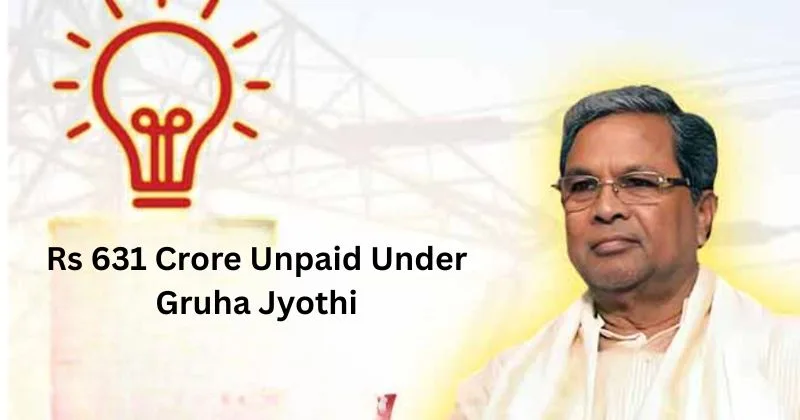
BENGALURU: The delay in releasing Rs 631.75 crore in pending subsidy payments under the Gruha Jyothi scheme has triggered a fresh political storm, with the opposition alleging that the Karnataka government’s financial condition is deteriorating and that welfare guarantees are being sustained at the cost of fiscal stability.
The issue came to light in the Legislative Council after Opposition leader Chalavadi Narayanaswamy raised questions about the disbursal of subsidies. In response, Energy Minister KJ George admitted that dues are pending with electricity supply companies, contradicting repeated government assurances that payments were being released on time.
The development has put the spotlight on the flagship Gruha Jyothi scheme of Chief Minister Siddaramaiah, which promises free electricity to eligible households. While the scheme has been politically projected as a major success, the financial data paints a more concerning picture.
Official figures show that between August 2023 and January 2026, power distribution companies raised claims of Rs 23,386.52 crore. Of this, Rs 22,754.77 crore has been released, leaving Rs 631.75 crore unpaid. Though the gap may appear small relative to the total outlay, experts warn that even such delays can severely impact the liquidity of power utilities that operate on tight margins.
The dues are spread across all major power distribution companies, indicating a systemic issue rather than an isolated delay. The BESCOM alone is awaiting Rs 328.38 crore. Similarly, Mangalore Electricity Supply Company has pending dues of ₹75.85 crore, while Chamundeshwari Electricity Supply Corporation is yet to receive ₹71.04 crore.
In north Karnataka, Hubballi Electricity Supply Company owes Rs 83.92 crore, and Gulbarga Electricity Supply Company owes Rs 72.56 crore. The uniformity of pending dues across all utilities has raised red flags about the state’s cash flow management.
Opposition leaders have seized on the data to accuse the government of masking a deeper financial crisis. “If the government cannot clear even committed subsidies on time, it clearly indicates a cash crunch. The reality is that the state’s financial health is worse than what is being projected,” a senior BJP leader alleged.
The Gruha Jyothi scheme covers a massive beneficiary base, with over 1.74 crore consumers registered and around 1.65 crore availing free electricity. While this has brought relief to households, it has significantly increased the exchequer’s subsidy burden.
In the BESCOM region alone, which includes Bengaluru Urban and surrounding districts, more than 76.58 lakh consumers have enrolled, with nearly 69.46 lakh beneficiaries. The surge in electricity consumption over the past three financial years has further escalated subsidy requirements, putting additional strain on government finances.
Experts point out that delayed payments to power companies could have cascading effects. Power utilities rely on timely subsidies to manage operational costs, pay generators, and maintain infrastructure. Any delay could disrupt maintenance schedules, delay infrastructure upgrades, and potentially impact power supply quality.
There are also concerns that continued financial stress may force utilities to resort to borrowing, thereby increasing their debt burden. In the long run, this could translate into indirect costs for consumers, either through higher tariffs or reduced service efficiency.
The opposition has also accused the government of prioritising political optics over prudent financial management. “The government is announcing schemes without ensuring sustainable funding. This is nothing but fiscal mismanagement that will hurt the state in the long run,” critics said.