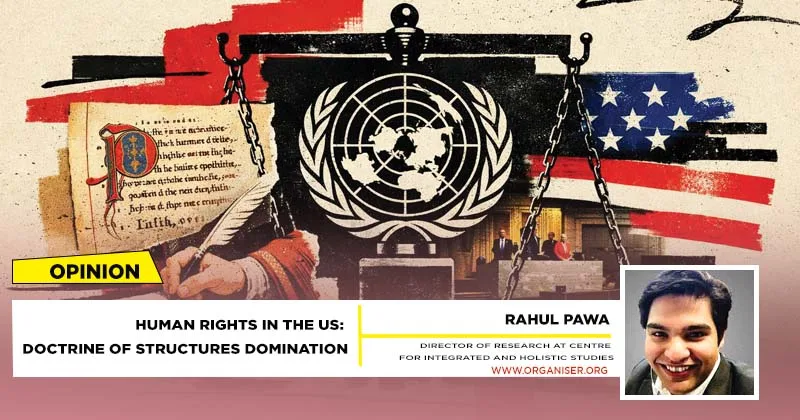
If this history is told from the vantage point of humanity, the first fact is not liberty. It is conquest. Before America became the self-appointed custodian of human rights, European settlers arrived in America with scripture, sovereignty doctrines, and a civilising mission that treated native nations not as equals but as peoples to be subdued, absorbed, or erased. The language of law came early; the practice of exclusion came earlier still. The U.S. Constitution itself originally excluded “Indians not taxed” from representation. Native Americans were not universally recognised as U.S. citizens until the Indian Citizenship Act of 1924. Meanwhile, the federal boarding-school system pursued forced assimilation for generations. That is not a strong foundation on which to lecture the world about universal rights.
This is the deeper pattern: rights in the Atlantic world were proclaimed as universal only after power had already decided who counted as fully human, fully civilised, and fully sovereign. The West’s great rights tradition was never born as a charter for all humankind. It began as an internal code for ordering power within a Christian feudal and later imperial world.
Decoding Magna Carta
Magna Carta, celebrated by some as a foundational liberty document, is the clearest example. It is often presented as the beginning of constitutional freedom, due process, and the rule of law. But Magna Carta was not a democratic charter. It was a political settlement between a king, the Church, and a rebellious aristocracy. It restrained royal arbitrariness within a feudal Christian order; it did not emancipate humanity. Its later myth became much broader than its original social reach. That matters, because it reveals a recurring Western habit: elite bargains are later universalised as moral breakthroughs.
The same pattern appears in the English Bill of Rights of 1689. It restricted monarchical power, insisted on parliamentary forms, and advanced legal protections, but only within a narrow political community already defined by rank, empire, and confessional history. Likewise, the Virginia Declaration of Rights and the American Declaration of Independence announced liberty in universal language while operating within a settler-colonial order built on slavery, indigenous dispossession, and racial hierarchy. The language was universal. The beneficiaries were not.
The US Constitution and Bill of Rights carried that contradiction forward. Their language gave enduring form to due process, protection from arbitrary state power, and individual liberty. The Fifth Amendment’s due process guarantee plainly echoes the Magna Carta tradition. Yet the same constitutional order coexisted with slavery, denied women full political personhood, excluded native nations from the democratic body, and tolerated racial caste for generations. In other words, rights were never absent. They were distributed selectively. America did not invent hypocrisy at the margins; it built selectivity into the structure of its freedom.
Dissecting US’s Human Rights
At home, America’s own record remains stained by segregation, race violence, mass incarceration, surveillance excesses, and repeated failures to apply equal dignity across class and race. Abroad, however, Washington acquired the ability to define which states were violators, which crises deserved outrage, which victims counted, and which coercive tools were morally justified. This is how selective universalism matures into doctrine. That is why so much of the modern rights discourse appears, from the outside, less like an impartial legal order and more like a civilisational grammar of power. It presumes the authority to define them, prioritise and enforce them. Once that authority is normalised, the cycle becomes familiar. Reports are issued. Narratives of atrocity are consolidated. Sanctions are framed as moral necessity. Economic leverage is described as accountability. Political pressure is dressed as principled concern. In weaker societies, the language of rights often arrives tied to influence, aid conditionality, diplomatic intrusion, or reputational coercion. This means the system is not innocent.
Unlawful Interference
The Iraq war remains a devastating illustration. A civilisation that claimed to uphold international order manufactured moral urgency around weapons that were never found. Kosovo had earlier shown how war itself could be narrated as humanitarian necessity. Guantánamo, Abu Ghraib, and the El-Masri rendition case exposed the inward exception: a state that spoke most fluently in the language of rights sustaining systems of detention, torture, secrecy, and legal black holes when it was itself the actor. Libya followed another arc: intervention justified in the name of protection, followed by collapse, fragmentation, and enduring instability. More recently, the US abduction of Nicolas Maduro from Caracas highlighted the same hierarchy: international law is most readily preached as a discipline for the weak and most readily relaxed when the powerful claim necessity. In each case, the rhetoric of higher values widened the moral space within which force, exception, or impunity could be defended.
Unmistakable Contradiction
That is the core argument. America did not construct human rights as an impartial universal ethic. It consolidated a rights tradition rooted in exclusion, translated it into universal language without surrendering selective application, and internationalised it from a position of overwhelming Western dominance. What emerged was not an equal moral order, but a stratified regime of dignity in which powerful states and their allies claimed the authority to define the universal in the image of their own history, faith, and strategic interests.
From the vantage point of humanity, the contradiction is unmistakable. The state that now presents itself as the guardian of universal rights built its moral vocabulary through conquest, exclusion, and selective inclusion, and later internationalised it under conditions of overwhelming Western power. That is not a footnote to the history of human rights. It is history. America developed human rights first as an inheritance for itself, and then as a language through which it could judge, pressure, and discipline others, while never fully submitting itself to the same standard. What it universalised was not dignity, but a structure of domination spoken in the name of dignity.