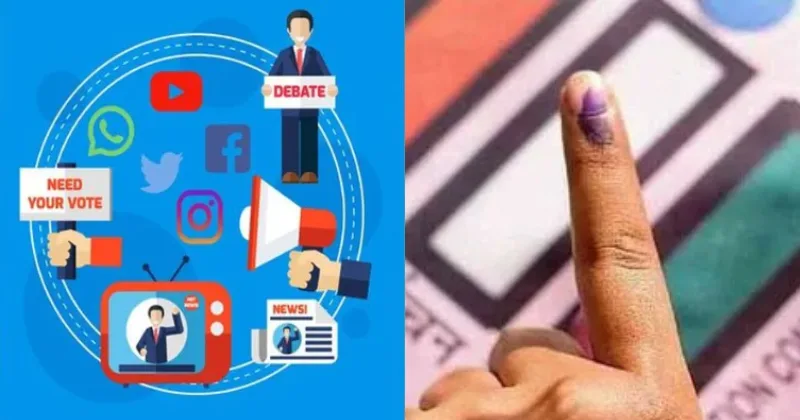
The Election Commission of India (ECI) has made it mandatory for political parties, candidates, and associated organisations to apply to the Media Certification and Monitoring Committee (MCMC) for pre-certification of all political advertisements, including those on social media platforms, ahead of upcoming Assembly elections.
EC in a press note issued on March 20, 2026, has laid down a regulatory framework for political advertising and digital campaigning, mandating strict compliance from political parties, candidates, and associated organisations ahead of the upcoming Assembly elections.
Referring to its earlier announcement of the election schedule on March 15, 2026, for Assam, Kerala, Puducherry, Tamil Nadu and West Bengal, along with bye-elections in six states, the Commission has now emphasised tighter scrutiny of campaign content across platforms.
Citing its press note, the ECI directed that no political advertisement, across electronic media such as television, radio, AV displays, e-papers, bulk messaging services, or social media can be published without prior approval from the MCMC.
Political Parties to get advertisements pre-certified by MCMC ✅
Candidates to share details of their authentic social media accounts ✅
Read more : https://t.co/Ei1M6LG9T9 pic.twitter.com/l14MwuxpAB
— Election Commission of India (@ECISVEEP) March 20, 2026
The move is aimed at tightening oversight on campaign content and ensuring compliance during the election period.
At the core of the directive is a mandatory requirement for all political parties, contesting candidates, and even organisations or associations to apply to the Media Certification and Monitoring Committee (MCMC) for pre-certification of political advertisements.
The ECI has clearly stated that no political advertisement shall be released on any internet-based platform, including websites and social media, without prior approval from the respective MCMC, making pre-certification a non-negotiable condition for digital campaigning.
The Commission has outlined a structured mechanism for certification.
Individual candidates and contestants must approach the District MCMC, while registered political parties headquartered in States or Union Territories must seek approval from the State-Level MCMC.
Applications are required to be submitted within specified timelines. Additionally, an appellate mechanism has been put in place, with Appellate Committees headed by Chief Electoral Officers (CEOs) at the State level to hear grievances against MCMC decisions.
In a significant compliance measure, candidates are now required to disclose details of their authentic social media accounts in their affidavits at the time of filing nominations, aiming to enhance transparency and traceability in digital campaigning.
The Commission has also directed MCMCs to maintain a strict vigil on suspected cases of paid news in the media and to initiate appropriate action wherever necessary, signalling heightened monitoring of covert promotional content.
Further strengthening financial accountability, the ECI reiterated provisions under Section 77(1) of the Representation of the People Act, 1951, along with directions of the Hon’ble Supreme Court of India. Political parties are required to submit a detailed statement of expenditure incurred on campaigning through internet platforms, including social media, within 75 days of the completion of elections.
Such expenditure disclosures must comprehensively include payments made to internet companies and websites for carrying advertisements, as well as costs related to content development and operational expenses incurred in maintaining social media accounts.
The Commission also highlighted that these measures were reinforced during a high-level meeting held on March 19, 2026, involving Chief Electoral Officers, State Police Nodal Officers, State IT Nodal Officers, and representatives of Social Media Platforms (SMPs). The meeting focused on sensitising stakeholders about regulatory provisions and ensuring timely action against misinformation, disinformation, and fake news during the election process.
With these directives, the ECI has signalled a stringent, multi-layered oversight framework covering political advertisements, digital campaigns, expenditure tracking, and information integrity as the country heads into a crucial electoral phase.