National security challenges in West Bengal
June 22, 2026
  • Read Ecopy
  • Circulation
  • Advertise
  • Careers
  • About Us
  • Contact Us
Android AppiPhone AppArattai
Organiser
  • ‌
  • Bharat
    • Assam
    • Bihar
    • Chhattisgarh
    • Jharkhand
    • Maharashtra
    • View All States
  • World
    • Asia
    • Europe
    • North America
    • South America
    • Africa
    • Australia
  • Editorial
  • International
  • Opinion
  • RSS @ 100
  • More
    • Op Sindoor
    • Analysis
    • Sports
    • Defence
    • Politics
    • Business
    • Economy
    • Culture
    • Special Report
    • Sci & Tech
    • Entertainment
    • G20
    • Azadi Ka Amrit Mahotsav
    • Vocal4Local
    • Web Stories
    • Education
    • Employment
    • Books
    • Interviews
    • Travel
    • Law
    • Health
    • Obituary
  • Subscribe
    • Subscribe Print Edition
    • Subscribe Ecopy
    • Read Ecopy
  • ‌
  • Bharat
    • Assam
    • Bihar
    • Chhattisgarh
    • Jharkhand
    • Maharashtra
    • View All States
  • World
    • Asia
    • Europe
    • North America
    • South America
    • Africa
    • Australia
  • Editorial
  • International
  • Opinion
  • RSS @ 100
  • More
    • Op Sindoor
    • Analysis
    • Sports
    • Defence
    • Politics
    • Business
    • Economy
    • Culture
    • Special Report
    • Sci & Tech
    • Entertainment
    • G20
    • Azadi Ka Amrit Mahotsav
    • Vocal4Local
    • Web Stories
    • Education
    • Employment
    • Books
    • Interviews
    • Travel
    • Law
    • Health
    • Obituary
  • Subscribe
    • Subscribe Print Edition
    • Subscribe Ecopy
    • Read Ecopy
Organiser
  • Home
  • Bharat
  • World
  • Operation Sindoor
  • Editorial
  • Analysis
  • Opinion
  • Culture
  • Defence
  • International Edition
  • RSS @ 100
  • Magazine
  • Read Ecopy
Home Politics

National security challenges in West Bengal: From infiltration to economic warfare

India’s eastern frontier is once again under the spotlight as mounting security concerns along the West Bengal–Bangladesh border raise questions about infiltration, organised crime, and economic destabilisation

Diganta ChakrabortyDiganta Chakraborty
Mar 20, 2026, 08:00 pm IST
in Politics, Bharat, World, West Bengal
Follow on Google News
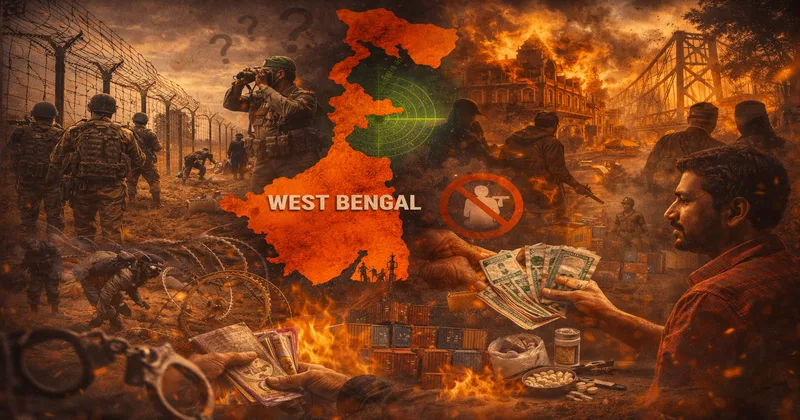
West Bengal marred by crime, violence and infiltration (Image created by AI)

West Bengal marred by crime, violence and infiltration (Image created by AI)

FacebookTwitterWhatsAppTelegramEmail

West Bengal, sharing an extensive international boundary of over 2,200 kilometres with Bangladesh, has long occupied a sensitive position in India’s internal security architecture. Characterised by riverine stretches, densely populated settlements, and historically fluid socio-cultural exchanges, this border remains one of the most porous in South Asia. In recent years, renewed judicial scrutiny, political debate, and security assessments have brought the issue of infiltration and border management back into sharp national focus. A significant development occurred in January 2026, when the Calcutta High Court directed the state government to expedite the transfer of acquired land to the Border Security Force (BSF) for the construction of border fencing. The Court’s observation that “national security cannot be delayed on administrative or electoral grounds” reflects growing institutional concern over prolonged inaction. The order came in response to a Public Interest Litigation highlighting how bureaucratic delays and land acquisition disputes have stalled fencing projects in several vulnerable stretches.

Government data presented during proceedings indicated that a substantial portion of the Indo-Bangladesh border in West Bengal remains unfenced or inadequately secured. These gaps—often located along riverine belts such as the Ganga-Padma system or densely inhabited enclaves—serve as conduits for illegal cross-border movement. Security agencies have consistently flagged these routes as facilitating unauthorised migration, smuggling of cattle and narcotics, and the circulation of counterfeit Indian currency. The issue is further complicated by the presence of char lands (riverine islands), which frequently shift due to erosion, making permanent fencing both technically and administratively challenging.

Also Read: No political ads without approval: Election Commission tightens rules ahead of Assembly polls

The statement placed in the Rajya Sabha by Nityananda Rai on 20 August brings into sharp focus a deeply concerning pattern of criminal activity along the Indo–Bangladesh border, particularly in the West Bengal sector. Far from being isolated law-and-order issues, the data points toward systemic vulnerabilities with serious implications for India’s national security architecture. The most alarming trend emerges from narcotics trafficking. While seizures stood at 4,988.282 kg in 2023 and briefly declined to 3,145.606 kg in 2024, the sharp surge to 5,729.340 kg in 2025 (till July) indicates not a reduction, but a rapid escalation in trafficking attempts. Such fluctuations often reflect adaptive smuggling networks rather than effective deterrence. The scale of narcotics movement across a sensitive international border raises concerns about the presence of organised transnational syndicates, which are frequently linked to terror financing and other destabilising activities.

Equally significant is the rise in economic offences, particularly gold smuggling. The increase in gold seizures from 166.810 kg in 2023 to 188.142 kg in 2024 highlights the persistence of illegal financial flows across the border. Although the 2025 figure (20.876 kg till July) appears lower, partial-year data often mask the full extent of operations. Gold smuggling is not merely an economic crime—it directly undermines financial stability by distorting markets, enabling the circulation of black money, and bypassing regulatory frameworks. More critically, such illicit financial channels can be exploited to fund anti-national activities, including extremist networks. The surge in seizures of Fake Indian Currency Notes (FICN) further compounds the threat. The jump from ₹15.86 lakh in 2023 to Rs 32.45 lakh in 2024 reflects a deliberate attempt to inject counterfeit currency into the Indian economy. Even the Rs 7.45 lakh detected in 2025 (till July) signals the continued presence of these networks. FICN operations are widely recognised as tools of economic warfare, aimed at weakening monetary stability, fuelling inflationary pressures, and eroding public trust in the financial system. Historically, such activities have also been linked to hostile external actors seeking to destabilise India internally.

Beyond economic crimes, infiltration has increasingly been viewed through the lens of national security. The Burdwan blast of 2014 marked a turning point in this discourse. Investigations revealed links to the Bangladesh-based extremist organisation Jamaat-ul-Mujahideen Bangladesh (JMB), exposing how cross-border terror networks could exploit local vulnerabilities. Subsequent reports by intelligence agencies have indicated sporadic attempts by radical elements to establish sleeper cells in border districts such as Malda, Murshidabad, and North 24 Parganas. While large-scale terror incidents have been limited, the potential risks remain a matter of concern for national security planners. The political dimension of the issue has also intensified. In early 2026, Samik Bhattacharya asserted that infiltrators were using Bengal as a transit corridor to other parts of India. Although such claims are contested by the state’s ruling establishment, they resonate with a broader national narrative that links border management failures to internal security challenges. Political polarisation, however, often complicates constructive policy dialogue, with accusations and counter-accusations overshadowing nuanced solutions.

A key concern lies in the lack of effective coordination between the Centre and the State. While border management is a Union responsibility, crucial aspects like land acquisition and local enforcement depend on state authorities, often creating implementation gaps. Judicial intervention has highlighted the urgent need for cooperative federalism, as poor coordination can delay critical infrastructure like fencing and surveillance. In essence, the issue of unfenced borders and infiltration in West Bengal goes beyond regional politics and requires a comprehensive national strategy.


Topics: fake Indian currency notesWest bengal electionsInflitrationJamaat-ul-Mujahideen BangladeshMurshidabadMalda
ShareTweetSendShareSend
✮ Subscribe Organiser YouTube Channel. ✮
✮ Join Organiser's WhatsApp channel for Nationalist views beyond the news. ✮
Previous News

Haryana govt orders meat shop closure near sensitive areas during Navratri

Next News

Is Mamata Banerjee’s DA announcement a genuine relief or just pre-poll optics?

Related News

Prime Minister Narendra Modi

BJP’s Victory with Vision: An idea of India that is Indian

NIA has chargesheeted 31 accused in four separate cases linked to the Malda SIR-related road blockades and illegal detention of judicial officers

NIA chargesheets 31 in Malda SIR road blockade, illegal detention of judicial officers in West Bengal

West Bengal Chief Minister Suvendu Adhikari

West Bengal: CM Suvendu Adhikari announces 142.79 acres land transfer to BSF for strengthening border security

Violence across Bengal raises questions over law & order as BJP workers come under attack

Blood-Stained Ballot: Violence across Bengal raises questions over law & order as BJP workers come under attack

Uttar Pradesh Chief Minister Yogi Adityanath

Bengal Storm by UP CM Yogi: BJP wins 19 of 22 seats, delivers massive strike rate

Kolkata police issued a strong warning against the circulation of fake or misleading content on social media

West Bengal Poll Results: Kolkata police cracks down on misinformation, urges public to maintain peace

Load More

Latest News

Kolkata Honours Gopal Patha, the Man Many Credit with Saving the City in 1946

Gopal Patha Honoured, Suhrawardy Name Removed: Kolkata corrects a partition-era historical wrong

Chinese President Xi Jinping

China Back to Mao Era? Xi unveils new doctrine of party supremacy over state and people

PM Narendra Modi (Image Source X)

NEET-UG Re-Examination: PM Modi delays airport departure to ease traffic for students

Assam Rifles celebrates 12th International Day of Yoga across Manipur

Assam Rifles celebrates 12th International Day of Yoga across Manipur amid ongoing ethnic crisis

Indian Navy performs yoga underwater

International Yoga Day: From Siachin to Indian Ocean, Dal Lake to Brahmaputra; India celebrated yoga in a unique way!

Rani Avantibai, Jhalkari Bai & Uda Devi: Uttar Pradesh is empowering its daughters with the memory of warrior-queens

Representative Image

Europe’s Supremacy: A manufactured narrative imposed via colonial power is counterd by India’s civilizational memory

The real question Kharge’s letter avoids: Where does Indian law require RSS to register? 

Yoga Day celebrations in Shanghai, China

International Yoga Day: Global celebrations echo the message of health, well-being and timeless ancient Indian wisdom

The Alchemy of Autarky: How India rewrote its economic destiny

Load More
  • Privacy
  • Terms
  • Cookie Policy
  • Refund and Cancellation
  • Delivery and Shipping

© Bharat Prakashan (Delhi) Limited.
Tech-enabled by Ananthapuri Technologies

  • Home
  • Search Organiser
  • Bharat
    • Assam
    • Bihar
    • Chhattisgarh
    • Jharkhand
    • Maharashtra
    • View All States
  • World
    • Asia
    • Africa
    • North America
    • South America
    • Europe
    • Australia
  • Editorial
  • Operation Sindoor
  • Opinion
  • Analysis
  • Defence
  • Culture
  • Sports
  • Business
  • RSS @ 100
  • Entertainment
  • More ..
    • Sci & Tech
    • Vocal4Local
    • Special Report
    • Education
    • Employment
    • Books
    • Interviews
    • Travel
    • Health
    • Politics
    • Law
    • Economy
    • Obituary
  • Subscribe Magazine
  • Read Ecopy
  • Advertise
  • Circulation
  • Careers
  • About Us
  • Contact Us
  • Policies & Terms
    • Privacy Policy
    • Cookie Policy
    • Refund and Cancellation
    • Terms of Use

© Bharat Prakashan (Delhi) Limited.
Tech-enabled by Ananthapuri Technologies